Abstract is an AI platform designed to help organizations understand and act on legislative, regulatory, and government change. Its Abstract Workers service combines structured government data with organization-specific context to continuously monitor developments, analyze potential impact, and support workflows across areas including legal, compliance, tax, labor, public policy, and government affairs. Abstract’s official site identifies Patrick Utz as Co-Founder and CEO and describes the company’s focus on contextualized policy intelligence and AI-driven workflows. Pulse 2.0 interviewed Utz to learn more about the company’s origins, its approach to regulatory intelligence, and how agentic AI could change the way organizations monitor and respond to government activity.
Patrick Utz’s Background


When asked about his background, Utz shared:
I studied electrical and computer engineering at LMU and worked in computer vision before starting Abstract.
Growing up with parents from Argentina, I heard firsthand how inflation, corruption, and political instability disrupt people’s lives and businesses.
In short, I observed how AI could unlock a new way to understand government and bolster representation for constituents.
This is what inspired Abstract.
We started by making lobbying and legislative tracking more accessible in California, and then decided to expand nationally in 2023.
Today we’re working toward what we call regulatory superintelligence: using AI to help organizations understand government policy changes across every level of government and anticipate what may be coming next.
How Abstract Started
When asked how the idea for Abstract came together, Utz explained:
Abstract started with a simple question: why is it still so difficult to understand what government is doing, and how can those decisions affect you?
There is an enormous amount of legislative, regulatory and government data available, but historically, making sense of it has required tremendous manual work.
Our original thesis was that AI could reduce that complexity and make the process of understanding these dense policy documents more accessible.
As the technology evolved, so did our thesis.
We moved from helping users answer “What’s changing?” to “What does this mean for me?” and increasingly, “What should my team or I do next?”
That evolution ultimately led us to Abstract Workers and our focus on custom agentic workflows.
Our agents now sit on top of the legislative and regulatory data we host, and enable workflows across departments such as public policy, compliance, legal, tax, labor, and government affairs.
Favorite Memory
When asked about his favorite memory working for Abstract, Utz recalled:
One of my favorite memories was early on, after we had launched our first product, it dawned on me that something we started as an idea in college had become a product people were actually relying on to make important decisions.
That feeling pops up every now and again when I hop on customer calls now and see how far our team has come, how much our product has evolved, and how many customers we are impacting on a day-to-day basis.
As a founder, those are the moments that stick with you.
I also can’t forget the conference where I dressed up as the Bill from Schoolhouse Rock…
Core Products And Features
When asked about Abstract’s core products and features, Utz explained:
Abstract is an AI platform built to help organizations understand and act on legislative, regulatory, and government change.
A major part of that today is Abstract Workers, our agentic service we launched in June.
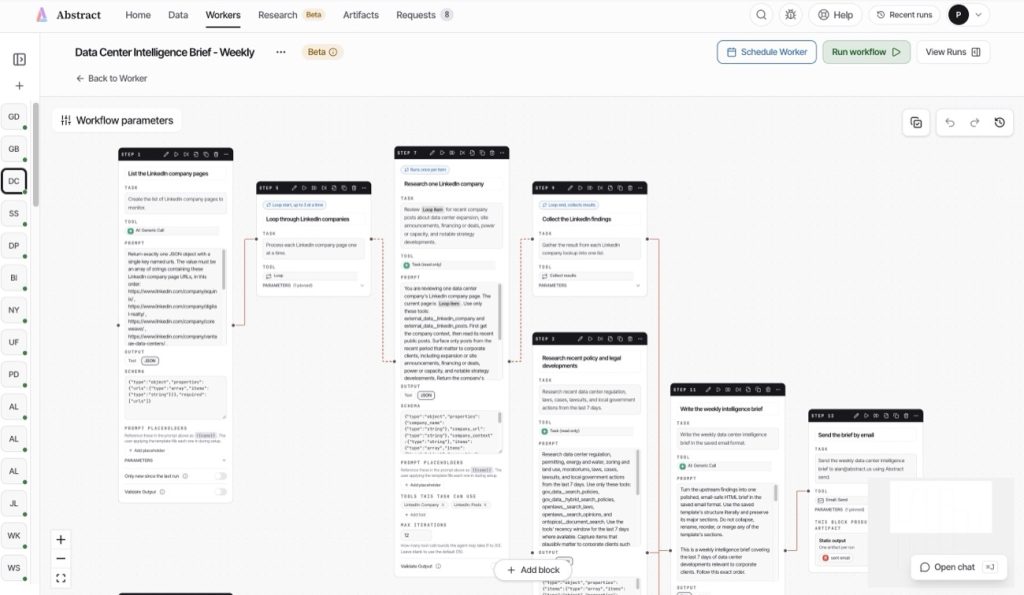
Workers can continuously monitor external developments, analyze them against an organization’s priorities and proprietary information, and execute workflows based on what they find.
For example, a Worker can monitor proposed legislation and regulatory developments, determine which changes may affect particular clients or business priorities, and trigger the appropriate next steps.
The goal is to move organizations from manually monitoring change to having AI continuously identify and act on what matters.


Solving The Government Data Challenge
When asked about challenges in the sector and how Abstract has addressed them, Utz said:
One of the biggest challenges has been that government data is incredibly fragmented.
Every jurisdiction publishes information differently, the quality varies, and a lot of it was never designed to be consumed by software.
AI has changed what’s possible, but you still have to get the underlying data right.
We’ve spent a lot of time building the infrastructure to ingest, normalize, and connect that information so the AI can actually be useful.
That’s been a big part of Abstract’s evolution, moving from helping customers track what government has already done to helping them understand what’s happening now and what’s likely to happen next.
How The Technology Has Evolved
When asked how Abstract’s technology has evolved since launching, Utz explained:
We started much more narrowly.
As I mentioned earlier, Abstract was originally built to help people track legislation in California. We then expanded that across all fifty states to tap into a larger market and make sense of government information that was scattered across hundreds of different sources.
Over time, we realized tracking wasn’t enough.
Customers didn’t just want to know that something changed. They wanted to know what it meant for their business, where the risk was, and what they should do next.
That’s really where the idea of regulatory superintelligence came from.
Now we’re taking that another step with Abstract Workers.
Workers are a service that’s built to monitor policy and regulatory developments, understand them in the context of a company, and then actually carry out the work that follows.
Whether that’s a compliance check, an impact memo or an ongoing monitoring workflow.
So, we’ve gone from tracking policy, to understanding it, to actually helping organizations act on it.
Key Company Milestones
When asked about some of Abstract’s most significant milestones, Utz highlighted:
There have been several important milestones for us, but a few stand out.
Building a platform capable of working across more than 1 million government records demonstrated the scale of the data problem we were taking on.
Expanding into Am Law firms and seeing our technology applied to real legal and business-development workflows was another major milestone because it validated that the problem we initially set out to solve extended well beyond traditional public policy teams.
Most recently, we’ve unlocked access to custom data sources and APIs so that Abstract Workers can talk with data from partners like Clio.
Workers also now support any live website, so clients have been relying on Abstract to reliably track updates across one-off websites, news sources, and even social media.
Customer Success Stories
When asked to share specific customer success stories, Utz explained:
One of the most interesting areas we’re working on is helping law firms turn external change into actionable client intelligence.
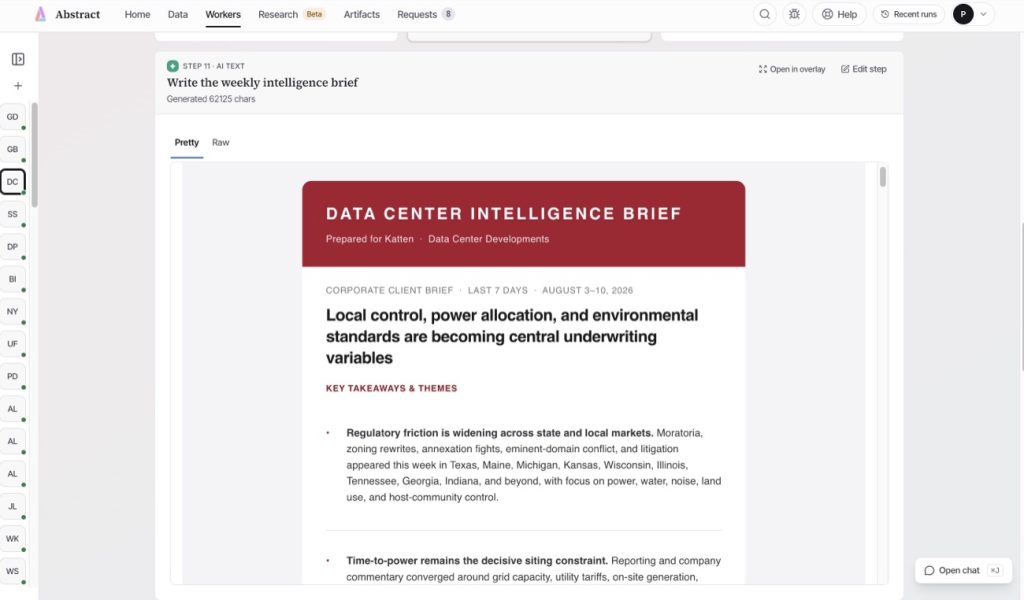
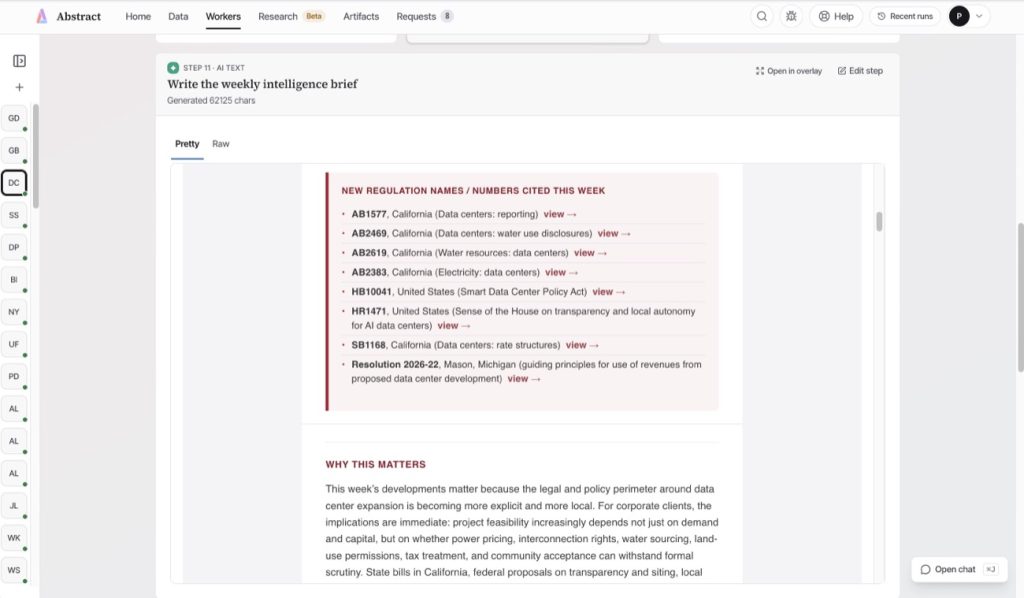
For example, we’re working with a firm that is monitoring local-government developments related to data centers to support its AI practice.
Instead of manually tracking activity across jurisdictions, the firm can use Abstract to continuously surface relevant developments and connect those signals to areas where its lawyers and clients may need to act.
Utz also shared several additional examples:
At a global law firm, their legislative research librarian ran his own side-by-side comparison against the platform the firm already paid for and Abstract.
He built the scorecard himself and tracked what each tool or service surfaced, what it missed, and what it caught first.
Abstract flagged a handful of highly relevant bills that their original platform missed.
The firm started with a handful of seats in one practice group and expanded from there.
The associate who does the day-to-day review put it plainly: “In terms of attorney time, this will be incredibly helpful in reducing that, especially at the beginning of the sessions.”
Their Chief AI Officer has since introduced Abstract to peer firms on his own initiative.
Utz continued with an example involving a public affairs firm:
A DC public affairs firm publishes a federal grants newsletter for its clients every cycle.
An associate built it by hand, scanning databases, writing summaries, and assembling the layout.
A Worker now does the scanning, tags each opportunity against the client priority documents the firm uploads, and drafts the newsletter into the firm’s own template.
The associate reviews it and sends it under the firm’s brand.
He wrote in on his own, without being asked: “I wanted to share that the grant reports have been a big success. The feedback has been great across the board… I’m really happy with how the worker has performed; it has saved me so much time.”
His principal watched the first newsletter come together during the onboarding call itself, and called it “pretty much exactly what we were looking for.”
The firm’s founder singled out the summaries underneath each grant.
Months later, the associate was still running it and asking what else could be automated.
Another use case involved a national trade association:
This client’s research lead maintains a member-facing database of state licensing requirements.
Updating it meant working through a handful of states a week, a nearly impossible task that was never fully done.
Abstract Workers were able to relieve that burden, and after seeing the first research outputs her reaction was: “This is just amazing. I don’t know how else to explain it.”
On the same call she asked to set up another Abstract Worker for the licensing database, a project that had been sitting on the back burner for years.
Utz also pointed to a solo lobbying firm:
The principal spent a chunk of every week assembling and scheduling client updates by hand, window by window.
It was the kind of work that has to happen and that nobody can bill for.
A Worker now produces the recurring client deliverable in his voice, on his schedule, aware of the legislative calendar.
“It’s like multiplying my team for a fraction of the cost of another hire. The rote, recurring work gets taken off my plate, and I get to focus on the client relationships and strategy that actually move the needle.”
Total Addressable Market
When asked about Abstract’s total addressable market, Utz explained:
We think about the opportunity as much broader than traditional government affairs or regulatory intelligence software.
Abstract sits at the intersection of legal technology, regulatory intelligence and enterprise AI, and as agents move from analyzing information to executing workflows, we believe those categories will increasingly converge.
This includes all law firms, corporate legal departments, consulting shops in PR and lobbying, and with scale, the other corporate departments that are impacted by regulatory change such as HR, product, and leadership.
Competitive Differentiation
When asked what differentiates Abstract from its competition, Utz said:
What really differentiates Abstract is the combination of the data we’ve built and what our technology can actually do with it, i.e., the agentic harness.
Most enterprise and legal AI starts with what an organization already has, including documents, contracts, matters, and institutional knowledge.
That’s incredibly valuable, but it’s only half of the picture.
Abstract adds the external piece: legislation, regulation, and government activity across federal, state, and local jurisdictions.
We’ve spent years taking that fragmented information and structuring it in a way that makes it usable by AI.
That means we’re not just telling a customer that something changed.
Abstract can connect external developments with an organization’s proprietary knowledge to determine whether something matters, why it matters, and what should happen next.
Abstract Workers can then initiate or complete the work that follows.
We think the next generation of enterprise AI will be differentiated less by who has access to the best model and more by who has the right data, context and workflows around that model.
Future Goals
When asked about Abstract’s future goals, Utz explained:
Our near-term focus is continuing to expand Abstract Workers: the types of workflows they can execute, the datasets they can draw from and the systems they can work across.
Longer term, we believe the legal and enterprise technology stack will look very different.
Rather than people moving between disconnected databases, applications and research tools to manually assemble information and determine what to do next, agents will increasingly work across those systems on their behalf.
We want Abstract to be a foundational part of that new infrastructure.
The Future Of Regulatory Intelligence
When invited to discuss another topic, Utz concluded:
I think we’re at the beginning of a pretty major shift in how companies deal with regulation.
Historically, legal, compliance, and government affairs teams have had to go looking for change.
They track bills, watch agencies, read alerts, and then figure out what any of it means for the business.
We think that model is changing.
The future is much more proactive.
Regulatory intelligence should be running in the background, understanding your business, watching what is changing across government, connecting those developments to your specific risks and priorities, and telling you what actually matters.
Over time, it should also be able to take on more of the work that follows.
That’s what we mean by regulatory superintelligence.
It is not just finding regulatory information faster.
It is bringing together government data, company context, and AI-driven workflows so the system can understand what matters and help teams act on it.
We’re already seeing that shift with Fortune 500 companies and Am Law 200 firms using Abstract.
They’re not just looking for another AI software to learn; they want a service that can connect regulatory change with their own business context and workflows.
That’s where we think the market is going, and it’s what we’re building toward with Abstract Workers.

