Allonic is developing a manufacturing platform that uses its proprietary 3D Tissue Braiding process to produce complex, compliant robotic structures in a single automated build. Pulse 2.0 interviewed Allonic co-founder and CEO Benedek Tasi to learn more.
Benedek Tasi’s Background
When asked about his background and the experiences that led him to establish Allonic, Tasi shared:
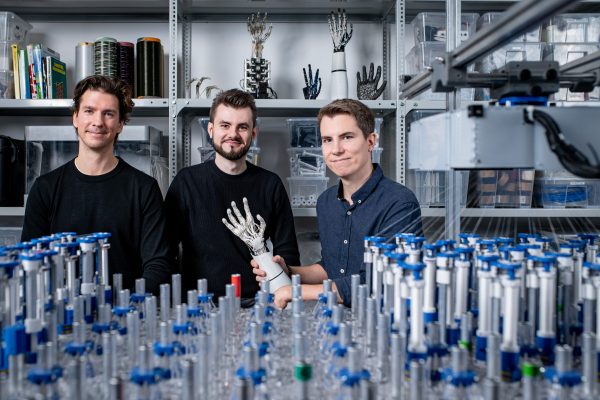
I’m a bionics and robotics engineer by training, working at the intersection of biomimetics, materials science, and advanced manufacturing. I started working on dexterous robotic hands at a university in Budapest, where I became fascinated by how biology solves mechanical problems through structure rather than rigid components.
As we tried to build anatomically inspired robotic hands, we kept running into the same problem: The closer we got to human-level dexterity, the more mechanically complex and expensive the systems became. That tension between elegant design and impractical manufacturing is what led me to found Allonic.

How Allonic Started
When discussing how the idea for Allonic came together, Tasi explained:
Allonic came out of frustration and curiosity.
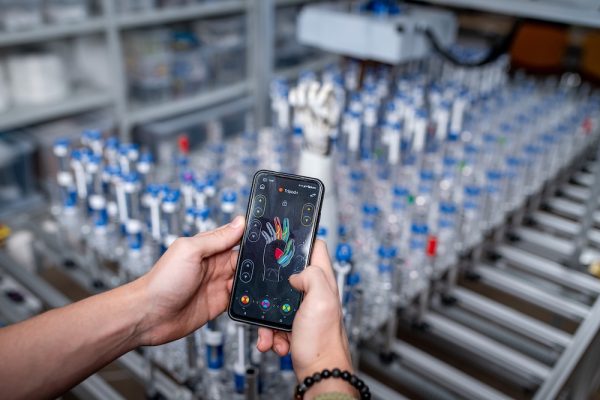
We were building biomimetic robotic hands and spending weeks assembling hundreds of tiny parts: tendons, pulleys, ligaments, and bearings. It felt completely disconnected from the elegance of the biological systems we were trying to emulate.
That’s when we realized the real problem was manufacturing. Robotics hardware is still built using industrial-era assembly methods. Meanwhile, AI and perception are accelerating at an extraordinary pace.
We saw a massive gap forming between software capability and hardware manufacturability. Instead of optimizing around those constraints, we decided to eliminate them entirely. That is how 3D Tissue Braiding was born as a fundamentally new way of producing robotic bodies in a single, automated process.
Proving The Technology
When asked about his favorite memory from working at Allonic, Tasi recalled:
One of the most meaningful moments for us was seeing our 3D Tissue Braiding process reliably produce complex, compliant robotic structures in a single automated build in minutes. That was when it became real, and it shifted the technology from an interesting concept to something that could genuinely reshape how robots are made.
Another major milestone was completing our first pilot in electronics manufacturing. For any deep-tech company, moving from lab validation to a real industrial environment is a critical step, and that cemented our belief that the problem we’re solving is a real one.
3D Tissue Braiding Platform
When describing Allonic’s core products and features, Tasi detailed:
Allonic is building a manufacturing platform for advanced robotic hardware.
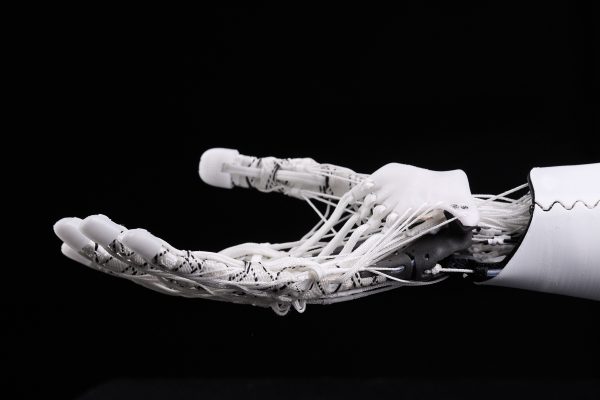
At its core is our proprietary 3D Tissue Braiding production process. Instead of assembling hundreds of parts, we weave structural fibers, tendons, joints, and other load-bearing tissues directly over a skeletal core so we can manufacture robotic bodies in a single, automated process.
Key features include:
- Fully automated production of complex, dexterous robotic structures
- Integration of multiple materials, including elastics, wiring, and sensing elements, in one build
- Direct translation from digital design to production code
- Dramatically reduced production time and cost
- Fewer failure points and improved compliance and safety
Our platform effectively collapses mechanical complexity into the manufacturing layer itself.
Bridging The Hardware Gap
When asked about the challenges Allonic has faced in the robotics sector and how the company has addressed them, Tasi noted:
One major challenge is that robotics is currently experiencing enormous excitement around AI and intelligence, but hardware manufacturing hasn’t evolved at the same pace. We’re fundamentally introducing a new way of producing robots.
There’s a natural education curve whenever you rethink infrastructure. We address this by working with industrial partners through pilot deployments to demonstrate the potential and impact our technology will have. Demonstrating real-world applications has helped shift the conversation from theory to proof.
Another challenge is recruiting talent across multiple deep disciplines: robotics, machine building, materials science, and computational software. We’ve built a highly interdisciplinary team of 15 engineers, and the pre-seed funding allows us to continue scaling this.
Technology Evolution
When discussing how Allonic’s technology has evolved since launching, Tasi described:
We first unveiled our 3D Tissue Braiding technology in May 2025. Since then, we’ve completed our first pilot project in electronics manufacturing and continued advancing the platform toward further pilots and early commercial deployments.
Our focus now is on accelerating development of the manufacturing system, expanding the team, and supporting industrial partners as we move toward broader adoption.
Major Company Milestones
When asked about Allonic’s most significant milestones, Tasi said:
- Revealing our 3D Tissue Braiding platform in May 2025
- Completing our first industrial pilot in electronics manufacturing
- Building a 15-person interdisciplinary engineering team
- Securing $7.2 million in pre-seed funding led by Visionaries Club, which is the largest pre-seed round in Hungary to date
The funding round was particularly meaningful because it validates that investors see manufacturing infrastructure as the next frontier in robotics.
Electronics Manufacturing Pilot
When invited to share a specific customer success story, Tasi explained:
Our first pilot was in electronics manufacturing, focusing on tasks that traditional industrial robots struggle with, including those requiring dexterity and adaptability, but where full humanoid systems are impractical or too expensive.
While we’re still early in commercialization and can’t share customer names yet, the pilot demonstrated that rapid, on-demand production of robotic end effectors significantly reduces downtime and increases operational flexibility.
We’re also seeing inbound interest from humanoid robotics companies and several large U.S.-based technology players, which reflects broader recognition that manufacturing is the next limiting factor.
$7.2 Million Pre-Seed Round
When asked about Allonic’s funding and revenue metrics, Tasi specified:
We’ve raised $7.2 million in pre-seed funding led by Visionaries Club, with participation from Day One Capital, Prototype, RoboStrategy, SDAC Ventures, TinyVC, and more than a dozen angel investors from U.S. and European technology companies.
This is the largest pre-seed financing completed in Hungary to date. We’re not sharing valuation or revenue details at this stage, as we’re currently focused on platform development and early industrial deployments.
Robotics Market Opportunity
When discussing the total addressable market Allonic is pursuing, Tasi stated:
We see ourselves as building infrastructure for the broader robotics ecosystem rather than targeting a single vertical. The global robotics market is set to exceed $200 billion over the next decade, covering industrial automation, logistics, healthcare, humanoid robotics, and consumer applications.
As robotics expands into more complex and human-facing environments, we’ll see the need for scalable, compliant, dexterous hardware grow dramatically. Our platform is designed to serve that entire ecosystem, from startups to large industrial manufacturers.
Allonic’s Differentiators
When asked what differentiates Allonic from its competition, Tasi emphasized:
Nobody is automating robotics manufacturing in this way. Most players focus on software, AI, or specific robotic applications. Others attempt to solve dexterity mechanically but still rely on traditional, assembly-heavy manufacturing.
We’re operating at the infrastructure layer. Instead of optimizing around old constraints, we remove them. By collapsing mechanical complexity into a continuous production process, we are making iteration cycles faster, lowering manufacturing costs, enabling greater design freedom, and building safer and more compliant robotic bodies.
Instead of competing with robot makers, we’re enabling them.
Future Goals
When discussing Allonic’s future goals, Tasi shared:
In the near term, our goals are to:
- Further industrialize the 3D Tissue Braiding platform
- Expand our engineering and operations teams
- Scale pilot programs into early commercial deployments
Long term, we aim to become the manufacturing backbone of the robotics industry.
When hardware can be designed, produced, and replaced on demand, robotics innovation accelerates exponentially. Our goal is to make hardware iteration as fluid as software iteration.
The Future Of Robotics
When invited to discuss any additional topics related to Allonic and the robotics industry, Tasi concluded:
There’s a lot of focus today on intelligent machines, and rightly so, but intelligence alone isn’t enough. For robotics to truly move beyond narrow industrial use cases and into everyday environments, the bodies of these machines must become more adaptable, safer, and easier to produce.
We believe the next wave of robotics innovation will depend just as much on advances in manufacturing as it does on advances in intelligence.

