

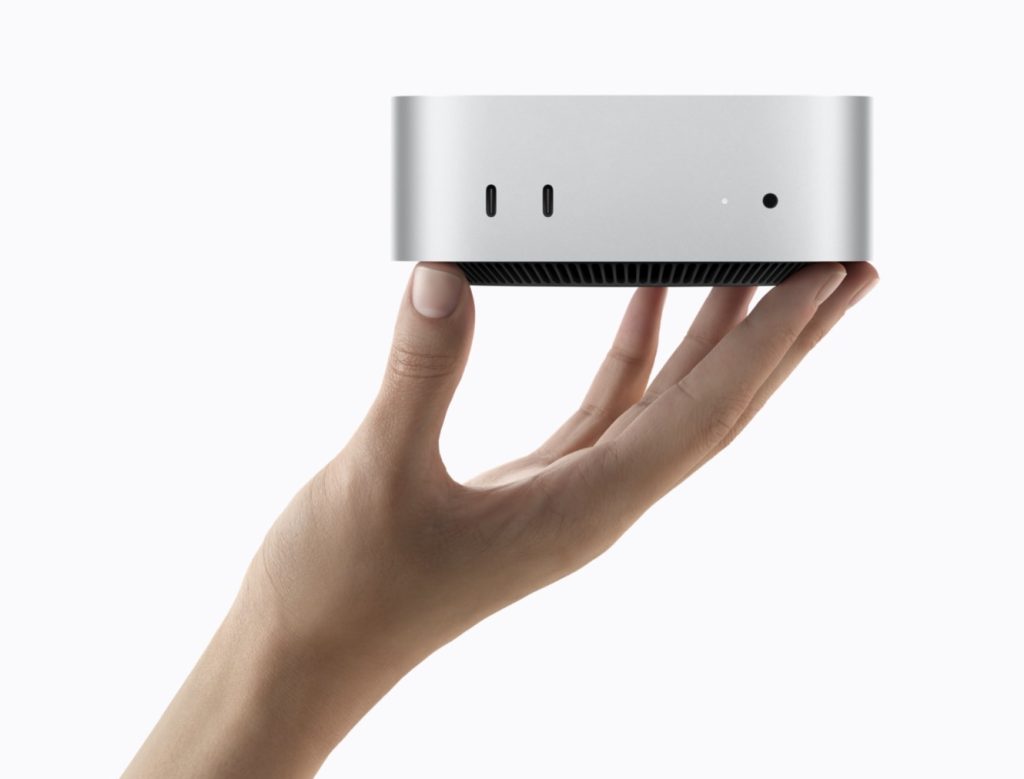
Apple has introduced a new generation of Mac mini powered by the all-new M6 and M5 Pro chips, positioning the compact desktop more aggressively around local AI workloads, professional creative applications, and always-on agentic computing. The M6 model starts at $899, while Mac mini with M5 Pro starts at $1,699.
Mac mini with M6 delivers up to four times faster AI performance, twice the graphics performance, twice the storage performance and 40% faster CPU performance compared with the previous-generation M4 configuration tested by Apple.
The M6 features a 12-core CPU and 12-core GPU, adding two CPU and two GPU cores compared with the previous generation.
For the first time on Mac mini, Neural Accelerators are integrated into each GPU core, while a new Dual 16-core Neural Engine delivers up to twice the performance of the previous generation.
The base M6 configuration includes 16GB of unified memory and can be configured with up to 32GB, with memory bandwidth reaching 170GB per second.
Apple said the M6 Mac mini can deliver up to 13.5 times faster LLM prompt processing in LM Studio compared with Mac mini with M1 and up to 4.8 times faster performance compared with M4.
The company also cited up to 2.3 times faster spreadsheet calculations in Microsoft Excel versus M1 and up to 1.5 times faster than M4.
Gaming performance with ray tracing in Cyberpunk 2077: Ultimate Edition can reach up to twice that of the M4 Mac mini.
Apple is also introducing a higher-performance Mac mini built around M5 Pro.
The M5 Pro configuration can include up to an 18-core CPU and 20-core GPU, with Neural Accelerators incorporated into every GPU core.
The chip supports as much as 64GB of unified memory and 307GB per second of memory bandwidth, allowing the system to handle larger local AI models, complex 3D environments, ProRes RAW video and large research datasets.
Apple said the M5 Pro model provides up to 8.5 times faster LLM prompt processing in LM Studio than a Mac mini with M2 Pro and up to four times the performance of M4 Pro.
Ray-traced Blender rendering can be up to 4.5 times faster than M2 Pro and 1.4 times faster than M4 Pro, while Affinity image-processing performance can be as much as 2.1 times faster than M2 Pro and 1.5 times faster than M4 Pro.
The new generation also brings significant connectivity upgrades.
Both Mac mini models support Wi-Fi 7, Bluetooth 6 and 2.5Gb Ethernet as standard, with 10Gb Ethernet available as an option.
The front retains two USB-C ports supporting USB 3 and a headphone jack.
On the rear, the M6 model includes three Thunderbolt 4 ports, while the M5 Pro version features three Thunderbolt 5 ports, alongside HDMI and Ethernet.
Apple is positioning Thunderbolt 5 as particularly useful for AI infrastructure.
Multiple M5 Pro Mac mini systems can be clustered through Thunderbolt 5 to run large AI models locally.
Apple has also added genlock support through USB-C, allowing precise synchronization between displays and cameras, including the iPhone 17 Pro.
The hardware launches alongside macOS 27 Golden Gate, which expands Apple Intelligence and introduces Siri AI.
Siri AI can use personal context across messages, emails and photos, answer broader questions and perform tasks across applications.
It is also integrated into Spotlight and systemwide context menus, while Visual Intelligence allows users to ask questions about information displayed on the Mac’s screen.
Apple is increasingly presenting Mac mini not simply as a consumer desktop but as a compact AI computing system.
The company specifically highlighted uses including running local models, creating AI agents that automate daily tasks and deploying Mac mini as an always-on deskside system for business AI workflows.
Mac mini with M6 starts at $899 in the U.S., or $799 with education pricing.
The M5 Pro version starts at $1,699, or $1,599 for education customers.
Preorders opened August 25 across 30 countries and regions, with deliveries and retail availability beginning September 22.
KEY QUOTE:
“Mac mini has always been our most versatile Mac. Whether it’s being used as a home computer, powering a professional studio, or as an always-on agentic device, it’s the little Mac that can do it all.”
“With a more powerful CPU and graphics, Neural Accelerators in the GPU, and higher memory bandwidth, Mac mini with M6 delivers a whole new level of AI performance. And with up to an 18-core CPU and 20-core GPU, Mac mini with M5 Pro is an ultracompact powerhouse for complex pro workflows.”
Johny Srouji, Chief Hardware Officer At Apple
