Astromech, an evolutionary biology AI company developing predictive models of biological change using evolutionary and multispecies genomic data, has raised $20 million in new funding at a $3.8 billion valuation. Biotech investor Bob Nelsen led the round, with participation from Peak 6, NeoGenesis Capital, Builders VC, and CAZ Investments. The financing brings Astromech’s total capital raised to $60 million.
Co-founded by Ben Lamm and George Church, Astromech plans to use the new capital to expand its research team, increase the number of species represented in its functional genomic datasets, and scale the comparative genomic infrastructure used to train its models.

Ben Lamm, Co-Founder of Astromech

Astromech is developing what it describes as a predictive model of biology, using genomic, evolutionary, and functional data to anticipate how living systems may change, where biological systems may be vulnerable, and which regulatory mechanisms drive those changes.
The company’s approach is intended to move biological research beyond analyzing organisms and diseases as they exist today toward forecasting future biological trajectories. Potential applications include anticipating genetic bottlenecks, responses to environmental change, drug resistance, disease progression, pathogen susceptibility, and other forms of biological change.
Astromech compares the concept to weather forecasting, where current conditions and historical patterns predict what could happen next. In biology, the company is seeking to use approximately 3.8 billion years of evolutionary history as a training signal for models that can recognize patterns of biological resilience, vulnerability, and adaptation.
Astromech was gestated at Colossal Biosciences and has access to genomic resources assembled by Colossal over the past five years. These include genomic data from extinct and living species, ancient DNA capabilities, large-scale biological data tooling, and scientific expertise spanning evolutionary systems and computational biology.
Rather than examining only which genomic sequences differ across organisms, Astromech focuses on when those differences emerged, how regulatory systems changed, and what those changes ultimately did to biological function.
The company’s architecture combines three broad layers of information: genomic data from living and extinct organisms, evolutionary data covering ancestry and divergence, and functional data spanning traits, expression, and biological response. Its models use these inputs to forecast where genomes or populations may be headed, identify where biological systems are most likely to fail, and determine which regulatory circuits drive those trajectories.
Two modeling engines underpin the system. One uses deep learning to identify patterns across species and biological systems, including gene expression, how organisms respond to their environments, and how vulnerabilities develop. The second reconstructs biological systems backward through evolutionary history and then applies the same mathematical framework forward to estimate possible future trajectories.
A central component is ancestral state reconstruction extended beyond genetic sequence. Astromech is working to reconstruct ancestral regulatory states involving chromatin accessibility, gene expression, and functional annotation rather than limiting reconstruction to ancestral proteins.
The company believes this matters for complex traits such as longevity because much of the relevant biological variation occurs in regulatory regions rather than protein-coding sequences. Astromech integrates evidence across data modalities using a Bayesian framework designed to produce calibrated confidence estimates rather than individual point predictions.
Astromech is also building functional genomic datasets across multiple species. Many models designed to predict regulatory function from sequence are trained primarily on one or two reference genomes because much of the historical functional genomic data has been concentrated there. Astromech supplements public datasets with internally generated functional data for species with limited coverage.
This broader comparative dataset is intended to enable models to analyze regulatory differences between evolutionary lineages rather than focusing primarily on variation within one species.
To support genome-scale analysis, Astromech has also developed a learned tree-inference method. In internal benchmarks, the method reconstructed phylogenetic trees approximately 100 times faster than conventional maximum-likelihood approaches while maintaining comparable topology accuracy.
The company said retrospective validation of its broader modeling pipeline recovered trait-associated genes previously established through published research while also identifying additional candidates for further investigation. Astromech plans to use future partner pilots to begin prospectively validating those predictions.
Potential applications for the platform span human health, biosecurity, agriculture, food security, and conservation. Astromech’s models could flag pathogen susceptibility across species before diseases reach humans, predict drug resistance before treatment failure, identify drivers of healthspan and disease risk, model herd vulnerability under disease and climate stress, assess ecosystem risks, and anticipate biological threats to food supplies.
The company’s strategy is to operate upstream of these individual markets by developing a common biological intelligence architecture that can be adapted to different species, biological traits, and applications rather than creating a separate model for each industry.
Longevity is serving as Astromech’s first major proving ground. Its initial demonstration maps 46 longevity-associated genes across a time-calibrated tree of life, allowing researchers to examine how genes associated with longevity, cancer resistance, and cellular and genomic maintenance have been conserved or altered throughout evolutionary history.
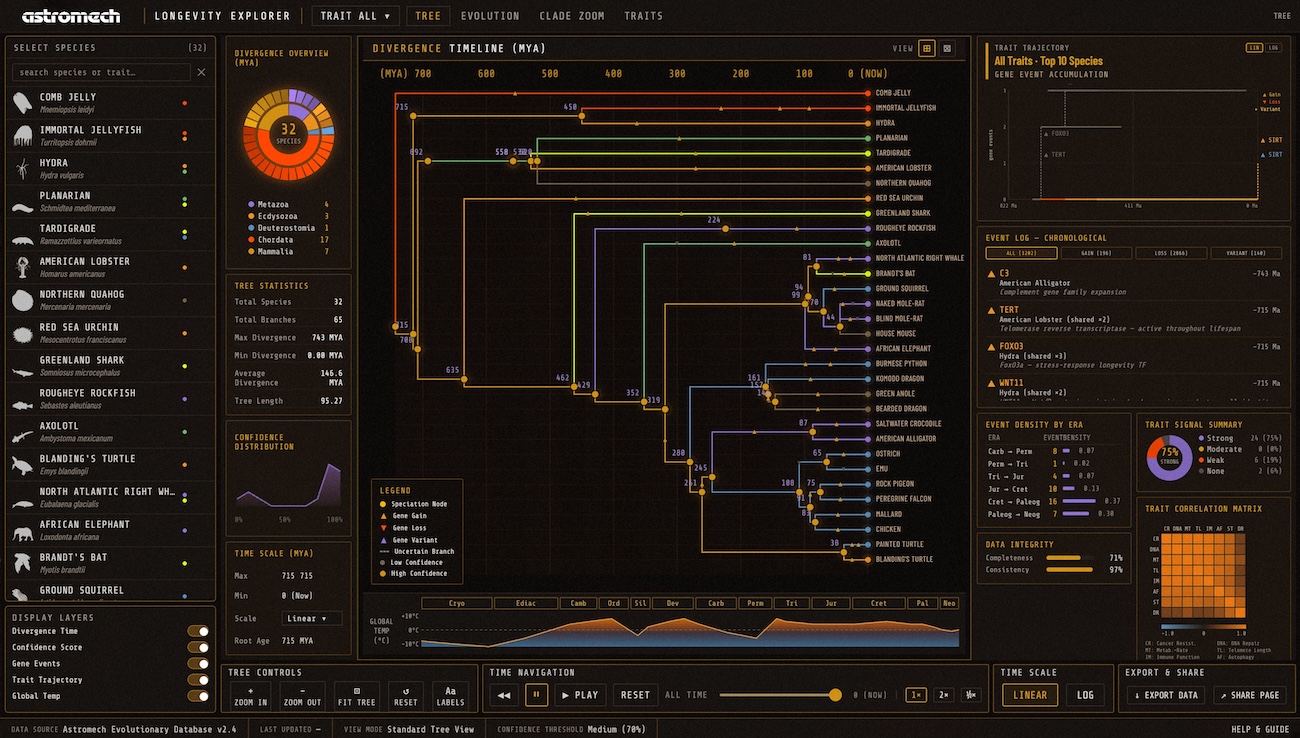
Every longevity gene, trait, and species on one time-calibrated map of the tree of life; 46 core genes traced through deep time, with conservation and selection visible at every branch.

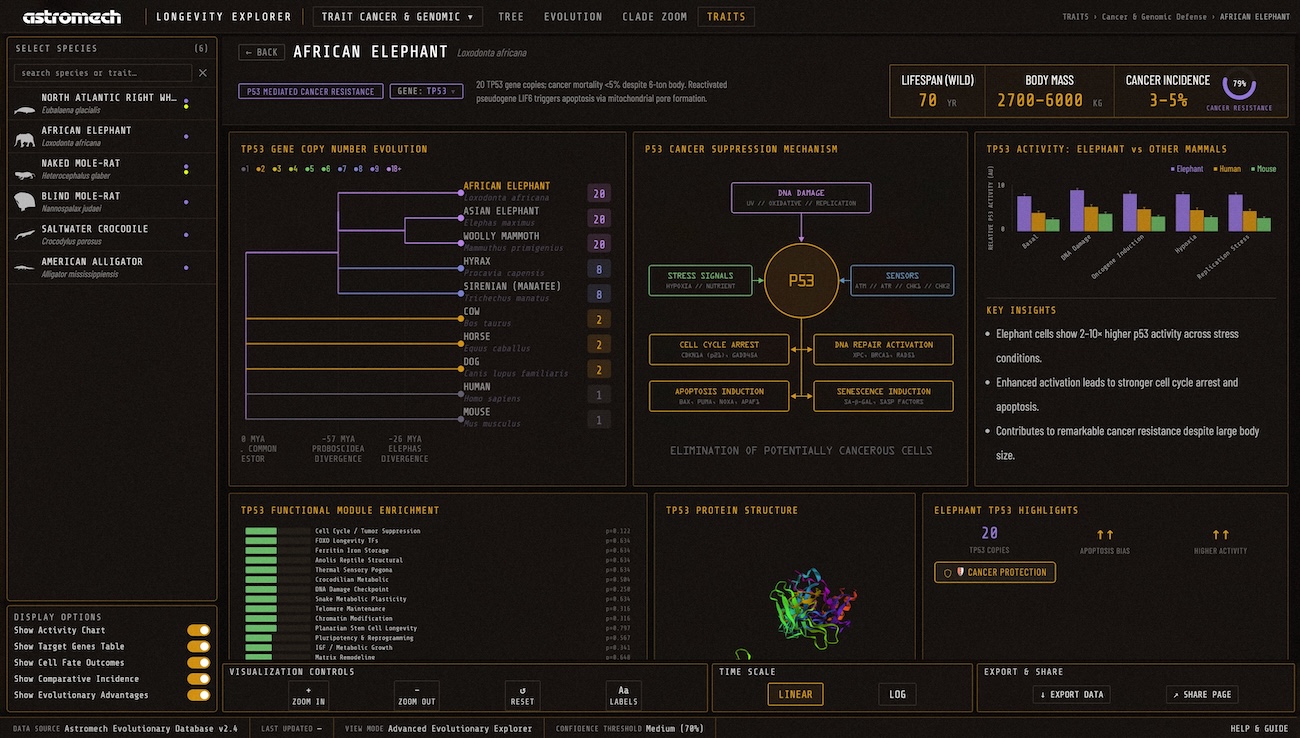
Elephants have 20 copies of the TP53 gene, and humans have only one. Astromech traces when that expansion happened and what the implications of that are for cancer incidence across mammals, including humans.
Astromech is using differences between species as naturally occurring biological experiments. Asian elephants, for example, have evolved notable cancer-suppression mechanisms despite their large body size and long lifespans, while Tasmanian devils are susceptible to a transmissible cancer that has severely affected wild populations.
Other evolutionary outliers include bowhead whales, which can live for more than two centuries despite their large body mass, and Brandt’s bats, which weigh only a few grams but can survive for more than 40 years. Birds also frequently live substantially longer than similarly sized mammals despite their comparatively high metabolic rates.
By comparing these evolutionary solutions, Astromech aims to identify genomic and regulatory mechanisms associated with resilience, vulnerability, longevity, and healthy aging, then use those findings to generate more precise hypotheses for future research.
Astromech’s unified modeling engine and longevity explorer are currently operational across genomes, genes, traits, and clades. The company’s next phase is expected to include forecasting pilots with partners in health and biosecurity, where its trajectory and vulnerability models can be applied to real-world biological problems.
Over time, Astromech intends to prospectively validate its forecasts and potentially integrate confirmed predictions into early-warning systems and therapeutic research programs. The company’s longer-term objective is to build a global biological intelligence platform capable of anticipating biological change before it occurs.
Astromech is also hiring across areas including ancestral modeling, regulatory genomics, genomic inference, sequence reconstruction, metabolic modeling, and protein folding.
KEY QUOTES:
“Biology runs the world and historically, we have only reacted to it. We can describe biology in extraordinary detail, yet we still struggle to anticipate what comes next. Astromech is building the AI system predicting how living systems will change and where they are most likely to break. Every genome carries a record of what changed, when it changed, and the tradeoffs that followed, but almost none of that history is readable at scale today. Astromech was built to close that gap, and this funding allows us to further expand that work far more across the tree of life.”
Ben Lamm, Co-Founder of Astromech
“Comparing living species by their genomes can fail to assign DNA differences to functional impacts. Most of the variations that matter for complex traits, for example, morphology and longevity are regulatory rather than coding, so reconstructing the ancestral regulatory state, not just the ancestral protein, has the crucial explanatory power. That takes functional data across many species rather than sequence alone, and AI reconstruction cheap enough to run genome-wide. Neither was true ten years ago.”
George Church, Co-Founder of Astromech

