

ATMO is a technology company that designs and builds smart environmental sensing devices, such as portable and stationary monitors for consumers and businesses to track air quality. Pulse 2.0 interviewed ATMO co-founder and CEO Vera Kozyr to learn more.
Vera Kozyr’s Background
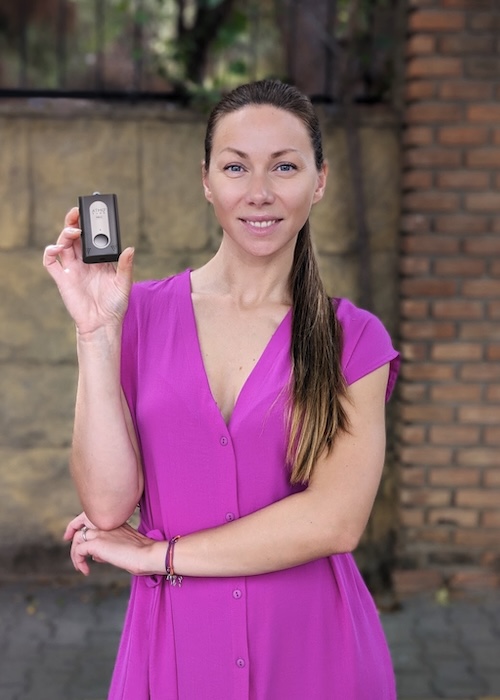
Could you tell me more about your background? Kozyr said:
I’m Vera Kozyr, Co-founder and CEO at ATMO, a smart air solutions company pioneering portable and stationary environmental sensing for consumers and businesses since 2016.
Our mission is to make air quality visible and meaningful. Our personal and indoor monitors help people and organisations understand the air in their immediate surroundings, how it affects wellbeing, health, and productivity and what to do about it. We turn environmental data into clear, actionable decisions.
As CEO, my focus is on building the engineering team and product vision that makes precision air data accessible to everyone.
Formation Of The Company
How did the idea for the company come together? Kozyr shared:
The idea started with a simple observation. People track many health-related metrics like sleep quality, heart rate, calories, and steps. Yet the air we breathe, which impacts all of these measurements, is often underestimated. I noticed how often official pollution reports downplay real exposure, leaving people unaware of what they inhale near roads, factories, or transit hubs. That gap became the founding insight: we don’t need city averages, we need personal, real-time air awareness.
Favorite Memory
What has been your favorite memory working for the company so far? Kozyr reflected:
Probably the moment our technology finally worked after our first product completely failed. That painful experience became our greatest teacher. We spent months rebuilding from scratch. Many of our early Indiegogo backers who stuck with us through every setback turned into our strongest advocates. Their support in health and wellness communities became the foundation of our growth.
Core Products
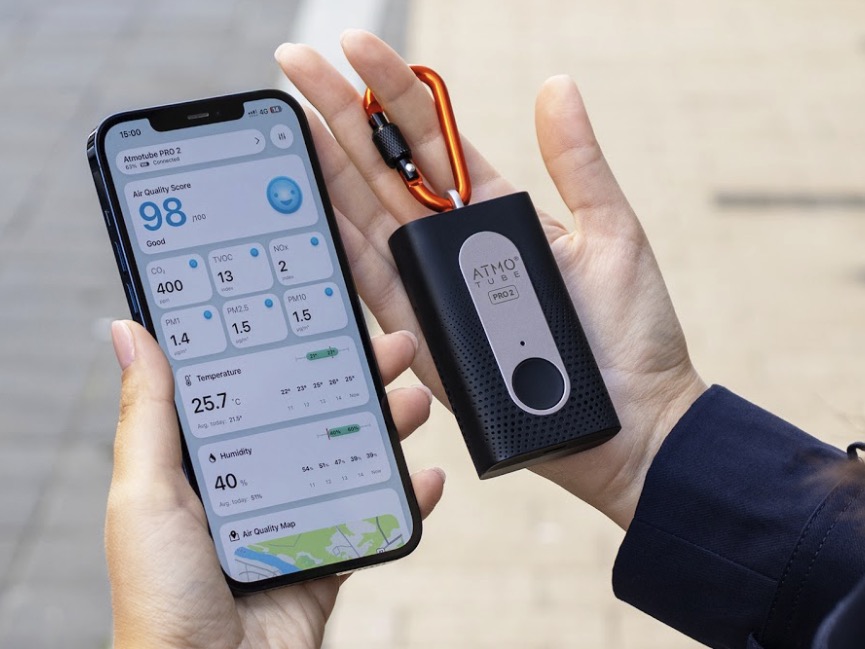
What are the company’s core products and features? Kozyr explained:
ATMO makes two core products.
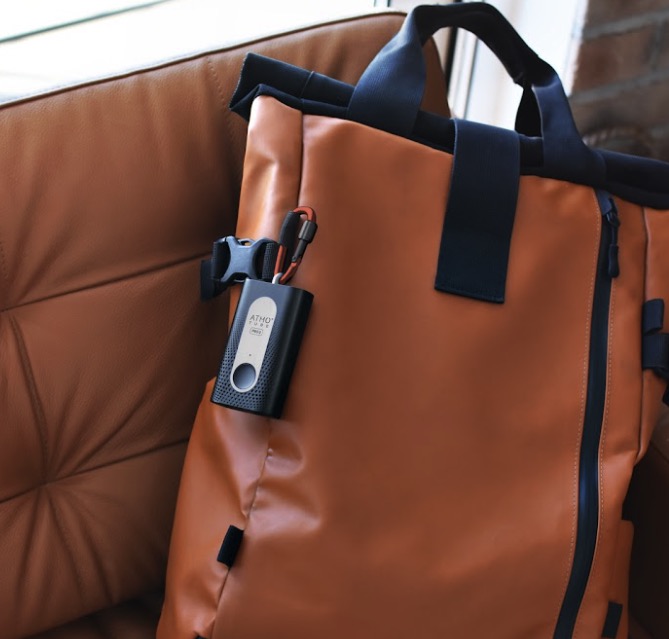
Atmotube PRO 2 is the first lab-tested wearable device tracking CO2, NOx, PM1/2.5/10 and other environmental metrics. It’s essential for urban residents, allergy and asthma sufferers, sportsmen, and frequent travelers. The device translates personal air data into actionable recovery insights.
Atmocube is an all-in-one real-time indoor air quality (IAQ) monitor for commercial and public spaces with a transparent interface. We launched it in post-COVID times, when people started coming back to offices, and the indoor air quality was going to be vital. We aimed to provide businesses with transparent and accessible information about workplace air quality for employees.
Challenges Faced
Have you faced any challenges in your sector recently? Kozyr acknowledged:
The biggest challenge is the absence of a universal air quality standard. AQI means something different in the US, EU, China, and India. A drive from Paris to Berlin requires an app to switch logic three times. This fragmentation makes it hard to build globally meaningful products and leaves vulnerable groups, including asthmatics, children, and the elderly, misreading safety signals. ATMO’s response aligns with the WHO 2021 guidelines and emphasizes data-driven fusion instead of depending on any single average source.
Evolution Of The Company’s Technology
How has the company’s technology evolved since launching? Kozyr noted:
ATMO launched via Indiegogo with a first device that failed, because sensors simply didn’t work. The team rebuilt from scratch, iterating until they delivered reliable accuracy. Since then, the technology has evolved from a basic pollution indicator to a platform integrating lifestyle data via Air Balance, AI-powered personalized recommendations, and API access for researchers. The latest generation doesn’t just report air quality. It interprets it on advice like “Open a window for 5 minutes to normalise CO₂” or “Change your morning jogging route as the park will be cleaner than your current street”. Hardware and software have been developed in parallel throughout.
Significant Milestones
What have been some of the company’s most significant milestones? Kozyr cited:
We launched in 2016 through crowdfunding, went through the kind of early product challenges and came out the other side with technology we were genuinely proud of. From there, things moved quickly.
Now we are selling 60,000+ devices across 40+ countries. We are also proud that researchers are choosing our devices for serious fieldwork. Today, more than 100 scientific projects are powered by ATMO data, with institutions like Johns Hopkins, UC Berkeley, Columbia University, and University College Cork.
On the product side, Atmocube winning both the iF Design Award and Red Dot was a signal that we’d gotten the balance right. We make a precision engineering product that doesn’t sacrifice the user experience.
Total Addressable Market (TAM)
What total addressable market (TAM) size is the company pursuing? Kozyr assessed:
ATMO operates at the intersection of two fast-growing markets. The global air quality monitoring market is projected to reach $8.9 billion by 2030, growing at 7.5% CAGR. On the wearable health side, the global wearable healthcare devices market is expected to reach $403 billion by 2033, growing at over 25% CAGR. As personal health tracking becomes standard and air quality awareness rises, ATMO sits at the intersection of both.
In the U.S., 79% of Gen Z consumers already use health technology such as wearables, telehealth, or online prescription services on a monthly basis, while 65% of consumers say they want healthcare to be built around prevention rather than treatment.
Future Company Goals
What are some of the company’s future goals? Kozyr concluded:
ATMO’s near-term goal is to expand its sensor ecosystem and data platforms for individuals, businesses, and researchers. Three major deployments with EU universities are currently in preparation, where thousands of ATMO devices will be used in large-scale environmental and sustainability programs. Long-term, we have a vision of a multilayer “Smart Air Economy”. In this concept, data from wearables, indoor monitors, and institutional data is used to create a wholesome AI-driven health profile. Such profiles can be used to enable predictive pollution alerts, create green navigation routing, and add air quality as a standard layer in personal health tracking.
