Audoo is a music technology company focused on improving the accuracy of public performance royalty data. Its flagship Audio Meter is a plug-in device installed in public venues such as bars, gyms, retailers, schools, and concert venues to identify music played in real time and provide verified usage data to Performing Rights Organizations. Founder and CEO Ryan Edwards created Audoo after his own experience as a musician exposed a gap in understanding whether artists were being accurately compensated when their music was played publicly. Pulse 2.0 interviewed Edwards to learn more about Audoo’s origins, its Audio Meter technology, the impact of AI-generated music, and the company’s goal of making accurate public performance data a global standard.
Ryan Edwards’ Background


When asked about his background, Edwards shared:
My journey wasn’t typical. I started my career in music, having been a drummer of an indie band in the 2000s.
We had a UK Top 10 chart hit, we toured the country and I got a close-up look at the inner workings of the music industry.
After we were dropped from our label in 2008, I worked in retail for a few years, then pivoted to the corporate world, gaining experience in different industries from commercial development across tech.
I spent some time at a fintech startup, and later became a senior leader at Visa Europe.
Each role helped me build my skill set and built the foundation for what I do now, whether that be understanding sales, managing customers or scaling a business.
My career took me through unique routes, but eventually led me to running a music-tech business, where I use all the skills I learned previously every day.
How Audoo Started
When asked how the idea for Audoo came together, Edwards explained:
I founded Audoo in 2018, a decade after The Lines.
It started when I heard my old band’s music playing in a store while out shopping in Oxford Circus.
My wife made a passing joke about how much I could earn in royalties, and it hit me that I didn’t know whether I was actually being paid for my previous work, and I had no way of finding out how much I was owed.
This led me to doing a deep dive into the royalty system and what I found shocked me.
Musicians and songwriters all around the world were having the same issue: money was being collected from their music being played in public, but there was no reliable way of knowing how much they should be getting in royalties, and in many cases they were missing out on earning anything.
I dug into how Rights Organizations track public performance data and distribute royalties, and saw that they were using the same methods they did decades before: proxies, sampling and estimates instead of tracking actual plays from public premises.
In some venues, data was even still logged manually with a clipboard and pen.
The scale of the problem was daunting, but I knew that the root of this was inaccurate data and measurement was just the start.
So I built the first Audoo Audio Meter as a prototype on my kitchen table, and this small piece of tech became our answer to a blind spot the industry had left neglected for decades.
Since then, we’ve installed our devices in restaurants, pubs, retail outlets, schools, major concert venues, gyms, bars, and so much more around the world, working with Performing Rights Organizations, or PROs, to make royalty distribution fairer, faster, and more accurate for artists.
Favorite Memories
When asked about his favorite memories working for Audoo, Edwards said:
One of my best memories is the moment Björn Ulvaeus called.
I grew up dancing to Dancing Queen with my parents in the kitchen, and years later here was the man who wrote it, on the phone, telling me he wanted to invest in what we were building.
It was completely surreal.
We still refer to that first investment round as “the series A(BBA).”
Sir Elton John then followed, investing as part of a £5 million round, and he agreed that artists aren’t being paid accurately for their plays because the data isn’t up to par or didn’t exist to begin with.
Beyond the personal side of it, these endorsements changed the trajectory of the company.
It gave us credibility and showed we weren’t alone in our fight for fair royalties.
These are legendary artists who have seen first-hand how drastically the industry has changed, from vinyl to streaming.
They feel as strongly as we do about protecting artist rights, recognize that more accurate public performance data is the way to do it and see the value in Audoo as the solution to the data problem.
Core Products And Features
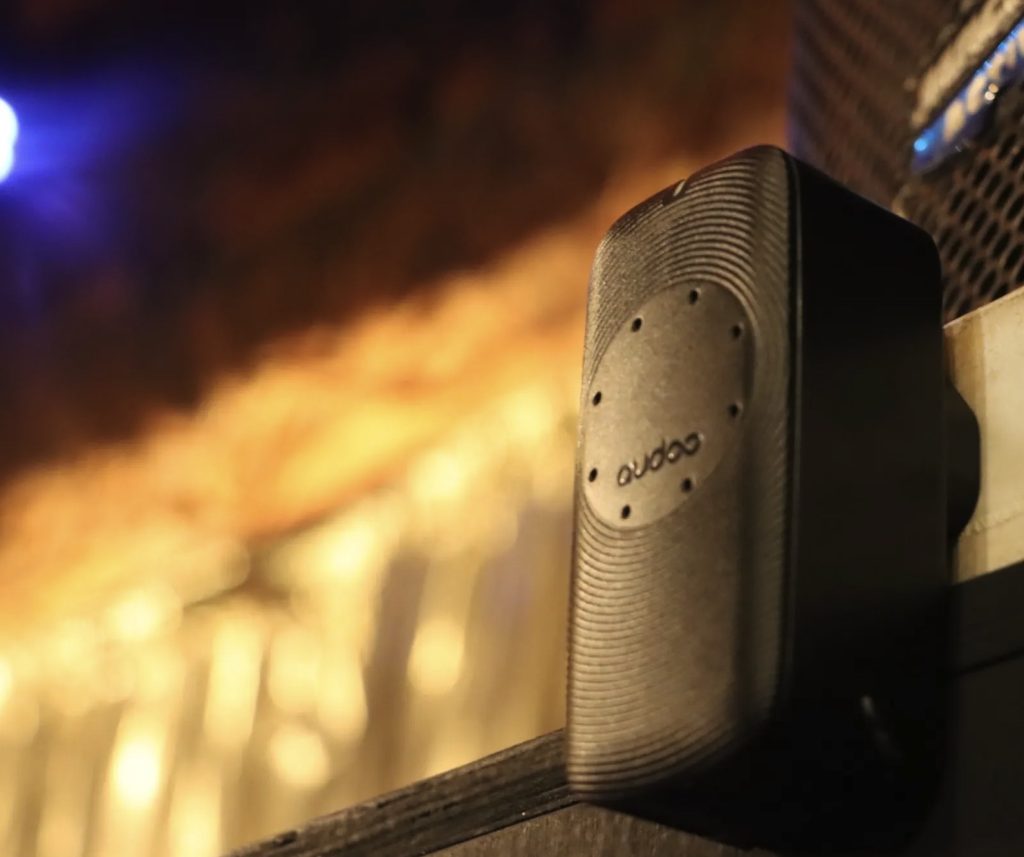

When asked about Audoo’s core products and features, Edwards explained:
Our flagship product is the multi-patented Audio Meter™, a small plug-in device that can be installed into public venues like bars, gyms and retail spaces.
The Audio Meter can capture music played in real time, bringing accurate tracking to public performance royalties, a system that has relied on outdated and ineffective methods.
This data helps PROs to ensure that royalties are more fairly distributed, while providing venues with insights on how music shapes customer experience and retention.
This technology is a huge step forward for an industry that has never had a reliable way to measure what is actually being played in real spaces.
Public performance is one of the largest royalty streams in music, and it affects every songwriter and performer whose work is played in a shop, gym, or bar, and that matters more than ever in the streaming and AI era.
The Challenge Of AI-Generated Music
When asked about challenges facing the music industry, Edwards highlighted AI-generated music:
The most pressing challenge right now is AI.
AI-generated tracks are flooding platforms in huge volumes, reaching mainstream music charts and diluting the wider royalty pool for human artists.
It’s the same problem we were founded to solve, just in a new form.
Without accurate data on what is genuinely being played, and by whom, royalties end up in the wrong place.
This is an ongoing problem that the entire industry is grappling with, but there are ways to get ahead of it.
Audoo’s technology can identify AI-generated tracks played in public venues, so PROs can separate human and synthetic music in their reporting instead of paying out blind.
We’re also pushing for the industry to go further than simply calling for labels.
We need infrastructure that can identify AI tracks in the real world, so royalties reach human artists, and clearer rules on AI training data to protect artists’ copyright.
It’s quite simple, but the debate is often overcomplicated for no real reason.
How Audoo’s Technology Has Evolved
When asked how Audoo’s technology has evolved since launching, Edwards explained:
At launch, the Audio Meter did one job: identify the music playing in a venue and report it back.
Making the hardware work in real environments was the hard part.
Venues aren’t controlled settings, so the device had to handle background noise, overlapping sound sources and continuous operation with nobody there to manage it.
The priority in the early years was accuracy and reliability.
Pilots across Europe and Australia gave us a music recognition rate of over 99.1% with consistent uptime, which was the threshold PROs needed before they would consider replacing existing methodologies.
It’s a little ironic, as pre-Audoo, the surveys by nature are inaccurate.
Since then, the evolution has been less about the device and more about what sits behind it.
We’ve built out the insights platform, so PROs receive useful reporting they can act on, and the platform gets regularly updated with new features, tools and capabilities.
Our tech can now even identify AI-generated tracks, making sure that the distinction between human-made and AI is visible in the data.
Key Company Milestones
When asked about Audoo’s most significant milestones, Edwards said:
Audoo has built strong relationships with some of the industry’s important organizations, and established a presence across the globe.
Our first commercial rollout came with APRA in Australia, followed by New Zealand.
We’ve since partnered with IMRO in Ireland, GEMA in Germany and have successfully piloted with the UK’s PRS & PPL.
Most recently, we’ve collaborated with Music Venue Trust here in the UK to bring our Audio Meters to over 100 grassroots music venues.
Every new market and partnership is a new milestone for us, bringing the system closer to modernizing and forging a path to make royalties fairer for artists around the world.
Competitive Differentiation
When asked what differentiates Audoo from its competition, Edwards explained:
The main difference is that we measure at source.
Rather than working from data feeds or samples, we put a physical device in the field where music is played most: in public venues.
The Audio Meter plugs into a socket and captures music in real time, sending verified data back to our system.
That data feeds a dashboard, so PROs can see exactly what was played, where and when, and venues get insight into how music choice shapes their business.
Because the device is plug-and-play and needs no technical setup from the venue, it can be deployed anywhere in the world, which is how we’ve scaled across four continents.
Future Goals
When asked about Audoo’s future goals, Edwards said:
The goal is to keep growing and expanding in key markets.
We want to make accurate public performance data the global standard.
We’re already in more than fifteen countries, but there are markets where royalties are still distributed almost entirely on estimates.
Every one of those represents artists going unpaid for their music being played in the real world.
Our work in the U.S. is also a big focus, being the world’s largest music market and where PROs distribute billions of dollars a year.
There is currently a formal investigation by the U.S. Copyright Office into the distribution practices of the PROs, something Congress is watching very closely.
Customer Success
When asked to share specific customer success stories, Edwards highlighted Audoo’s relationships with venues and rights organizations:
Our customers have mattered just as much as our investors, in some ways more, because they’re the ones who prove the product works.
Audoo’s Audio Meters are deployed on premises worldwide at no cost, and we’ve got a network of hospitality and retail partners who’ve come to rely on our reporting as much as the PROs do.
Recently, we launched into Belgium with SABAM across 85% of all discotheques.
Upon announcement of the partnership, both we and SABAM started receiving requests from other types of locations — retail, record stores, cafes and more — asking if they could have an Audio Meter and help in delivering accuracy.
It was a great display of businesses firstly wanting their fees to go to the artists they play, but I felt it underlined how businesses genuinely want to do the right thing.
Total Addressable Market
When asked about Audoo’s total addressable market, Edwards explained:
Because the current system is so behind the times on using tech to report public performance, Audoo has had a big opportunity to address that blind spot.
Around $2.5 billion in royalties sits unclaimed across the industry, with up to 20% of works having no songwriter or publisher identified against them.
CISAC puts global collections for creators at around €11.75 billion a year, with public performance one of the fastest-growing parts of it.
Our market is effectively every premises worldwide that pays a music license, and almost all of it is still reported on estimates.
Why Accurate Public Performance Data Matters
When invited to discuss another topic, Edwards concluded:
The key point is that the people hit hardest by inaccurate data and public performance tracking is everyone, not just big or new artists.
It’s often the ones whose music gets played in a bar or a grassroots venue but never shows up in the radio and streaming datasets royalties are calculated from.
Many artists aren’t even registered with a collection society, so that money doesn’t reach them at all. It stays in the system’s “black box.”
If you look at just the UK, in 2025 PPL and PRS for Music state in their annual transparency reports they distributed a collective £361.5 million in public performance royalties.
This is a huge number.
What many miss is that these are nonprofit organizations, and they deducted £77.1 million in public performance administration fees, and £163.5 million overall.
That’s a lot of administration fees for what we and many believe is little to no accuracy.

