

Bluebeam provides collaboration and workflow software that helps architects, engineers, builders, trades, and owners review documents, manage construction workflows, and coordinate projects in real time. Pulse 2.0 interviewed Bluebeam Head of Product Luke Prescott to learn more.
Luke Prescott’s Background

When asked about his background and the experiences that led him to Bluebeam, Prescott shared:
I’ve always enjoyed creating and building. After college, I was hired onto a construction crew in Pasadena, California, coincidentally the same city where Bluebeam is headquartered today. Being on job sites gave me firsthand exposure to the complexity of construction projects and the communication challenges teams face.
In 2008, I was introduced to Bluebeam, and it immediately clicked. The tools were clearly designed by people who understood how builders actually work. And the rest is history, as they say. What started as curiosity quickly became a career focused on helping develop technology that solves real-world problems for the people designing and building our world.
Luke Prescott’s Responsibilities
When asked about his primary responsibilities as Bluebeam’s Head of Product, Prescott explained:
As the Head of Product at Bluebeam, my role is to help guide the vision and development of the products our customers rely on every day.
I work closely with an incredibly talented team of designers, product managers, product marketers, and engineers to build solutions that address real-world challenges across the architecture, engineering, and construction industry. A big part of the role is also staying deeply connected to our users, understanding how they work, where their workflows break down, and where technology can meaningfully improve outcomes.
What I love most about this job is that AEC professionals are natural problem-solvers. Whether they’re designing infrastructure, managing construction sites, or coordinating complex projects, they are constantly innovating. Our job at Bluebeam is to build tools that amplify that creativity and make collaboration easier across teams.
Seeing AI’s Potential
When asked about his favorite memory from working at Bluebeam, Prescott recalled:
One moment that stands out happened during a small customer workshop where we were testing some early AI capabilities we had been developing.
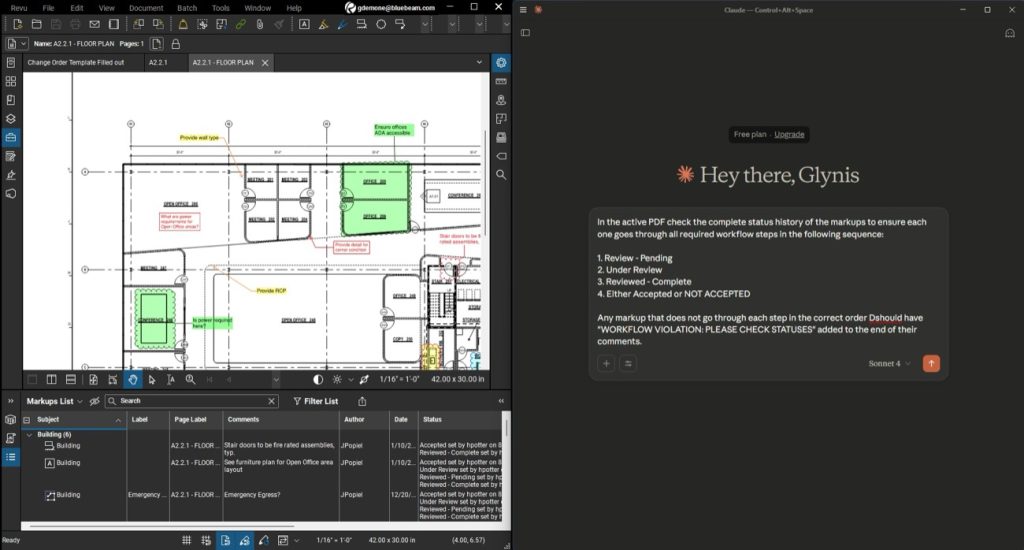
I had just started typing an AI prompt when one of the users leaned toward the camera, eyes wide, and literally dropped his jaw. In that moment, he realized the potential of connecting Bluebeam Revu with Anthropic’s Claude and what that could mean for reviewing drawings and extracting information from project documents.
Seeing a long-time power user suddenly rediscover the software with a new sense of possibility was incredible. Moments like that remind me why innovation matters. It’s not just about new features; it’s about unlocking new ways for people to work.
Core Products And Features
When describing Bluebeam’s core products and features, Prescott detailed:
Bluebeam helps architects, engineers, builders, trades, and owners communicate together to solve daily challenges. We serve industries across the public sector, enterprise, energy, mining, residential construction, and infrastructure and are trusted by more than 4 million individuals across over 160 countries.
Leveraging AI at its core, Bluebeam’s software is built to enable real-time collaboration between teams, strengthening workflow management, reducing rework and errors, and ensuring projects are completed more efficiently.
Bluebeam enables teams to mark up and measure documents in real time from a desktop or mobile device, leading to faster design reviews. Today, Bluebeam users can also access a range of integrations with leading software to support permitting, document management, PDF creation, and more.
In December 2025, Bluebeam announced several new product updates, including the launch of Task Link, a first-of-its-kind native integration between Bluebeam Revu and GoCanvas.
Task Link enables teams to push tasks instantly to the field from Bluebeam Revu, capture verifiable on-site data through GoCanvas mobile forms, and keep teams aligned with automatic notifications as work progresses.
We also have our biggest product release in years launching in 2026: Bluebeam Max. This is our new premium Bluebeam subscription that delivers advanced automation, intelligent markups, and AI-powered reviews to help teams build faster, work smarter, and reduce risk.
Construction Industry Transformation
When asked about recent challenges in the construction technology sector and how Bluebeam has addressed them, Prescott noted:
Construction is going through one of the most significant transformations in its history. For decades, the industry has struggled with labor shortages, fragmented communication, and workflows that still rely heavily on manual processes.
At the same time, we’re seeing a major shift toward digital tools and AI-driven workflows. The challenge isn’t just introducing new technology but ensuring those tools are practical, accessible, and designed around how people work.
In October 2025, Bluebeam launched our Building the Future: Bluebeam AEC Technology Outlook 2026 report, based on a survey of more than 1,000 global technology decision-makers within AEC firms.
Our survey evaluated topics including the state of AI and digital tool adoption within the sector, barriers to integration, 2026 technology investment plans, and the growing impact of AI in addressing labor challenges.
AI continues to gain rapid and widespread adoption across nearly every industry, and Bluebeam’s 2026 report provides an inside look into how AEC leaders are responding and adapting to this change.
Technology Evolution
When discussing how Bluebeam’s technology has evolved since launching, Prescott described:
One of the biggest factors shaping Bluebeam’s evolution has been the strength of our user community. Through forums like Bluebeam User Groups and direct engagement with customers around the world, we continuously learn how professionals are using our tools and where they need more support.
Those insights drive how we innovate.
A great example is Bluebeam Max, which I mentioned earlier. Our new premium subscription launching in 2026 introduces an intelligent-first approach to managing construction workflows.
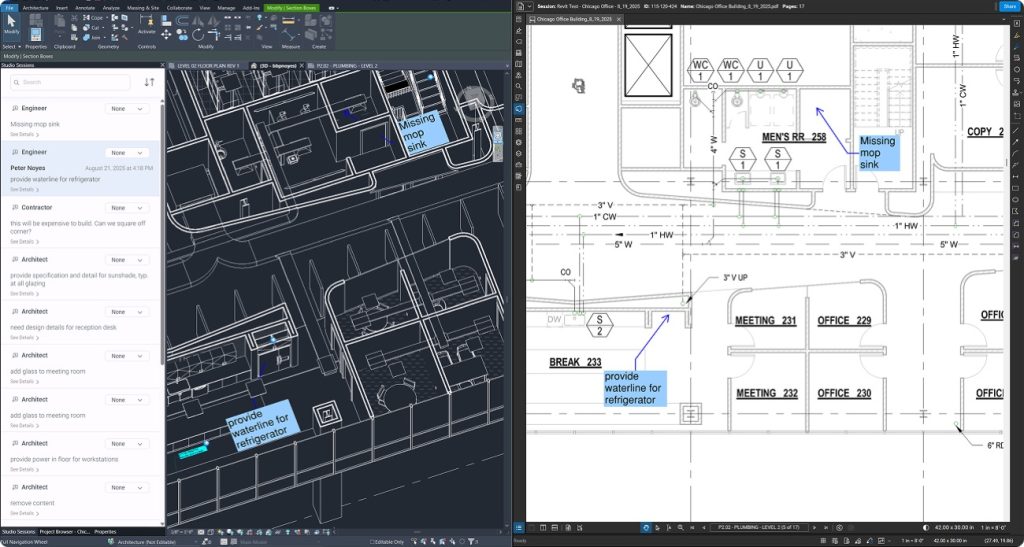
Bluebeam Max includes capabilities such as advanced markup automation tools, large-scale drawing visualization, Connected Sessions with Revit that bridge two-dimensional reviews and three-dimensional models, and integrations with Anthropic’s Claude to unlock new ways of interacting with document data.
We’re also introducing tools like Smart Review and Smart Overlay that help detect design issues faster and surface insights from drawing sets before teams even begin their review.
All of these innovations are grounded in a simple philosophy: Technology should enhance the expertise of construction professionals, not replace it.
Major Company Milestones
When asked about Bluebeam’s most significant milestones, Prescott said:
Since its founding in 2002, Bluebeam has grown alongside the construction industry’s digital transformation.
One pivotal moment came in 2014, when Bluebeam joined the Nemetschek Group, becoming part of a global network of companies focused on technology for the built environment.
Over the past several years, we’ve expanded our global presence, launched new cloud-based solutions, and strengthened partnerships across the construction technology ecosystem.
More recently, our 2025 acquisition of Firmus AI marked a major step in integrating artificial intelligence directly into construction review workflows. The technology will be integrated directly into our new Bluebeam Max subscription.
In that same month, Bluebeam also announced an expanded partnership with Procore, a leading global provider of construction management software.
The partnership featured two new integrations, Procore Documents + Bluebeam and Procore Submittals + Bluebeam, both developed to enable teams to work from a single source of truth across project lifecycles.
Portland International Airport Transformation
When invited to share a specific customer success story, Prescott explained:
Named The Washington Post’s No. 1 best airport in America in 2025, Portland International Airport has been in operation for more than 50 years. In 2019, PDX underwent a $2 billion transformation of its terminal that resulted in doubling the size of its main hall.
This transformation was Oregon’s largest-ever permitted project and was required to be completed without disruption to airport operations. With the additional challenge of the COVID-19 pandemic, the Terminal Core Redevelopment was streamlined and made possible through the collaborative work of Bluebeam and ZGF Architects.
At the height of the pandemic, the project team was forced to suddenly abandon in-person operations, resulting in hundreds of architects, engineers, and consultants working on Oregon’s most ambitious civic project directly from their living rooms.
Despite the workforce challenges following the onset of the pandemic, including mandatory lockdown orders and delayed project timelines, the collaboration between ZGF Architects and Bluebeam kept a team of hundreds working seamlessly together online.
Through the terminal transformation, ZGF Architects leveraged Bluebeam’s tools and software, including Studio Sessions, standardized markups, and Sets.
Studio Sessions replaced traditional redlined drawings, custom Tool Sets standardized markups across disciplines, and Sets helped organize thousands of project sheets into a single source of truth.
Each of these enabled accelerated review periods, fewer coordination errors, greater project visibility, and the ability to mentor junior staff in the process.
The Terminal Core Redevelopment at PDX is just one example of a transformative project requiring seamless collaboration between all parties involved and made possible through Bluebeam’s technology.
Despite the challenges, from needing to transform the terminal while keeping airport operations open to the complete halting of the PDX project at the height of the COVID-19 pandemic, ZGF Architects delivered a civic landmark for the city of Portland.
Bluebeam’s Community
When asked what differentiates Bluebeam from its competition, Prescott emphasized:
Technology is important, but what truly sets Bluebeam apart is the community that surrounds it. Our users are active collaborators who help shape the future of the platform.
In September 2025, Bluebeam hosted its inaugural Unbound Conference in Washington, D.C.
The conference featured renowned speakers, including Apple Co-Founder Steve Wozniak; former Head of Innovation and Creativity at Disney Duncan Wardle; Bluebeam CEO Usman Shuja; and Professor Georg Nemetschek, founder of the Nemetschek Group, among many others.
In partnership with ZERO Prostate Cancer and Howard University, Bluebeam also held a free prostate cancer screening for male conference attendees.
This screening was held as part of Bluebeam’s Check Yourself initiative, dedicated to promoting awareness, advocacy, and support for the physical and mental health and well-being of men within the AEC industry.
This initiative was especially pertinent to Bluebeam’s work with construction professionals, a community that is disproportionately affected by a critical health gap.
According to a 2025 Bluebeam survey of construction and engineering professionals in the U.S., 65% of male construction workers have never been screened for prostate cancer, and nearly half, or 46%, believe they face more stigma around discussing health than those in other sectors.
Future Goals
When discussing Bluebeam’s future goals, Prescott shared:
One of the most exciting areas of innovation is how intelligent technology can assist Bluebeam users as they work.
Historically, every markup or annotation in a drawing set had to be created manually by the user. Today, we’re beginning to see the potential for intelligent automation to assist with those workflows, whether that means generating markups, identifying issues across drawing sets, or surfacing insights before a user even begins a review.
These capabilities will look different depending on the role and workflow of each user, but they all point toward the same goal of helping individuals work more efficiently while also improving outcomes at the project and business levels.
It starts with empowering the individual professional, but the impact quickly expands across teams, organizations, and entire projects.
Supporting Future Construction Professionals
When invited to discuss additional topics concerning Bluebeam and the construction industry, Prescott concluded:
One topic that’s especially important to us is supporting the next generation of construction professionals.
The AEC industry is facing a significant workforce shortage, and we believe technology education plays a critical role in preparing future professionals.
Through our Bluebeam Academic Program, students and educators at high schools, colleges, and universities can access Bluebeam software for free as part of their coursework.
We also offer Bluebeam University, a learning platform available to all subscribers that provides training and certification programs to help teams get the most out of the tools they use every day.
By investing in education and skills development, we hope to empower the next generation of professionals who will shape the future of our built environment.
