

Bretton AI runs AI-native operations for the financial back office. Banks regulated by the OCC, Federal Reserve, and FDIC use Bretton AI to run compliance, risk, fraud, and operations on one platform, on their own data and policies, with every output traced, cited, and audit-ready. Bretton AI offers two paths: the Bretton AI Platform, where teams build and run their own agents, and Bretton AI Managed Services, where a dedicated Bretton team runs the program end to end. Everything is underpinned by Bretton AI’s Trust Infrastructure for model governance, continuous evaluation, traceability, and quality assurance. Pulse 2.0 interviewed Bretton AI Co-Founder and CEO Will Lawrence to learn more.
Will Lawrence’s Background

When asked about his background and the experiences that led him to establish Bretton AI, Lawrence shared:
I’m the Co-Founder and CEO of Bretton AI, based in San Francisco.
Before Bretton AI, I led product work on Meta’s anti-money laundering platform and worked on payments and compliance products, including WhatsApp Payments. After that, I joined Paxos and built identity and compliance infrastructure for a fintech platform used by millions of crypto wallets globally.
I’ve spent my career inside financial crime and compliance systems. I’ve seen how banks operate up close, how regulators think, and where technology actually helps versus where it creates more noise. That perspective is what led me to start Bretton AI.
How Bretton AI Started
When discussing how the idea for Bretton AI came together, Lawrence explained:
When I was building AML systems, I realized something important. Banks have invested heavily in risk detection, but most of the work that follows is still manual.
Compliance teams are drowning in alerts. Investigators jump between five to 10 systems. Multipage narratives are filled out manually. Excel and pivot tables are everywhere. External research takes a huge amount of time.
At most institutions, around 70% of compliance spending still goes to people and outsourcing. That’s the real cost center.
So, we flipped the equation. Instead of helping detect more alerts, we focused on helping remediate them. We built AI agents that actually complete investigations: transaction analysis, KYC and KYB reviews, AML and sanctions investigations, and ongoing monitoring. That was where we started. As customers applied the same approach to adjacent workflows, Bretton AI expanded into a platform for the financial back office.
The goal is simple. Help institutions grow without growing the back office: clear more work, serve customers faster, and reduce operating costs without adding equivalent headcount or risk.
Memorable Company Moments
When asked about his favorite memories from working at Bretton AI, Lawrence recalled:
There have been a few.
One that stands out is being onsite with a top-five U.S. bank while we were designing its first set of AI agents for AML and sanctions. Seeing how seriously global systemically important banks are moving on this has been one of the biggest surprises over the last year.
Another big moment was seeing Bretton AI on the Nasdaq board in Times Square in New York after our Series B. Three years ago, we were building early agents at a dining room table during Y Combinator. That contrast is wild.
But honestly, the best moments are always customer-driven. When a compliance leader tells us their onboarding time dropped by 50% or their SBA loan-origination review times fell by 87% , that’s what matters.
Core Products And Features
When describing Bretton AI’s core products and capabilities, Lawrence detailed:
We run AI-native operations for the financial back office.
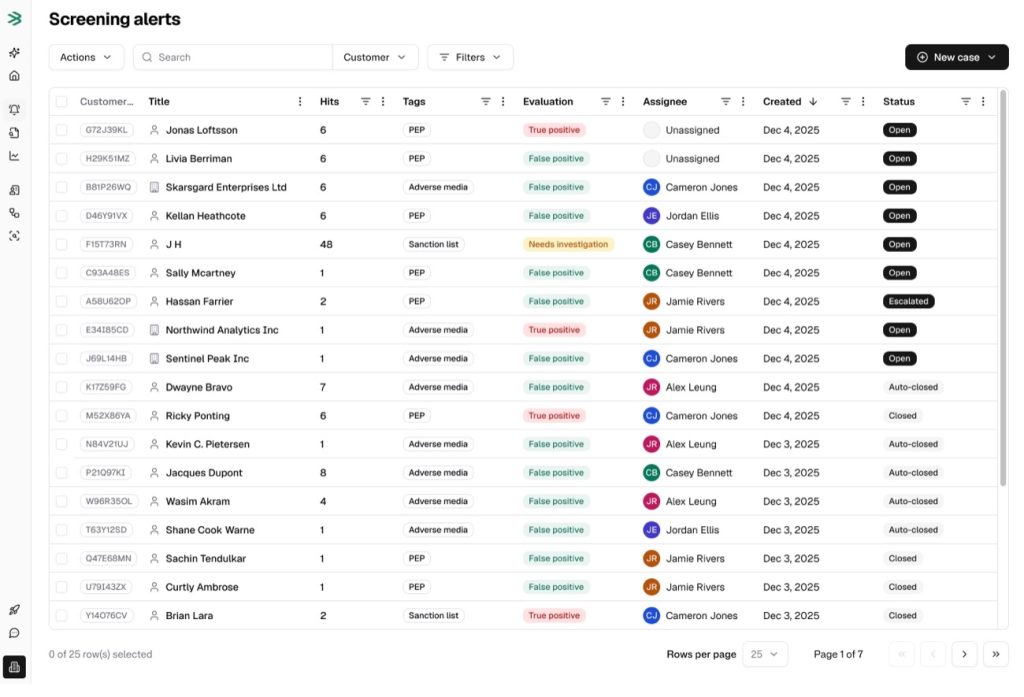
The Bretton AI Platform lets institutions build and run their own agents across compliance, risk, fraud, and operations. It includes Builder for custom agents, Workbench for case teams, and Templates for pre-built workflows. Bretton AI Managed Services gives institutions the option to buy the outcome, with a dedicated Bretton team running the program end to end on the same platform.
Our agents handle real investigative work: transaction analysis, KYC and KYB reviews, AML and sanctions investigations, enhanced due diligence, quality-control lookbacks, and ongoing monitoring.
Most vendors summarize alerts. Our agents complete full investigations. They gather evidence across multiple systems, apply the institution’s own policies, synthesize it, and produce traced, cited, and audit-ready outputs.
We also built what we call Trust Infrastructure. That includes model governance, continuous evaluation, traceability, and quality assurance. Governance is not layered on later. It’s embedded into every agent.
We are not a financial-crime point solution. Bretton AI runs the work end to end across the financial back office.
Building Trust In Regulated AI
When asked about challenges in the financial crime and compliance sector, Lawrence acknowledged:
The biggest challenge is trust.
Financial crime is deeply regulated. Teams are trying to understand how to explain AI to their regulators. Model risk management guidelines like SR 11-7 were written for deterministic models, not generalized AI systems.
So, we spend a lot of time on education. I’ve been in Washington, D.C., speaking to regulators about AI in AML and Bank Secrecy Act compliance. We work closely with banks regulated by the Office of the Comptroller of the Currency, Federal Deposit Insurance Corporation, and Federal Reserve.
We don’t treat governance as an afterthought. We build with model risk management, documentation, quality assurance, and escalation frameworks from day one. That’s what allows institutions to move from pilot to production.
Technology Evolution
When discussing how Bretton AI’s technology has evolved since launching, Lawrence described:
Early on, we focused on getting water through the pipes. Usage mattered more than massive contracts. We wanted real workflows, real feedback, and real edge cases.
Over time, the scope expanded. We went from a scrappy startup with a handful of agents to a platform for the financial back office, with AI-native Managed Services on top.
We brought Builder, Workbench, Templates, and Trust Infrastructure together in the Bretton AI Platform, then added Bretton AI Managed Services for institutions that want Bretton AI to run the program end to end.
The evolution has been from point solutions for financial crime to AI-native operations across compliance, risk, fraud, and operations.
Major Company Milestones
When asked about Bretton AI’s most significant milestones, Lawrence highlighted:
A few big ones:
-
- Raising our $15 million Series A.
- Raising our $75 million Series B.
- Rebranding from Greenlite to Bretton AI.
- Launching the Bretton AI Platform.
- Launching Bretton AI Managed Services.
Operationally, the traction has been meaningful:
- Completed 1.2 million Level 1 and Level 2 investigations.
- Eliminated more than 195,000 hours of manual work.
- Saved customers more than $18 million in headcount costs and risk reduction.
- Grew average contract value from roughly $50,000 to about $201,000.
- Achieved net dollar retention of more than 180%.
We’ve also grown from a team of seven to a multidisciplinary team of builders, operators, and domain experts from places like Meta, Netflix, Uber, Stripe, SpaceX, and more.
Customer Success Stories
When invited to share examples of Bretton AI’s production impact, Lawrence recounted:
Yes. This is the part I’m most proud of because it’s real production impact.
A $15 billion financial institution reduced business process outsourcing spending by $5.35 million in the first year after deploying Bretton. That’s not a pilot. That’s replacing headcount-based outsourced work with AI-native operations.
A Fortune 500 company cut institutional onboarding time by 50%. That means customers get unblocked faster and compliance teams are not drowning in backlog.
At First Internet Bank, Bretton AI reduced SBA loan-origination review times by 87%, moving reviews from eight to 10 hours to under one hour and saving 24,300 hours annually. When compliance moves faster, the whole bank moves faster.
More broadly, we’ve now completed more than 1.2 million Level 1 and Level 2 investigations for customers and eliminated more than 195,000 hours of manual work. In 2025 alone, customers saved more than $10 million in headcount costs and risk reduction. Across customers, Bretton AI has also delivered four to nine times the analyst capacity and roughly 50% savings on BPO contracts.
What matters to me is that these are regulated institutions, including banks supervised by the OCC, FDIC, and Federal Reserve. They are not experimenting casually. They are deploying AI-native operations in real workflows because the economics and controls work. That’s the difference between an AI demo and a production system that can carry regulated work.
Funding And Growth Metrics
When asked about Bretton AI’s funding and business metrics, Lawrence disclosed:
We raised a $75 million Series B led by Sapphire Ventures, with participation from Greylock, Thomson Reuters Ventures, Canvas Ventures, Y Combinator, and TIAA Ventures. In total, we’ve raised about $95 million across three rounds.
We’re not sharing revenue or valuation. What we can share is that we sell multiyear enterprise contracts, our average contract value is just over $200,000, and our net dollar retention is more than 180%. Our goal this year is to quadruple revenue from an already substantial base.
Market Opportunity
When discussing the total addressable market Bretton AI is pursuing, Lawrence estimated:
The opportunity is the financial back office: compliance, risk, fraud, and operations, where work has historically scaled with headcount and outsourcing. Financial crime is where the proof is strongest because the work is high-volume, unstructured, and heavily scrutinized.
Historically, every new market, product, and customer added more operational work and more people or BPO spending. Bretton AI is transforming that operating layer by letting institutions run more work on AI-native infrastructure, on their own data and policies, with every output traced and audit-ready. The opportunity starts in financial crime and extends across the financial back office wherever growth still requires equivalent growth in operational headcount.
Bretton AI’s Differentiators
When asked what differentiates Bretton AI from its competition, Lawrence emphasized:
Three things:
First, we run the work end to end. Point solutions flag or organize cases; Bretton AI completes the operational work, so capacity stops scaling linearly with headcount.
Second, defensibility. Bretton AI operates on the institution’s own data and policies, and every output is traced, cited, and audit-ready, with model governance and human oversight built in.
Third, durability. The system gets sharper with every case, so the value compounds instead of going stale.
Our alternatives are point solutions, headcount-based BPOs and advisory firms, and general-purpose AI tools. Unlike those approaches, Bretton AI runs the work across the financial back office.
Future Goals
When discussing Bretton AI’s future goals, Lawrence outlined:
We are in growth mode. We’re investing heavily in research and development to deepen the Bretton AI Platform, expand its agent and template library, and strengthen Trust Infrastructure. We’re scaling our go-to-market operations. And we’re hiring exceptional technical talent.
We’re also expanding Bretton AI Managed Services, giving institutions another way to adopt AI-native operations by buying the outcome rather than staffing and managing another software product themselves.
Long-term, we want Bretton AI to become the AI-native operating layer for the financial back office. Financial crime is where we started, but the long-term opportunity spans compliance, risk, fraud, and operations. Our goal is to help institutions grow without growing the back office.
