

C-Infinity is developing an AI-powered manufacturing reasoning layer designed to bridge the gap between product design and production planning. Its initial focus is assembly planning, where its AutoAssembler platform translates engineering designs into manufacturing-ready process intelligence by combining deterministic reasoning with machine learning. Pulse 2.0 interviewed C-Infinity Founder and CEO Sai Nelaturi to learn more about the technology, manufacturing AI, and the company’s vision.
Sai Nelaturi’s Background

When asked about his background, Nelaturi shared:
I spent over 15 years working at organizations like PARC and Carbon, focusing on advanced manufacturing challenges such as multi-axis machining, lattice design, and additive manufacturing.
During that time, we operated at the intersection of cutting-edge process capabilities and the engineering teams attempting to apply them in real-world production environments.
Across industries like aerospace, medical devices, and consumer hardware, we repeatedly observed the same fundamental issue: designs completed in CAD were often far from being production-ready.
This consistent gap between design and manufacturing readiness ultimately shaped my perspective and led to the founding of C-Infinity.
How C-Infinity Started
When asked how the idea for C-Infinity came together, Nelaturi explained:
The idea for C-Infinity emerged from repeatedly seeing a critical gap in the manufacturing stack: the absence of a computing layer that translates product design into manufacturing-ready process intelligence.
While CAD, PLM, and MES systems each serve important roles, none were designed to handle the reasoning required to convert design intent into feasible production plans.
This transformation was still being done manually by expert engineers, which does not scale in high-pressure, fast-moving environments.
C-Infinity was founded to build that missing reasoning layer, with an initial focus on assembly planning, which is a domain that clearly exposes the complexity of translating product structure into process structure.
Core Products And Features
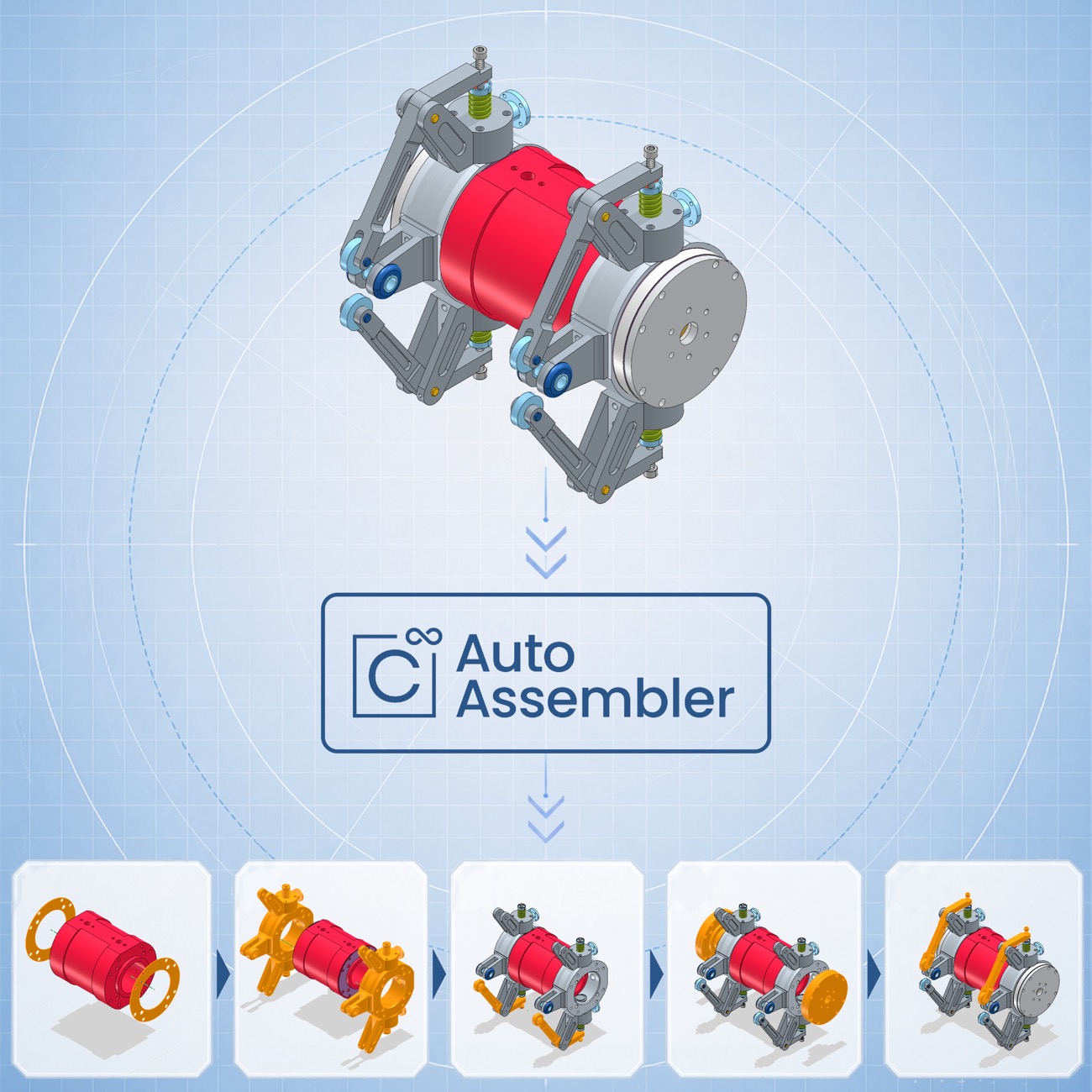
When asked about C-Infinity’s core products and features, Nelaturi detailed:
C-Infinity’s core product is AutoAssembler, which functions as a manufacturing reasoning system.
It treats engineering and manufacturing bills of materials (EBOM and MBOM) as interconnected representations and uses that relationship to generate assembly process plans.
The platform combines deterministic, model-based reasoning, accounting for geometry, motion, constraints, and feasibility, with machine learning that captures customer-specific preferences and recurring planning patterns.
It also integrates into existing enterprise workflows, particularly around engineering change orders (ECOs), where it identifies design changes, determines reusable planning logic, generates missing steps, and updates work instructions.
Managing High-Mix Manufacturing
When asked about recent challenges in the sector and how C-Infinity is addressing them, Nelaturi explained:
One of the primary challenges lies in managing high-mix product environments with continuous engineering changes.
Variant proliferation, where a single product family can produce thousands of configurations, places significant strain on traditional planning approaches.
Each engineering change requires re-evaluating which parts of an existing manufacturing plan remain valid and which must be updated, often across multiple variants simultaneously.
Addressing this requires shifting from a data management mindset to a manufacturing reasoning approach, where systems can dynamically assess change impact and maintain consistency across evolving product configurations.
How The Technology Has Evolved
When asked how C-Infinity’s technology has evolved since launching, Nelaturi said:
At the outset, the focus was on proving the concept by using real-world examples to demonstrate that the ideas were both viable and practical.
We then brought those examples to early customers, and once they saw the solution in action, it created the confidence needed to move forward.
From there, we transitioned to a more modern technology stack, combining service-oriented architecture with machine learning, simulation, and GPU-based geometry processing.
In parallel, we worked through how to deploy these sophisticated models in a way that balanced performance with real-world constraints: protecting intellectual property, managing hardware complexity, and safeguarding proprietary know-how.
Today, that foundation allows us to deliver this capability consistently, and at scale across all customers.
Key Company Milestones
When asked about some of C-Infinity’s most significant milestones, Nelaturi highlighted:
We’ve onboarded top companies, including Fortune 100 manufacturers that have confirmed the scale of the problem we are solving.
These companies spend tens of millions of dollars yearly, and they are looking to us to transform their legacy processes using AI.
The fact that the product is deployed and used at companies of this stature is extremely encouraging, and with a really strong pipeline, it gives a high level of confidence about the market we’re addressing.
Funding
When asked about funding metrics, Nelaturi revealed:
We have raised $16 million in total funding led by Canaan Partners, with participation from Inventus Capital, Bee Partners, and Radius Capital.
Total Addressable Market
When asked about the total addressable market C-Infinity is pursuing, Nelaturi explained:
For our initial wedge, the MVP, the opportunity is substantial. In the U.S. alone, we estimate at least an $8 billion market, with an additional $13 billion in the EU.
More broadly, the total addressable market extends across the entire manufacturing sector, particularly among companies moving toward high-mix production.
That means the long-term opportunity encompasses virtually any manufacturer looking to apply AI to complex, variable production environments.
Competitive Differentiation
When asked what differentiates C-Infinity from its competition, Nelaturi said:
C-Infinity differentiates itself through its focus on building a dedicated manufacturing reasoning layer rather than extending existing CAD or PLM systems.
Its neuro-symbolic architecture combines deterministic planning, required for correctness in manufacturing, with machine learning that adapts to each customer’s workflows and preferences.
The platform is deployed within each customer’s environment, ensuring that proprietary manufacturing knowledge remains secure and becomes more valuable over time.
Additionally, C-Infinity prioritizes deep integration at key workflow points such as ECOs and design releases, allowing it to operate as an event-driven intelligence layer across the enterprise stack.
Future Goals
When discussing C-Infinity’s future goals, Nelaturi explained:
A key long-term goal is to shift manufacturing intelligence earlier in the product lifecycle.
While AutoAssembler currently addresses downstream challenges like ECO processing and assembly planning, the broader vision is to bring that same reasoning capability upstream into design.
This would allow engineers to evaluate manufacturing impact in real time, reducing iteration cycles and improving production readiness before designs are finalized.
The Shifting Manufacturing Bottleneck
When invited to discuss another topic, Nelaturi concluded:
A central theme is the shifting bottleneck in manufacturing. While AI is accelerating design generation and simulation, the real constraint is increasingly validation, determining which designs can actually be manufactured, assembled, and scaled.
The greatest value will come not from generating more design options, but from embedding manufacturing intelligence into the design process itself, enabling engineers to create solutions that are production-ready from the outset.
