

Calix provides a vertical platform built specifically for broadband service providers, spanning access networks and customer premises systems through cloud software, managed services, and agentic AI. The company focuses on helping providers grow their businesses, simplify operations, and improve subscriber experiences. Pulse 2.0 interviewed Calix Chief Product Officer Shane Eleniak to learn more.
Shane Eleniak’s Background

When asked about his background and what led him to join Calix, Eleniak shared:
I grew up in very traditional telecom and networking, where the most important things were reliability and scale. If your solution fell over on a bad day, nobody cared how clever the technology was. That early experience wired me to think in terms of clean data paths, rock-solid infrastructure, and services that “just work” for the customers on the other end.
Over time, my work shifted up the stack into security, applications, and data center or cloud-based services, first at companies like Corente and CommScope, and then eventually at Calix. I kept running into the same pattern, though: lots of powerful technology, but not enough focus on how you create value for real customers and build sustainable businesses.
When the chance came to join Calix in 2015, what attracted me was two things: the opportunity to transform a public company and the opportunity to build a platform for service providers to move from utility to truly managed experiences and hopefully transform an industry.
Chief Product Officer Responsibilities
When asked what a Chief Product Officer does at Calix, Eleniak explained:
My job is to make sure we have a strategy to grow the company over the next five years, deliver sustainable differentiated value to our customers, hire and grow the right talent, foster a culture of distributed leadership, and ultimately build the right things, in the right order, that work in the real world. At Calix, that means taking everything we know about communications service providers and their subscribers and turning it into products that make their lives simpler, not more complicated.
Ideas are easy; what matters is how we execute and whether they solve a real problem. A big part of my role is staying close to customers, so I understand what’s slowing them down, where they’re short on people or time, and then making sure our best ideas are aimed straight at those points of friction.
At the same time, ambitious ideas are the lifeblood of innovation. My punch list as a CPO is always much longer than what we can ship in a release cycle. We work on a consistent 90-day schedule that allows for predictable innovation upgrades for our customers. That’s a good problem to have. It means the team never stops pushing for meaningful improvements that create real value for our customers rather than just adding features for the sake of it.
Calix’s Differentiators
When asked what distinguishes Calix from other companies in the broadband and AI markets, Eleniak emphasized:
Many technology companies sell horizontal tools or narrow point solutions. Calix is different because we’re a vertical platform that was built specifically for service providers, from the access network and customer premises systems all the way up through cloud software, managed services, and now agentic AI. Instead of asking our customers to stitch all that together, we do the hard work in the architecture so they can stay focused on running their businesses and serving subscribers with unmatched experiences.
Second, we treat AI as part of a complete stack, not as frosting on top. Years before “agentic AI” was a buzzword, we were preparing for it by understanding what a marketer, network engineer, or support representative actually does in a day. Now, we can apply that thinking to an agent-enabled platform that supports those workflows. And we’ve built the right foundation so we can plug agents into those workflows and have them act with context under clear guardrails.
Finally, we focus our work on outcomes. Our customers don’t wake up wanting another dashboard or another model; they want lower churn, higher take rates on new services, faster issue resolution, and happier subscribers. Everything we build moves those needles in a measurable way. If a feature doesn’t help a service provider grow, simplify, or improve the subscriber experience, it doesn’t belong in the product.
The AI Layer Cake
When discussing Calix’s “AI Layer Cake” and why it matters, Eleniak outlined:
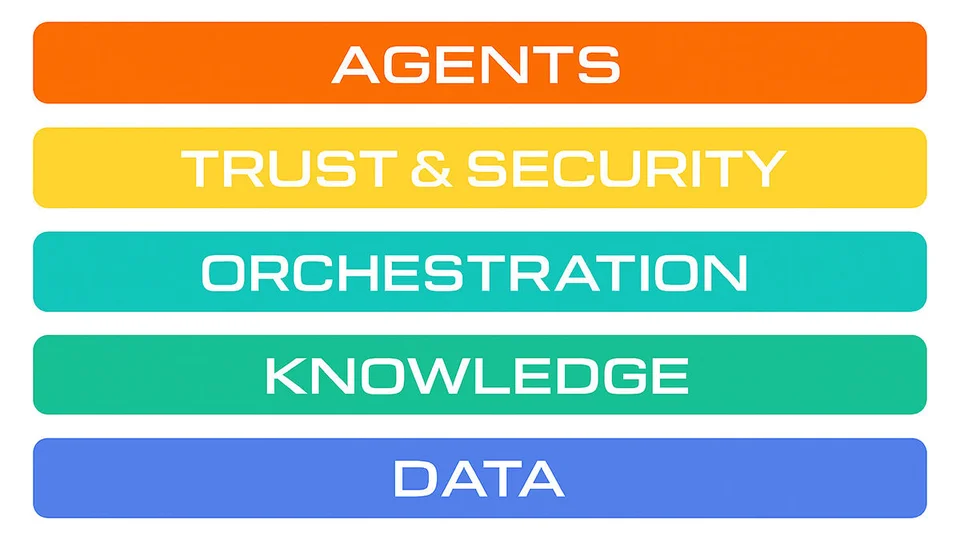
When people say “AI,” they usually mean the visible part, generative AI you can talk to and interact with naturally. But that’s the tip of the iceberg. Beneath that lies all the important, less glamorous stuff: a new technology stack designed for agentic AI, with five layers that can evolve independently but work together. They are data, knowledge, orchestration, trust, and then the action layer where agents actually execute.
Data is where everything lives today, including telemetry, events, tickets, and subscriber records. The knowledge layer turns that into a shared, up-to-date understanding of what’s happening across your products, customers, and operations, so agents can reason instead of just query. Orchestration decides how work moves: which agents to involve, in what order, and when a human needs to step in. Trust governs who and what is allowed to act on whose behalf and under which conditions. Only then does that iceberg tip, the agents and experiences everyone sees, become functional.
Without this layered foundation, AI stays a demo. If you bolt an LLM onto a few tools, you get clever prototypes that nobody will ever let touch production systems. But this technology stack, where each layer is explicit, enables you to evolve the layers independently. That, in turn, lets you improve your models or adopt new ones without rewriting workflows. Orchestration and trust become first-class design problems instead of background assumptions. That’s what lets agents move from being toys on the edge of the work to being accountable teammates inside the workflows that actually run the business.
Engineering AI For Trust
When asked why trust remains a major challenge for AI and what it means to engineer for trust, Eleniak described:
Most companies still rely on a security model designed for people with rights, not for nonhuman teammates that can act. Single sign-on and role-based access are great, but they don’t solve the trust issue in an agentic world. They only tell you who can get into a system, not whether a specific action is appropriate given the context and the proposed actor. If you don’t make that distinction explicit, your agentic AI projects will remain projects and never move into full-scale production because no one will want to let agents near the systems where real work has real consequences.
So, when I talk about engineering for trust, I mean treating it as a fundamental layer in the architecture, not a set of after-the-fact controls. We start from a zero-trust mindset. We ask, “Should this agent, on behalf of this person, at this time, be trying to do this at all?” If the answer is no, the flow stops there. The trust layer acts like a traffic cop at the start of every interaction: Who are you, what are you trying to do, and why does this make sense given our policies, risk appetite, and current context?
From there, engineering for trust involves guardrails, observability, and reversibility by design. Every agent gets a clear identity and “agent card” defining what it’s allowed to do, in which systems, under which conditions, and when it must hand back to a human. Every interaction is treated as a session with full logging, so you can see what happened, reconstruct why, and roll it back if something goes wrong. We also add layered gateways around the session and the models themselves, watching for misuse, policy violations, or attempts to poison the system. Done well, that lets you move fast with agents working inside real workflows while still being able to sleep at night.
Managing Millions Of Subscribers
When asked what enables Calix’s AI to help manage millions of broadband subscribers and how customers are using it, Eleniak noted:
We’re able to operate at that scale because we did the hard work first. For years, we’ve been building a vertical platform around how broadband businesses actually run, how subscribers behave, how networks perform, and how marketing, operations, and support teams do their work day to day. That gave us the necessary insight and understanding to introduce agents that know what a good subscriber experience is and can act to support that experience.
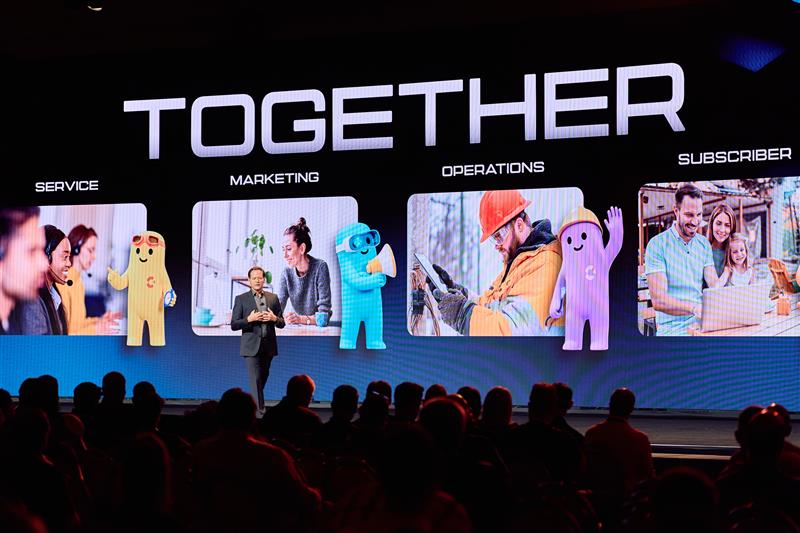
In practice, customers are using our AI to extend their teams in a labor-constrained world and move toward true personalization at scale. Marketing agents identify high-value segments, design campaigns, and push them live through the platform with human approval at the right checkpoints, so a small marketing team can run programs that used to require a much bigger staff. Network operations agents monitor telemetry in real time, flag emerging issues, and propose or execute corrective actions under tight guardrails, which helps lean operations teams manage millions of subscriber sessions without burning out. Support agents triage tickets, surface full subscriber context, and recommend next-best actions so frontline representatives can deliver more tailored help on every call. And the reach of what agents can do will be extended as we roll out more agent-to-agent capabilities where immediate human involvement isn’t necessary.
Speed And Safety Challenges
When asked about the challenges broadband providers face as they adopt AI and the tension between speed and safety, Eleniak observed:
Honestly, we’re finding that most broadband companies, actually most companies in general, don’t have an AI problem. They have knowledge and workflow problems. Their data and insight live in silos: marketing over here, network operations over there, and support somewhere else. So, AI ends up as a clever feature on top of each silo instead of something that changes how work gets done. If you don’t have a shared, near-real-time view of what’s happening with your subscribers and your network, AI will just give you nicer dashboards, not better outcomes. Fortunately for broadband service providers, we have a simple fix: our platform embeds knowledge and workflow insight, so they can focus on their business goals and tap agents to help them achieve them.
There’s also an inherent tension between speed and safety when you’re trying to apply AI. It’s tempting for some companies to adopt an “apply AI everywhere and see what happens” approach. With agentic AI, you could end up with hundreds, maybe even thousands, of agents nobody really understands. But the other extreme isn’t the answer either: a four-year program that treats AI like an ERP rollout from the 1990s, where by the time the governance decks are done, the business has moved on. At Calix, we offer providers a better path: a vertical technology stack that already understands broadband workflows, so they can start with narrow, high-value use cases and expand safely. That’s how you move fast enough to matter without betting the network on a science experiment.
Future Innovations
When discussing the future goals and innovations that excite him most, Eleniak highlighted:
What excites me most is not a specific model or feature; it’s the shift of agentic AI from being a productivity tool to an actual digital teammate. AI agents built on the right technology stack won’t just help someone run a report or draft a campaign; they’ll execute meaningful chunks of the customer, product, and employee lifecycles in concert with human teams. That changes who does the work, how decisions get made, and how you design a business.
In broadband specifically, I’m excited about two things. One is true personalization at scale. Imagine giving every subscriber the feeling of a dedicated team supporting their experience, even when you’re serving hundreds of thousands of households with a lean staff. The other is what I’d call “knowledge for everyone.” A marketer in a rural cooperative and an operations lead at a regional fiber provider can both act with the same level of insight their best expert has today because they, along with their AI agents, have access to the company’s expertise embedded in the federated knowledge layer of the technology stack we’ve been discussing. When we get that right, the distinction between a “big” and “small” provider starts to matter a lot less than the quality of its stack and the organization’s combined, codified expertise.
Scaling AI Responsibly
When asked what advice he would offer companies trying to scale AI responsibly, Eleniak advised:
First, stop treating AI as a laboratory project and start treating it as a business transformation. If it lives in a sandbox with a few clever demos, it will die there. Bring it into the core lifecycles of your company, customers, employees, and products because that’s where the real work happens. If you aren’t willing to rethink those flows, you’re not really doing AI; you’re just adding more confusion.
Second, design for trust from day one. Start with a zero-trust mindset: assume agents can do nothing until you explicitly define who they act for, what they can touch, and under what conditions. Make every action observable and, where it matters, reversible. If you do that, you can let AI systems move faster than humans ever could while still being able to explain what happened and, if needed, unwind it.
Redesigning Work With AI
When invited to share any additional thoughts about the future of AI, Eleniak concluded:
I’d add that, as with many new technologies, most of us are enthralled by the technology itself, who has the best model, and how the next release will perform. New models are great, and they’ll keep making incredible progress. But to me, that’s not nearly as interesting as what will ultimately make the difference: what you do with the technology, where you apply it, and what it radically changes.
Point AI at the same old silos and fiefdoms, and you get faster versions of the problems you already have. But rethink how you organize the work to create new products, keep employees engaged, and give customers incredible experiences, and now agentic AI can help you achieve things you simply can’t attempt today. Of course, that requires a lot of imagination, which is what really excites me about where we are today. We pretty much have a blank canvas on which to redesign our companies and our future.
