

Callie Care is an AgeTech startup developing a proactive, phone-first voice AI platform designed to help older adults maintain independence, manage everyday needs, and stay connected with family members and care teams. The company’s technology operates through ordinary phone calls and text messages, providing assistance with transportation, groceries, medications, appointments, companionship, and wellness check-ins without requiring a smartphone app or additional hardware. Co-founded by Yury Palevich, Michil Androsov, and Igor Gurovich, Callie Care aims to address challenges associated with aging alone through personalized AI assistance. Pulse 2.0 interviewed Callie Care Co-Founder and CEO Yury Palevich to learn more about the company’s origins, voice AI technology, customer adoption, growth strategy, and long-term vision for aging-in-place services.
Yury Palevich’s Background

When asked about his background, Palevich shared:
Before launching Callie Care, I spent three years at inDrive, the second-largest ride-hailing platform in the world, during its expansion into a multi-service super-app, and before that I built Avito Delivery from scratch, which grew to 29M+ orders a year across 17M+ sellers. I also co-founded iBolit, a consumer telemedicine app rated 4.9.
I’m building Callie Care together with Michil Androsov (who is our CTO) and Igor Gurovich (our CPO). Earlier Michil was CTO of inDrive, where he scaled engineering from 50 to over 500 people and co-invented the patented system that routes hundreds of millions of rides. And Igor Gurovich is a serial founder with an exit. Among the highlights of his career I can name Refocus where he achieved $12M in revenue.
At Callie Care, we’re applying what we’ve learned from our experience in mobility and marketplaces to serve older adults, an audience that has long been overlooked by most tech companies.

How The Idea For Callie Care Came Together
When asked how the idea for Callie Care originated, Palevich explained:
It really started with my co-founder Igor’s personal experience. As his grandfather got older, Igor was spending a lot of time with him, mostly at home, and tried every piece of technology available at the time to make his life easier. Nothing worked. The interfaces were too complex and none of them was designed for an older person.
The only thing that did work was a voice speaker, something like an Alexa. That stuck with him. He kept coming back to how unfair it is that people get cut off from the world as they age, simply because technology isn’t built for them and there are almost no products made for them. For the next ten years he watched this market closely, waiting for the moment he could actually do something about it.
That moment came through our team. We had originally built a voice assistant with a different focus, an MVP that could book restaurants and handle everyday tasks. What we noticed was that older adults started finding it on their own and staying. Igor had been talking about this audience for years, so we sat down together and rebuilt the product around their needs. That product became Callie Care.
Favorite Memory Working At Callie Care
When asked about his favorite memory working at the company, Palevich recalled:
When we were building the companion side of the product, a huge number of deeply lonely people started writing to us. Reading their messages, hearing how much lighter they felt just because someone talked with them and listened, was the moment it clicked for me.
That’s when I knew that we were on the right path, that we could build technology that is genuinely useful and valuable for older adults, especially those living alone.
Core Products And Features
When asked about Callie Care’s core products and features, Palevich explained:
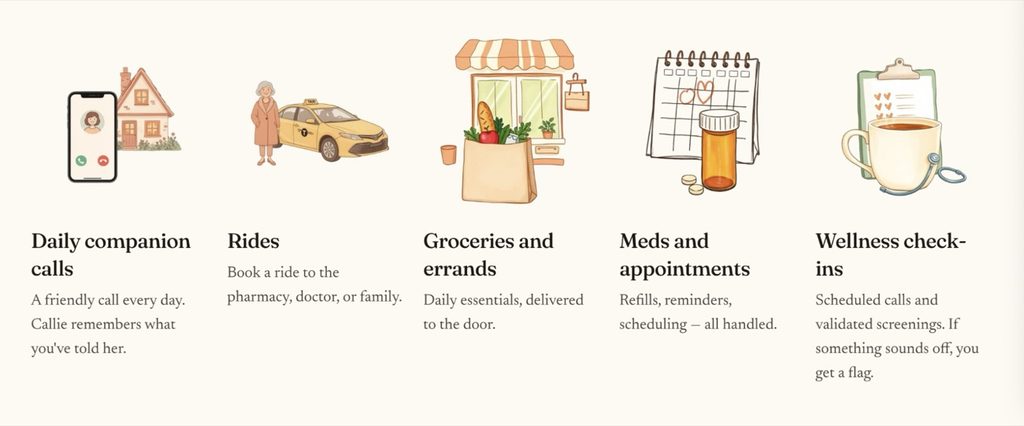
Callie Care is a proactive voice AI companion for older adults that works entirely over a normal phone call or SMS. No app, no smartphone, no device to install. Under one voice we run five skills, all powered by what we call the Callie Care Layer, which knows each person’s health, routine, and network:
- Transportation, our flagship skill today: members call to order a ride and we handle it end to end, picking the time, writing driver notes, and booking it.
- Groceries and products, voice-ordered shopping that remembers regular carts, diet, and packaging.
- Medications and appointments, refills, reminders, and scheduling aligned to each person’s pill schedule and doctors.
- Companion calls, natural daily conversations designed with gerontologists, with real memory of family, history, and interests.
- Wellness check-ins, friendly scheduled calls that capture mood and health signals and deliver them to family and the care team.
Behind Callie Care’s voice is a platform of six specialized agents, including caller identity validation, per-user memory, a proactive engine that initiates contact on its own, and a three-tier safety escalation.
Challenges In The AgeTech Market
When asked about challenges in the AgeTech sector and how Callie Care is addressing them, Palevich identified three areas:
I’d pay attention to three things here. First, the industry has largely defaulted to monitoring. Most products treat the older adult as something to be tracked, which really addresses the anxieties of doctors and family more than it helps the person.
Very few ask what older adults actually want, which is to live more comfortably, not to feel like they’re in a prison where every parameter is watched. We built Callie Care around the person, not the surveillance.
Second, monetization is genuinely hard because of how healthcare is structured. People are used to a product or service being covered by insurance, but most things aren’t, and getting a good product to the point where it is covered takes an enormous amount of work, which is especially tough at an early stage. That acts as a real brake on innovation in this space.
Third, something we learned firsthand through our transportation skill, especially rides for people in wheelchairs. Despite huge demand, this part of the industry is still far from digitized or convenient for the end user.
The big players like Uber and Lyft barely cover it, wheelchair-accessible rides in particular. The supply mostly comes from many small local operators that are nowhere near digital, and that gap is exactly where the opportunity is.
How The Technology Has Evolved
When asked how Callie Care’s technology has evolved since launching, Palevich said:
We started with a single companion call and have grown into an orchestrated platform. The biggest shift was going from one voice doing one thing to six specialized agents working under a single voice, backed by a memory layer that builds a richer profile of each person every time we talk.
We added a proactive engine so Callie Care reaches out instead of waiting to be asked, and we moved from conversation into action, starting with the ride concierge and now rolling out groceries.
To the member nothing changed, it’s still just a phone call, but there’s a great deal more happening underneath.
Significant Milestones And Customer Adoption
When asked about Callie Care’s most significant milestones, Palevich highlighted adoption, retention, unit economics, and investor support:
Getting real adoption and retention from an audience everyone said was too hard to reach, with our ride volume growing more than 90% month over month and an 82% repeat rate.
Making the unit economics work, driving our cost to acquire a member down sharply and pushing LTV to CAC toward our target as every new cohort gets cheaper.
Raising our pre-seed round from people who believe as strongly as we do in this idea and this market.
Customer Success Stories
When asked about specific customer success stories, Palevich described how older adults are using Callie Care’s transportation services:
I’ll mention several clients’ cases. One takes a Callie Care ride to dialysis every Monday, life-sustaining treatment he now never misses.
Another took 30 rides to 19 different places in a single month, effectively replacing both her car and the daughter who used to drive her. A third, who has no car, uses Callie Care every single day to get to her morning shift.
The pattern we care about is that our power users run their entire mobility through us and keep coming back.
Funding And Revenue Metrics
When asked about funding and revenue metrics, Palevich revealed:
We recently raised a $500K pre-seed from people who believe in this idea and this market as strongly as we do, to expand the product and grow the direct-to-family business.
On traction, what we’re most proud of is the shape of the growth rather than any single number: rides growing more than 90% month over month, an 82% repeat rate, and acquisition costs falling with every cohort.
We’ll share more detail as we head into our next, larger raise later this year.
Total Addressable Market
When asked about the total addressable market Callie Care is pursuing, Palevich explained:
We’re going after the aging-in-place market, roughly a $22B opportunity spanning direct-to-family subscriptions, transport and commerce, and eventually value-based-care reimbursement.
The tailwind underneath it is demographic and permanent: 58 million Americans are already 65 or older, 17M live alone, and the vast majority want to age at home.
What Differentiates Callie Care From Its Competition
When asked what differentiates Callie Care from other companies developing technology for older adults, Palevich identified three factors:
First, we’re a vertical voice AI built specifically for older adults. Everything happens through voice, over the phone they already use, with no app, no device, and no install, on the one interface they already trust.
Second, and this is the core of it, Callie Care is proactive. It doesn’t sit and wait to be opened or asked. It calls you, it already knows your context deeply, and it acts on your behalf, booking the ride, ordering the groceries, handling the refill.
That active, do-it-for-you quality is what sets us apart from every passive app or chatbot.
Third, the context layer underneath: because every interaction is voice and memory-backed, we’re building the profile, consent, and care-actions layer for the older adult population, which a chatbot or a hardware gadget can’t easily replicate.
Future Goals
When asked about Callie Care’s future goals, Palevich outlined a three-stage strategy for expanding the company’s technology and services:
We see it in three stages.
Today, the assistant: a daily proactive voice companion handling rides, groceries, medications, and appointments.
In 2-3 years, the platform: serving the whole second half of life across phones, speakers, and connected devices, plus structured screenings for value-based care.
In 5+ years, the infrastructure: the senior-context layer that every voice product talking to an older adult calls first for context, consent, and care actions.
Our long-term research goal is to explore how voice biomarkers can help identify early signs of cognitive decline years before a clinical diagnosis.
The Broader Vision For Voice AI And Aging
When asked what single idea he wanted readers to take away from the conversation, Palevich concluded:
One line sums up why we’re doing this: AI isn’t replacing people, there just aren’t enough people.
Almost 15M older Americans live alone, caregivers don’t scale, and families are stretched thin. That’s not only a social problem, it’s a medical one.
Voice AI is the only interface that can reach this generation at scale, on the device they already own, today.
