

Capitol AI is building a sovereign operating system for intelligence for regulated, high-stakes institutions, including professional services firms, publishers, and government agencies. Capitol runs entirely inside enterprise infrastructure, transforming proprietary data into structured, decision-grade artifacts, including due diligence reports, regulatory documentation, and executive intelligence. Model-agnostic and fully auditable, with no data egress, the platform gives institutions durable control over their data, workflows, and standards. Pulse 2.0 interviewed Capitol AI founder and CEO Shaun Modi to learn more.
Shaun Modi’s Background

Could you tell us more about your background? Modi said:
“Both of my parents were designers and built careers around shaping complex information into something people could actually use. I trained at the Rhode Island School of Design, started coding as a teenager, and launched my first small business before high school ended so building has always felt like my default setting. In addition, my grandfather was the former Executive Officer of the President’s Science Advisory Committee, so all of these early exposures to public institutions shaped how I think about systems that must endure scrutiny and operate with accountability over time.”
“At Airbnb and NASA, and then again when I worked inside government environments, I worked on products that carried real consequences. Across those settings, I kept seeing a recurring pattern. Institutions had deep expertise and enormous volumes of data, yet information lived in fragments across systems and teams. As work moved forward, context shifted. Decisions carried weight yet the reasoning behind them often became harder to follow over time.”
Formation Of The Company
How did the idea for Capitol AI come together? Modi shared:
“During COVID, I was working on government projects where time and clarity really mattered. Institutions had access to data but there was a clear bottleneck at the synthesis part. Analysts were spending huge amounts of energy reconciling documents instead of getting the necessary information they needed to apply their own judgments. The people in the room had deep expertise and they had access to information but what they lacked was a coherent system that could synthesize everything in front of them.”
“At the same time, AI models were advancing rapidly and output could be generated quickly but there was a missing infrastructure piece that could transform information into structured, accountable, and verifiable insight.”
“That gap became the founding thesis of Capitol AI. We founded the company to build the connective tissue – the “intelligence infrastructure” – between enterprise data, AI, and real workflows inside heavily governed and regulated environments. Data sovereignty is required in high stakes environments. Customers retain full control over their data, model selection, and workflow standards. Every output is traceable to source material, and each step of execution is logged to create a complete audit trail.”
Intelligence Infrastructure
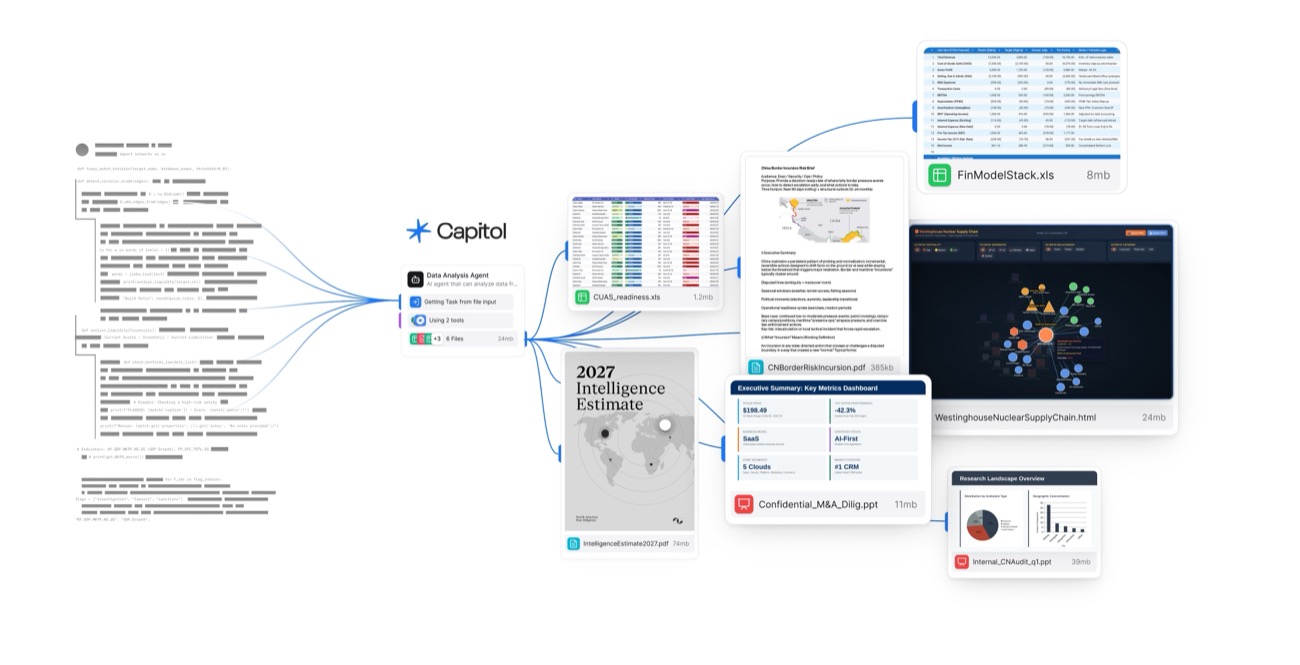
You describe Capitol AI as “intelligence infrastructure.” What does that mean in plain terms? Modi noted:
“When I say “intelligence infrastructure,” I mean we’re building the system that turns an institution’s proprietary data into decision-ready work product inside its own secure environment.”
“In plain terms, if you’re a consulting firm doing due diligence or a government agency evaluating procurement proposals, Capitol takes all of your internal data, external sources, and defined standards and turns them into structured, auditable reports. Every claim is sourced. Every step is logged. Every output is repeatable.”
Infrastructure means it becomes part of how the organization operates. It runs inside their environment, integrates with their data, supports multiple AI models, and produces artifacts that can withstand scrutiny. It’s not an assistant giving suggestions. It’s a governed system that produces work you can defend.
Differentiation From The Competition
How did design influence the way you built Capitol AI, and what differentiates Capitol AI from other companies in this space? Modi affirmed:
“Design taught me to pay attention to what happens when systems operate under pressure. In large organizations, information lives across PDFs, spreadsheets, databases, slide decks, dashboards, emails, and internal tools. As AI increased output, that volume flowed into workflows that already struggled to stay connected.”
“That dynamic shaped how we built Capitol AI. We chose to address structure first, focusing on preserving context as work moves between teams, keeping information connected across steps, and making assumptions visible. A system should help people reason clearly over time, not just generate answers in isolation.”
“We also wanted to give organizations the ability to operate using Capitol AI across multiple models rather than relying on a single provider. Our team, from our own experiences working in these types of organizational environments, is well aware of how important prioritizing reproducible outputs is so teams can trace how conclusions were formed. Evaluation is embedded into the product itself with guardrails placed directly into workflows so validation becomes part of the process.”
“What differentiates Capitol is that orientation toward durability. Many companies optimize for model performance or speed but we optimize for clarity, auditability, trustworthiness, security, and institutional reliability. Our focus sits on the moment when a decision carries weight because we know that in those environments structure matters more than novelty.”
AI Adoption For Institutions
As AI adoption matures, what are institutions actually looking for? Modi pointed out:
“That conversation has shifted from when we first began. Early on, leaders asked what AI could do but now they’re asking how it can integrate into core systems safely. They care about data control, long-term flexibility, and outputs that stand up under scrutiny.”
“In finance and procurement, teams prioritize clarity under sensitive time pressures but in professional services, organizations focus on attribution and editorial integrity and, in government organizations, data security and sovereignty is paramount. Regardless of the industry or sectors, we’ve seen how durability has become the central theme for everyone and are able to provide every priority focus for our customers.”
“Institutions want AI that strengthens their internal capabilities rather than creating new dependencies.”
Broader Economic Impact Of AI
How does focusing on a structured decision-making lens influence the way you think about AI’s broader economic impact? Modi explained:
“Looking at example workflows such as procurement or due diligence, you see recurring patterns where teams need to analyze large volumes of information under compressed timelines reconciling spreadsheets, reports, contracts, and market data.”
“AI changes the rhythm of that work. Structured systems can ingest information, compare alternatives, surface tradeoffs, and preserve evidence chains so experts can then apply judgment to what matters most.”
“That dynamic extends across the economy. AI increases productivity when it reduces friction and supports accountability at the same time and economic competitiveness ultimately ties back to that balance.”
Data Sovereignty
Why is data sovereignty such a priority for your customers? Modi emphasized:
If you’re a highly regulated or high-stakes enterprise like our customers are, your data includes client information, proprietary analysis, sensitive transactions, and internal decision frameworks. That data is often regulated, contractually protected, and central to how you create value. If it leaves your environment or flows through systems you don’t control, you introduce compliance risk, legal exposure, and strategic dependency.
In these sectors, decisions have consequences. They affect markets, clients, procurement outcomes, and public trust. You need to know exactly how an AI system reached a conclusion, what data it used, and whether the output can be reproduced under scrutiny. If you cannot explain it, you cannot defend it.
So data sovereignty is a requirement. Institutions want AI that strengthens their existing controls and governance frameworks, not something that sits outside of them.
Next Phase Of AI
Looking ahead, how do you see the next phase of AI unfolding for enterprises? Modi concluded:
We’re moving from experimentation to accountability.
For the past two years, enterprises have been piloting AI in pockets of the organization. The next phase is about embedding it into core workflows where the stakes are higher and the tolerance for error is lower. That changes everything. Leaders are no longer asking, “Can we use AI?” They’re asking, “Can we defend how it works, what it costs, and what decisions it influences?”
As AI moves into finance, compliance, procurement, and strategic decision-making, it has to behave like infrastructure. That means traceability, cost discipline, reproducibility, and flexibility across models. Multi-model environments will become standard, not because it’s fashionable, but because enterprises will not want to be structurally dependent on a single vendor.
The deeper shift is this: AI will not create a durable advantage by producing more content. It will create an advantage by strengthening institutional judgment. The systems that win will be the ones that preserve context, carry forward institutional memory, and make high-consequence decisions more rigorous, not just faster.
