

Centrical is the AI Orchestration System for the hybrid frontline, where people and AI agents play as one team. Across sales, service, and operations, Centrical turns business goals into adaptive performance programs, building and running the KPIs, learning, coaching, simulations, and challenges needed to turn strategy into frontline behavior. The system connects these in one continuous loop, adjusting as performance and behavior change so organizations move from strategy to execution faster, while people remain in control of the decisions and judgment that matter.
Pulse 2.0 interviewed Centrical Founder and CEO Gal Rimon to learn more about the company’s origins, its approach to frontline performance, and how agentic AI is changing workforce management.
Gal Rimon’s Background

When asked about his background, Rimon shared:
I spent nearly two decades in business intelligence, working with consulting firms like EDS and Deloitte and later running my own company.
We helped some of the world’s largest organizations make sense of their data, and we were good at it. But I kept running into the same wall.
Companies had charts, KPIs, and dashboards. They had more data than they could process. And still, very little actually changed.
Managers would look at the numbers, nod, and go back to doing what they were doing before.
That frustration became the founding idea behind Centrical. I wanted to build the bridge between insight and execution, starting with the frontline employee.
How Centrical Started
When asked how the idea for the company came together, Rimon explained:
About 15 years ago, while running my previous company, we worked with an insurance provider trying to improve revenue and profitability.
After a month of analysis, we identified the problem: most customers stuck to basic plans even though better options existed. We built data models, segmented customers, and designed next-best-action workflows across every channel.
We piloted it with a small group of teams, and the results were strong: higher revenue, better conversion, improved agent efficiency, and higher customer satisfaction.
Then we rolled it out across the whole operation, and the results scattered. Same data, same workflows, same next-best actions, but some teams improved sharply and others barely moved.
When we dug into what separated them, it came down to a single variable: the manager.
Where a manager had the time to sit with their agents and work the recommendations, behavior changed. Where they didn’t, the recommendations sat there.
And most managers didn’t have the time. Our own data showed managers spent 60% of their time on data analysis and 20% on evaluations, leaving less than 20% for actually supporting their teams.
The intelligence existed. The action didn’t follow.
So I built Centrical on four principles: data must be actionable, that action must change behavior, training and coaching must be used to drive that behavior, and a feedback loop must connect it all.
Those four things still sit at the core of everything we do. Agentic AI is making it possible to make this process autonomous, hyper-personalized, and intelligent in ways that weren’t possible before.
Core Products And Features
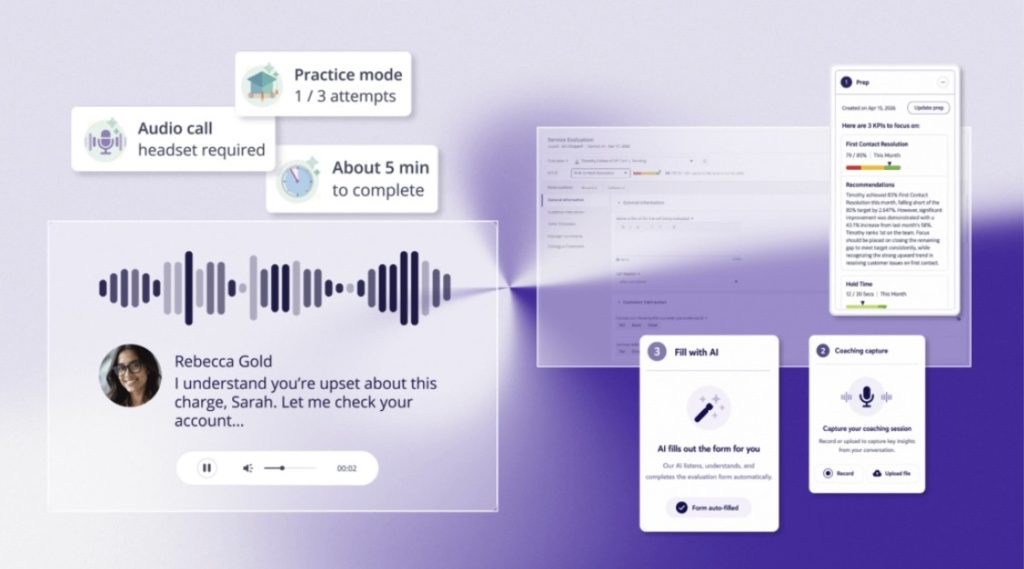
When asked about Centrical’s core products and features, Rimon detailed:
The best way to think about it is as a single Workforce Orchestration System, not a collection of features.
We start with the program or business outcome: a KPI improvement campaign, a product launch, an onboarding class, whatever the organization is trying to achieve.
From there, the system builds an adaptive performance program around that goal, bringing together the KPIs, learning, coaching, practice simulations, and challenges needed to turn strategy into frontline behavior.
It connects these in one continuous loop, adjusting as performance and behavior change to identify where the gaps are and course correct in real time.
When a gap surfaces for a specific employee, the platform identifies the root cause and orchestrates the right action: a coaching prompt for the manager, a targeted practice scenario for the employee, a microlearning module, or a nudge.
And we measure whether behavior actually changed so the system learns and the impact compounds.
Our capabilities replace disparate tools across coaching, performance management, training and role-play, quality management, and recognition to drive improvement and growth.
We’ve built AI Coaching, so managers see who to coach, on what, and when, with the right actions prioritized for the business.
AI Role-Play Simulations enable employees to practice high-stakes conversations before they face them live.
No other platform connects all of these layers in one closed loop.
Proving AI Outcomes
When asked about challenges in the sector and how Centrical has addressed them, Rimon explained:
AI has flooded this market with promises, and buyers are right to be skeptical.
Everyone can talk about features and AI. What they can’t always show is outcomes.
Our answer is proof. A top-five U.S. bank’s fraud back office reduced errors by 66.7% and increased accounts processed by 4.8%. TP Samsung improved first-call resolution by 7.5% while cutting manager administrative work by 70%. Deutsche Telekom’s retail partner network saw a 19% improvement in overall sales.
We lead with those numbers because they’re what actually matters to a VP of Operations trying to justify an investment to a CFO.
The second challenge is timing, and it looks like an education problem, but it’s really an operating model problem.
Metrigy’s Q2 2026 research, reported by Beth Schultz at No Jitter, found that nearly 39% of companies plan to replace core systems with an orchestration platform by the end of this year.
But most of what’s being sold as orchestration is backend plumbing: connecting tools and data.
Companies buy that expecting it to also solve performance, and it doesn’t, because plumbing doesn’t tell you who owns an outcome or what standard it’s held to.
So the real work isn’t explaining our category, it’s getting a buyer to separate two questions they’ve been treating as one: how do my systems talk to each other, and how do I manage performance across everyone, human or AI, doing the work.
We overcome it by leading with the second question.
Before we talk product, we ask what their operating model looks like today: who owns each initiative, what gets measured, and how they’ll know if it worked.
Most don’t have a clear answer yet, and that gap is exactly what we built the Workforce Orchestration System to close.
How The Technology Has Evolved
When asked how Centrical’s technology has evolved since launching, Rimon said:
We started as a gamification platform over a decade ago, gamifying KPIs.
But it became obvious quickly, just telling someone they need to improve was not enough.
You can tell someone to sell more, but motivation, while necessary, isn’t enough. Knowledge and skills are critical, too.
So we added personalized microlearning and role-play simulations.
From there, we built our manager experience to close that gap too, as so much of a team’s performance depends on the quality of the manager and their ability to coach effectively.
Now we’re bringing AI agents in, autonomously orchestrating all of it: the motivation, the learning, the coaching, the right next step for each employee, manager, and AI agent.
And that turns it into a compounding loop, where every action feeds back, the system gets smarter, and a smarter system makes the next action better.
It’s an exciting time.
Key Company Milestones
When asked about some of Centrical’s most significant milestones, Rimon highlighted:
Earning the trust of some of the world’s largest enterprises, organizations with tens of thousands of frontline employees operating across dozens of countries, was a milestone in itself.
I travel constantly, and whether I’m checking into a hotel, renting a car, or visiting a banking partner’s lounge, I have pinch-me moments.
I don’t take for granted the amazing brands we get to represent every day.
Being recognized as a leader in Workforce Engagement Management by both Frost & Sullivan and QKS Group validated what we’ve spent over a decade building.
And of course, most recently, closing this Series D allows us to accelerate that work, both in product and global reach.
Customer Success Stories
When asked to share specific customer success stories, Rimon said:
TP Samsung’s customer service teams improved first-call resolution by 7.5% while reducing manager administrative work by 70%.
These results show the platform helping the employee and the manager simultaneously, which is the whole point.
Deutsche Telekom’s retail partner network achieved a 19% improvement in overall sales and a 32% increase in streaming platform subscriptions.
And a top-five U.S. bank’s fraud back office saw a 66.7% reduction in errors and a 4.8% increase in accounts processed.
In a high-stakes, compliance-heavy environment, those numbers change how leadership thinks about frontline performance investment.
Competitive Differentiation
When asked what differentiates Centrical from its competition, Rimon explained:
Most tools stop at insight, explaining what happened.
The big difference is that we turn the goal itself into a running program.
Competitors tend to solve one part of the problem: performance visibility, or coaching, or learning, or gamification.
We connect all of them into a single system that plans, runs, and keeps improving the program.
When an employee has a performance gap, our platform identifies the root cause, triggers the right practice, enables the manager to coach what matters, and measures whether behavior actually changed.
Gamification is part of that, and it runs deep, built over a decade, not points and badges bolted onto a dashboard.
But it works because it’s wired into the same loop as the coaching and the learning, not because it’s a standalone trick.
Pull any one piece out and run it on its own, and it’s not as effective.
That’s the actual differentiator: the connection, not any single piece of it.
Future Goals
When asked about Centrical’s future goals, Rimon said:
We’re thinking about growth across multiple areas.
We serve enterprises in 150 countries and 60 languages today, and this round will accelerate our growth globally.
Deepening autonomous orchestration will be one of our areas of focus.
The next stage is a system where a leader declares the goal and the system builds the program, runs it, and keeps improving frontline execution without requiring a manager to initiate it.
Finally, extending the platform to govern performance across human and AI workforces together.
As AI agents take on more frontline tasks, enterprises need the same rigor around performance standards, coaching, and measurement for those digital workers as they have for human ones.
We’re positioned to be the Workforce Orchestration System for that hybrid frontline, where humans and AI agents play as one team.
Humans And AI Working Together
When invited to discuss another topic, Rimon concluded:
AI will keep reshaping how frontline work gets done.
But the conviction at the center of everything we build has not changed: technology raises the ceiling, and people are what move the business, now working alongside AI agents on the same team.
The frontline employee, the manager who coaches them, the leader who designs the system – those are still the people who determine whether a customer has a good experience, whether a sale happens, whether a company executes on its strategy.
I believe the organizations that invest in their people as they invest in AI will build workforces that are more capable, more resilient, and more ready for whatever comes next.
