

CollectivIQ is an AI consensus platform for business intelligence that simultaneously queries leading LLMs, including ChatGPT, Claude, Grok, and Gemini, to synthesize, annotate, and deliver a single, verified, and high-quality response. Ultimately, CollectivIQ reduces reliance on a single AI vendor and minimizes hallucinations and bias. Pulse 2.0 interviewed CollectivIQ CEO John Davie to learn more.
John Davie’s Background
Could you tell me more about your background? Davie said:
“I grew up with an entrepreneurial father, so I knew I wanted to build something of my own from a pretty young age. After I graduated from NYU, my father and I started brainstorming business ideas, and we kept coming back to this problem we saw in foodservice: small, independent restaurants didn’t have the same buying power as national chains.”
“That became the foundation for Buyers Edge Platform, a procurement company for the foodservice industry, which I founded in 1998. It was built to help independent restaurants access the kind of pricing, tools, and support that were historically only available to much larger companies. Over time, we cracked the code on scaling that model.”
“Today, Buyers Edge is a multi-billion-dollar company. We work with roughly 300,000 foodservice outlets in some way, shape, or form, including about 100,000 independent restaurants. We have roughly 1,250 employees, and we processed about $100 billion in foodservice transactions last year. That mom-and-pop restaurant focus is still core to the business, and it’s one of the reasons I’m so proud of what we built.”
Formation Of The Company
How did the idea for CollectivIQ come together? Davie shared:
“CollectivIQ was developed to solve challenges we experienced when trying to deploy AI across Buyers Edge. Like many companies, our team was using AI across the business, but the experience was fragmented. Different folks preferred different LLMs, and specific tools were better suited for certain tasks. We even tried rolling out a single LLM across the organization, but it was expensive, we were dealing with rampant hallucinations, and we were losing context across our team. We realized that locking ourselves into one system limited flexibility, and we still didn’t have a reliable way to validate answers, compare outputs, preserve context, or create a shared system of record.”
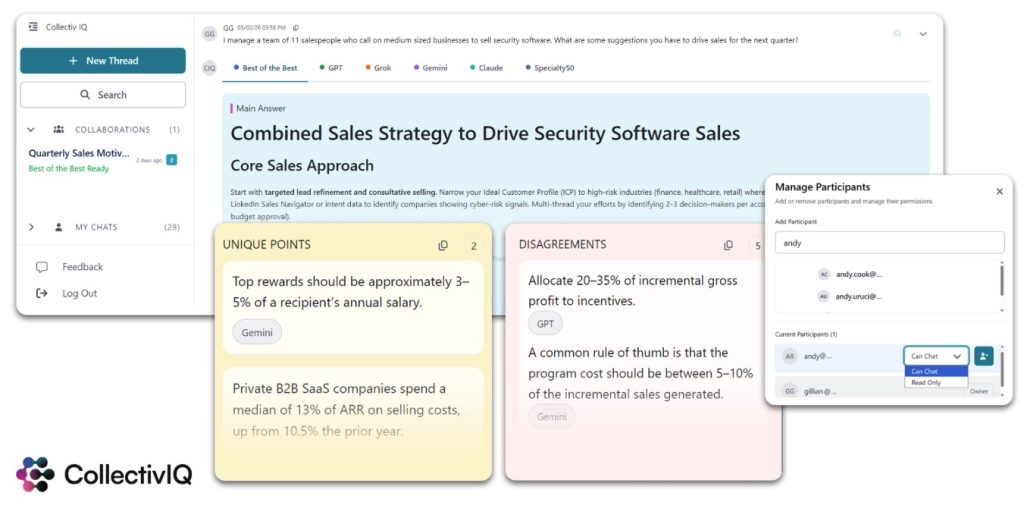
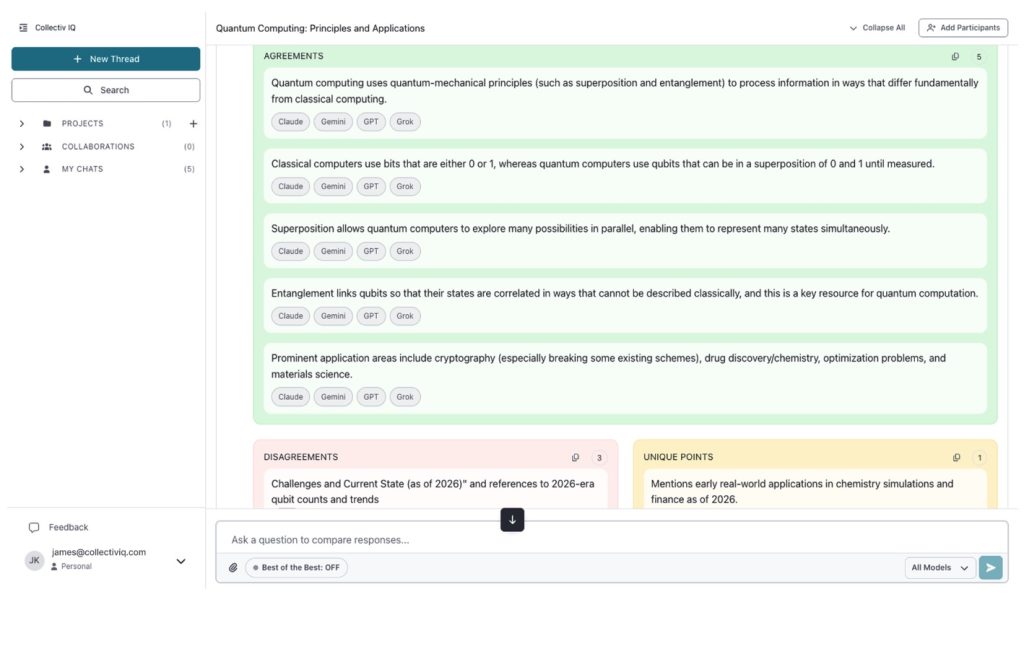
“So instead of betting everything on one model, we built CollectivIQ to bring the leading LLMs together in one place. The platform queries multiple leading models at once, including ChatGPT, Claude, Gemini, Grok, and up to ten others. It then compares where they agree and disagree, synthesizing the best answer into one output informed by consensus. It worked so well for Buyers Edge that we decided to roll it out to the broader market in March of this year.”
“Because CollectivIQ provides the best of what all the LLMs have to offer in one place, companies don’t have to choose between flexibility, trust, cost control, and governance. It’s a direct answer to so many of the challenges slowing down AI adoption across the workplace.”
Favorite Memory
What has been your favorite memory working for the company so far? Davie reflected:
“The first time I put a prompt into CollectivIQ and saw the consensus-based output was a pretty incredible moment. Up until then, the concept made sense in theory. We believed that if you could query multiple LLMs, identify the strongest parts of each answer, and fuse them, you could create something more useful and trustworthy than any single model’s response. But seeing the platform bring back a “best of the best” answer from four different LLMs was the moment it became real, and we knew we had a game-changing solution on our hands.”
Core Products
What are the company’s core products and features? Davie explained:
“CollectivIQ is the first AI consensus platform built for business intelligence. Instead of asking one model for one answer, users can simultaneously query multiple leading LLMs and get back one synthesized, annotated response. The platform shows where the models agree, where they differ, and how the final answer was formed. That transparency is really important for business users who need to make decisions with confidence. Users can also work in shared threads with their colleagues, offering strong collaboration capabilities based on shared context.”
“Ultimately, we’re working toward CollectivIQ becoming the intelligence layer for businesses. We want users to implement it as a centralized platform across the organization, where teams can leverage cutting-edge AI, preserve knowledge, collaborate on outputs, and build a living knowledge base over time.”
Challenges Faced
Have you faced any challenges in your sector of work recently? Davie acknowledged:
“A major technical challenge for us has been making the user experience feel simple, despite how much is going on in the backend of the platform. For example, for retrieval-augmented generation (RAG), we needed CollectivIQ to work across structured and unstructured files and still produce useful, accurate outputs. We’ve also worked on shared threads and projects, which sound straightforward from a user perspective but are complex because you’re combining context, collaboration, permissions, and multiple model outputs in one workflow.”
“We’ve approached those challenges by staying focused on the actual business use case. We built CollectivIQ inside a real operating company, not in a vacuum, so the goal has always been to solve problems teams actually deal with every day. That has been and will continue to be our guiding light.”
Evolution Of The Company’s Technology
How has the company’s technology evolved since launching? Davie noted:
“We’ve been expanding the platform pretty quickly to meet user demand, and we recently announced several enhancements. Now, users can select which LLMs they want to respond to a prompt, or they can use our ‘Best of the Best’ output based on consensus. This offers a greater level of flexibility while still providing oversight and collaboration. We’re now officially multimodal, as we added image generation to the platform.”
“We also introduced integrated payment capture, expanded RAG capabilities so users can query structured and unstructured data from file uploads, file generation, project organization, and a Triager feature that better understands what a user is asking for and routes the request appropriately. And there’s much more to come in the pipeline.”
Significant Milestones
What have been some of the company’s most significant milestones? Davie cited:
“Our first major milestone was proving the technology inside Buyers Edge Platform. CollectivIQ was never meant to be a theoretical project. We built it because we needed a better way to use AI across our large, complex business. That gave us a real-world testing ground from day one.”
“Launching CollectivIQ publicly and introducing the AI consensus category was also a massive milestone. Our goal is to move the conversation away from ‘which single model should I choose?’ and toward ‘how do I make AI outputs more strategic, trusted, transparent, and useful across the business?’”
“Finally, as I shared in the previous question, we just announced our most feature-rich product release to date. Together, the updates make the platform more flexible, collaborative, and practical for day-to-day business use.”
Customer Success Stories
Can you share any specific customer success stories? Davie highlighted:
“One of the strongest examples of CollectivIQ’s impact is within Buyers Edge itself. The platform helps employees access multiple leading models in one place, compare outputs, and work together instead of in isolated chats. CollectivIQ gives everyone on our team access to the models they need without forcing the company into a single vendor or stacking multiple per-seat licenses.”
“We’re seeing similar value with early external users. For example, one customer who works closely with startup founders uses CollectivIQ to pressure-test market sizing, messaging, competitive research, and pitch deck materials. Instead of relying on one model’s answer, they can compare multiple LLMs at once and quickly identify where there’s consensus. That helps them move faster while feeling more confident in the recommendations they’re giving founders.”
Funding/Revenue
Are you able to discuss funding and/or revenue metrics? Davie revealed:
“CollectivIQ is self-funded, which reflects how and why we built it: mobilizing a team that has already scaled an enterprise to address real business needs. We’re still early in the commercial rollout, so we’re not sharing revenue metrics at this stage.”
Total Addressable Market (TAM)
What total addressable market (TAM) size is the company pursuing? Davie assessed:
“The market opportunity is enormous because the problem is not limited to one use case. Every company is trying to figure out how to use AI safely, effectively, and at scale. The early wave of AI adoption was about access, simply giving employees tools and letting them experiment. The next wave is about real business use, meaning trust, governance, collaboration, and cost control are nonnegotiables.”
“We see strong applicability across industries where accuracy and accountability matter, including financial services, healthcare, legal, consulting, corporate strategy, technology, and enterprise environments. Ultimately, if a company is using AI to make business decisions, it needs a way to validate outputs and preserve intelligence across the organization.”
Differentiation From The Competition
What differentiates the company from its competition? Davie affirmed:
“Most AI tools are built around a single-model experience. You ask one model a question and get one answer, with that model’s strengths, weaknesses, and blind spots baked in. Because CollectivIQ queries all the leading models and provides the answer that’s based on consensus, we don’t have to ask companies to bet everything on one LLM.”
“We also offer a ton of flexibility. New models are coming out constantly, and the ‘best’ model for one task may not be the best for another. CollectivIQ lets companies take advantage of the latest and greatest AI capabilities as they become available without switching platforms, retraining employees, or buying separate licenses for every tool.”
“And because we were built inside an enterprise, we’re focused on the issues that actually matter at scale: hallucinations, bias, security, vendor lock-in, collaboration, and cost. The platform is designed to serve as an AI trust layer, helping companies move from experimentation to decision-ready intelligence.”
Future Company Goals
What are some of the company’s future goals? Davie emphasized:
“The big vision is for CollectivIQ to become a shared brain within the organizations that use it. Most companies know their data is valuable. At Buyers Edge, for example, we think a lot about the value of our foodservice transaction data. But over time, I believe the intelligence created by employees can become just as, if not more, valuable than customer data.”
“As we connect internal data sources, meeting notes, and documents, CollectivIQ can become the central intelligence layer across the company. The platform will get smarter over time because it is capturing more context and institutional knowledge.”
“Here’s an example. When a talented employee retires or leaves, a company loses most of their knowledge and insight. But if that person has been using CollectivIQ, leveraging the notetaker to capture their calls and contributing to shared threads and projects, their knowledge can remain accessible when they leave. Instead of saying, “What would Taylor have done?” you can actually ask the platform and benefit from the history of their thinking.”
“Ultimately, these capabilities will turn AI from a tool people use in isolation into a shared intelligence asset for the entire business.”
Additional Thoughts
Any other topics you would like to discuss? Davie concluded:
“As we started building CollectivIQ, we realized that the decision companies make about AI right now will be one of the most important they make for the next decade. If you go all in on one system and your employees don’t like it, or the model isn’t the best fit, or the pricing changes, or other models outgrow its capabilities over time, it’s very difficult to make a change. We saw that firsthand at Buyers Edge.”
“That’s part of why I think the ability to avoid vendor lock-in is so important. Companies shouldn’t have to decide today that they’re all in on one model forever. The AI landscape is changing too quickly. CollectivIQ gives organizations a way to stay flexible, access the best models as they evolve, and keep the intelligence generated by employees inside one governed, collaborative system.”
“Our ultimate goal is to make AI more trustworthy, transparent, and valuable for companies. Choosing the flexibility CollectivIQ offers now increases value today and in the long term.”
