

CoverPin is an AI-powered global entity management and compliance platform that helps companies manage corporate registrations, business licenses, tax filings, governance requirements, and insurance obligations. The company supports compliance operations across more than 80 countries and all 50 U.S. states, serving over 100 customers across industries including technology, healthcare, private equity, and consumer businesses. Its platform combines AI automation with local professional expertise to handle regulatory requirements and administrative tasks, allowing organizations to focus on growth rather than fragmented compliance workflows. Steven Choi, an investor and director of CoverPin, is a Bay Area entrepreneur with experience at Google and Uber and involvement in startups that achieved IPO and acquisition exits. Pulse 2.0 interviewed CoverPin Investor and Director Steven Choi to learn more about the company’s origins, AI-powered compliance infrastructure, international expansion, customer success stories, and its plans to connect compliance management with commercial insurance.
Steven Choi’s Background And Experience

When asked about the team’s background and the experiences that shaped CoverPin, Choi shared:
Our team comes from Meta, Google, Uber, Capital One, EY, and Davis Polk, and it includes product leaders, designers, engineers, lawyers, and accountants. Across those companies, we saw the same thing firsthand: as a company scales, compliance gets messy fast. Every new state, country, entity, or location adds registrations, licenses, filings, director changes, and insurance requirements, and nobody owns it end-to-end.
We had built workflow software before. The tools were good, but the back office kept blocking sales and product launches. A deal waited on a missing license, a launch waited on a new entity, and an enterprise contract waited on proof of insurance. Software that only tracked the work didn’t remove the blockage, because someone still had to do it.
So we built CoverPin to own the outcome, not just manage the workflow, and to make compliance something that speeds growth up instead of slowing it down.
How The Idea For CoverPin Came Together
When asked how the idea for CoverPin originated, Choi explained:
CoverPin started with a simple observation: two very different kinds of companies were struggling with the same problem.
At one end were hyperscaling companies expanding into dozens of jurisdictions, sometimes forming several legal entities in a single month. They had well-funded legal and finance teams, yet their compliance operations were held together by spreadsheets, email threads, and a patchwork of local providers.
We saw companies expand internationally faster than their internal teams could keep up. They could hire hundreds of people, sign multimillion-dollar contracts, and launch in new markets, but changing a director, renewing a business license, or filing an annual report could take weeks. Often, no one had a complete picture of which entities existed, who owned them, or what obligations were coming due.
These companies didn’t lack resources. The infrastructure for managing compliance simply hadn’t kept pace with how fast a business could scale.
At the other end were small and medium-sized businesses, where the contrast was even starker. An owner with two or three entities faced many of the same obligations as a multinational: registered agents, annual filings, tax registrations, licenses, and ongoing governance. But with no legal department or compliance team, they relied on an accountant, an outside attorney, or their own spreadsheets.
The enterprise had the budget but lacked the infrastructure. The small business needed the same infrastructure but couldn’t afford the traditional solution.
That became the foundation for CoverPin. We believed that if we could build compliance infrastructure sophisticated enough to support a company operating in 50 countries with hundreds of entities, we could make the same technology accessible to a founder running one or two businesses.
It’s also why we deliberately started with enterprise problems. Enterprise customers surface the hardest edge cases, from cross-border governance and beneficial ownership reporting to tax obligations, insurance requirements, and local regulatory filings. Solving them forces us to build a system with a much deeper understanding of compliance. Once that infrastructure exists, the marginal cost of serving a smaller company drops dramatically.
We also saw that compliance data is valuable well beyond corporate filings. Commercial insurance, for example, depends on accurate information about legal entities, locations, licenses, and business activities, yet brokers, underwriters, and companies still exchange it manually, creating friction and inconsistencies.
Our vision is to connect these fragmented workflows into a single infrastructure layer where a company’s compliance information is structured, continuously maintained, and actionable.
CoverPin wasn’t built just to replace spreadsheets or make filings cheaper. We built it because the infrastructure that lets a multinational operate globally should be available to a small business owner without requiring an entire legal and finance department.
Technology has made it easier than ever to start and scale a company. We want to make staying compliant just as easy.
Favorite Memories Working At CoverPin
When asked about his favorite memories working with the company, Choi recalled:
Our favorite memory is from our very first “order” customers, because we did everything by hand. A major automaker needed to renew a DMV license, so we went to the dealer and got it done ourselves. Our first retail customer needed a business license renewed, and we did that one manually too. We weren’t building software yet. We were living the customer’s life, and that taught us what to automate and what not to.
One moment stands out. When we went to file at a local city hall, the public secretary pulled out a binder with the city’s license collection list and walked us through it. Seeing it, we realized how much potential there is to digitize both the corporate side and the government side.
The reason compliance is still so slow is that the private sector doesn’t understand how the government handles it. That was the key insight: we have to work backwards from the receiver, not from the filer’s point of view.
The biggest lesson was that nobody wanted to buy a tool that generates workflow. They wanted to not think about it and have it done, start to finish.
That insight is what got us our next 100 customers in the mid-market and enterprise. It also became our mantra: do everything manually before you automate it.
I think that discipline is why our automation across registered agents, annual reports, AGMs, director changes, and license renewals actually works. We only automated what we had already done enough times to understand.
Core Products And Features
When asked about CoverPin’s core products and features, Choi explained:
CoverPin is an AI-driven global entity management and compliance platform that covers companies across 80+ countries and all 50 US states. The core pieces are:
- Registered agent services in all 50 states and internationally, with mail scanning and service-of-process handling.
- Annual reports and franchise tax filings, tracked and filed on time for every entity.
- AGMs and board resolutions: meeting notices, resolutions, minutes, and powers of attorney, including bilingual documents and apostilles for jurisdictions like Japan, Korea, Saudi Arabia (Regional Head Quarters), UAE, Brazil, UK, Germany, and 80 other countries.
- Director and officer automation: appointments, resignations, KYC, and registry updates handled end to-end.
- License and permit management: tracking, applying for, and renewing business licenses and permits by location, including our LicenseIQ product.
- Insurance quoting and tracking: quotes, policies, and renewals tracked in the same system as the entities and locations they cover.
- Automatic document collection: we gather the formation documents, certificates, and registry records that filings depend on, so customers stop chasing them.
- Tax and statutory compliance coordination across the US and international jurisdictions, with Auto-Tax & Entity Org Chart generations.
Challenges In International Compliance
When asked about the challenges of managing compliance requirements across different countries and how CoverPin addresses them, Choi explained:
International compliance is the hardest part: every country has its own registry, language, and notarization or apostille rules. A US-notarized document that works in one country gets rejected in another because of the format.
Local requirements also change often, such as director KYC in India, SIRET and payroll registration in France, or tax agent requirements in Mexico. We solved this by building country-specific playbooks and templates into the platform, so each rejection teaches the system and the next filing goes through.
Humans review the edge cases and AI does the repetitive work.
For the countries, counties, and municipalities where a filing still needs a person on the ground, we built a network of lawyers, accountants, and ALSP partners who operate as runners.
Our Agentic tool generates the documents, then they feed our platform and fulfill the gaps that require in-person, human connection points.
How CoverPin’s Technology Has Evolved
When asked how the company’s technology has evolved since launching, Choi explained:
We started by doing the work manually, then automated only what we fully understood. That began with the highest-volume tasks like annual reports, agent notices, and deadline tracking.
Today AI extracts data from formation documents, registry filings, and certificates, drafts resolutions and POAs, and flags risk before deadlines.
Our goal is to build an Amazon- and Uber-like experience for compliance: click to fulfill, then set and forget. A customer shouldn’t have to learn the process. They tell us what they need, we do it, and we keep it current.
That’s the “services-as-software” model: customers buy outcomes, such as every subsidiary staying compliant, not a pile of workflows.
Significant Company Milestones
When asked about CoverPin’s most significant milestones, Choi highlighted customer growth, international expansion, and its professional services partnerships:
- 100+ customers, mostly enterprise and mid-market, across tech, healthcare, private equity, and consumer industries.
- Manage compliance across 80+ countries and all 50 US states, with some customers spanning 60+ jurisdictions on their own.
- Built a partner channel with law firms and accounting firms. They use CoverPin to surface their clients’ compliance gaps, which lets them cross-sell and capture more revenue while we handle the fulfillment.
- Built out multi-country operations in the US, Japan, India, UAE, UK, Mexico, Ireland, France, and Brazil.
Customer Success Stories
When asked about customer success stories demonstrating CoverPin’s impact, Choi shared:
One example is a global security software company with more than 60 entities across five continents. They had been paying a legacy provider and still couldn’t see which entities were out of compliance.
We moved them onto CoverPin, consolidated their entity data and POAs, and cleaned up legacy dissolutions. They saved over 50% of the time it took to complete the work, with 40% cost savings compared to their legacy provider.
Another example involved a rapidly scaling company that had spent nine months trying to establish subsidiaries in India, Brazil, and Germany without success. The delays were putting a multimillion-dollar customer opportunity at risk because the company couldn’t legally begin operations in those markets.
Within just 30 days, we helped them accomplish what had been stalled for nine months. We coordinated everything from incorporation and director KYC to post-incorporation compliance and bank account opening, removing the administrative and regulatory bottlenecks preventing them from becoming operational.
What made this particularly meaningful was that compliance wasn’t simply an administrative burden. It had become a direct barrier to revenue. By accelerating their market entry, we helped turn a stalled expansion into a viable multimillion-dollar business opportunity.
Funding And Revenue Metrics
When asked about CoverPin’s financial performance and revenue model, Choi explained:
We’re profitable, and we benchmark ourselves against companies like Surge AI or Mailchimp that grew efficiently.
We track two kinds of revenue: recurring compliance revenue, and platform-adjacent revenue that comes from the same customer relationship.
The model is similar to how Rippling and Workday grow: the core product gets us in the door, and the adjacent products multiply revenue per customer.
For every $1 we generate on compliance, we see 3 to 4x that on insurance revenue. Over 50% of our customers came through referrals.
Total Addressable Market
When asked about the total addressable market CoverPin is pursuing, Choi described opportunities across legal technology, professional services, and insurance:
We start in legal and compliance, which is the entry point, and the much larger opportunity is the insurance market that compliance data unlocks.
The chart below shows the scale of each on a log axis, because the numbers are too far apart for a normal chart.
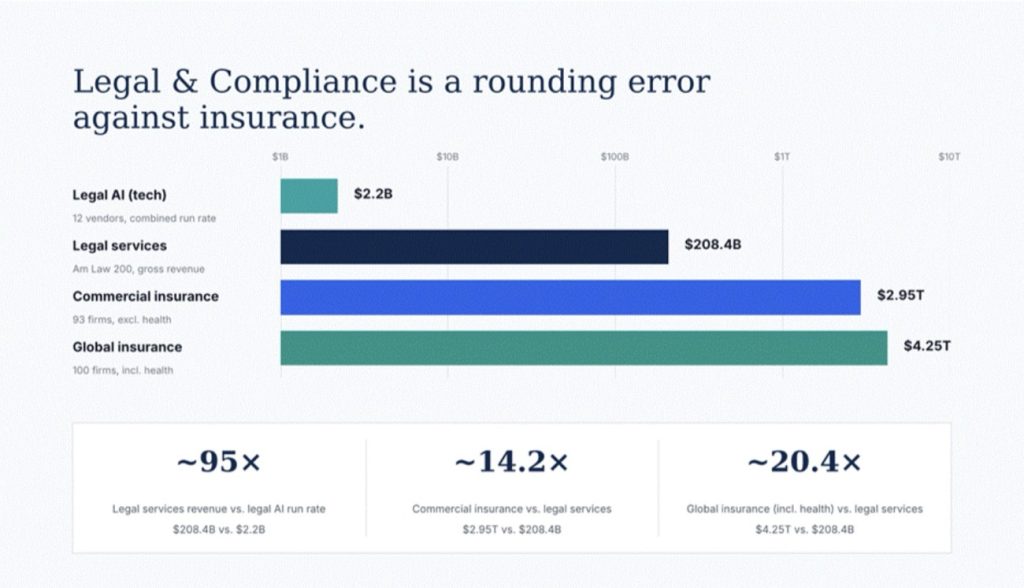
Legal AI / tech companies have a combined run rate of about $2.2B across the top 12 vendors. Legal services, measured by Am Law 200 gross revenue, is about $208.4B, roughly 95x larger.
Commercial insurance is about $2.95T, roughly 14x larger than legal services, and global insurance including health is about $4.25T, roughly 20x larger.
To put it another way, Clio and Harvey’s combined run rate is smaller than what a single mid-sized commercial insurer like CNA Financial does in a year.
That is why we built insurance quoting and tracking into the same platform as entities, licenses, and filings. Compliance gives us the verified data on every entity, location, and license, and that is exactly what brokers and underwriters need to price risk.
What Differentiates CoverPin From Its Competition
When asked what distinguishes CoverPin from traditional compliance software and service providers, Choi identified several factors:
- We do the work, not just give you a tool. We learned by doing every filing manually first, and customers want the outcome, not a workflow generator.
- AI-native, not software layered on a services business, so our cost to serve is lower, and pricing is more transparent.
- True international coverage with local expertise, including bilingual documents and apostille handling.
- One platform covering entities, directors, licenses, insurance, and locations, not separate tools.
- Speed: filings and director changes done in days, not weeks.
- Data quality: we don’t let our customers do data entry. We update records automatically from registries and source documents, and we invest heavily in data labeling and review, because AI quality is the moat in compliance.
- MCP connection: customers can connect CoverPin to their own LLM tools and run reports on their entities, licenses, and filings in plain language.
Future Company Goals
When asked about CoverPin’s future goals, Choi outlined plans to expand its compliance technology and further integrate commercial insurance capabilities:
Become the default system of record for global entity and license compliance and displace the legacy incumbents.
We want to expand country coverage, deepen tax and filing automation, and automate director and officer changes end-to-end.
Longer term, we expect compliance platforms to consolidate, the way payroll and benefits did with Gusto, Rippling, ADP and Workday, and we intend to be the consolidator in our category.
We also want to de-risk companies to the minimum, so that we can help every company lower its insurance premium.
The Broader Role Of Compliance Data In Business Growth
When asked whether there were any additional topics he wanted to discuss, Choi emphasized how compliance data can provide insight into business activity and expansion plans:
Compliance is boring, but it is the best indicator of where companies are expanding, contracting, or placing bets.
A new entity, a new license, or a new director in a country shows what a company is about to do long before it shows up in earnings.
In that sense, compliance is the metric for how a business will perform in two to three years.
AI hurts when it’s wrong in legal and compliance, so we keep humans in the loop on judgment calls and use AI for the heavy lifting.
Also, a missed annual report or AGM can mean a lapsed registered agent, penalties, or a company losing good standing, and most executives don’t realize this until it happens.
One of the biggest advantages of compliance is that much of the regulatory information is already publicly available, and many corporate filings become part of the public record once submitted.
The real opportunity isn’t creating new data, but structuring, connecting, and making existing information actionable.
