Demoboost is an all-in-one demo automation platform that allows B2B tech and software companies to create, personalize, and track interactive product demos for their sales processes. Pulse 2.0 interviewed Demoboost CEO Anna Decroix to learn more.
Anna Decroix’s Background
Could you tell me more about your background? Decroix said:
I’m Polish, married to a Frenchman, and living in Australia — so diversity has always been built into my life. I was born in Poland but was always drawn to international experiences. I never actually worked in Poland early in my career — my first role was in Germany, then France, and eventually Australia, which has been home for many years now. Working across cultures shaped how I lead, communicate, and build teams.
Professionally, I started in FMCG marketing, building brands and managing P&Ls in large organizations. Over time, I moved into more complex categories — particularly consumer tech at Dyson, where I was CMO for Australia and New Zealand. That’s where I really developed a passion for innovation and technology.
While at Dyson, I began mentoring startups — and that gradually pulled me into the tech world full time. Co-founding a B2B SaaS company was, in a way, also a return to my roots. For the first time, I was building something with a Polish company — albeit from Australia.
It felt like everything came together: global experience, commercial leadership, and reconnecting with where I started. And I haven’t looked back since. I love building, scaling, and turning vision into execution.
Formation Of The Company

How did the idea for the company come together? Decroix shared:
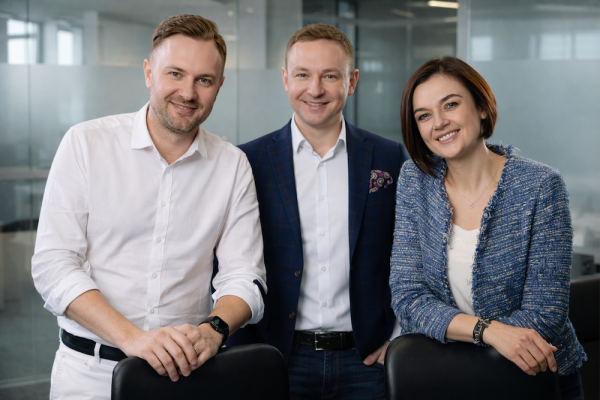
The idea came together quite organically. Through my Polish network and startup mentoring work, Piotr, Igor, and Kamil reached out while they were building Demoboost. They had deep product and sales experience but lacked strong go-to-market leadership. What started as mentoring and consulting quickly became something much bigger.
We all understood the demo problem very intimately, just from different angles. Piotr & Igor had lived it as sales leaders; Kamil came from a tech and partner background; and I had seen it from the buyer’s perspective — especially during my time at Dyson, where I drove digital transformation and saw how critical product experience is in complex buying decisions.
We realized that demos were a major bottleneck to software selling and buying. They were too manual, too expensive to produce, not scalable, and not accessible for the buyers when and where they wanted them.
The insight was simple but powerful: if the demo is the strongest lever in B2B sales, why isn’t it structured, scalable, and measurable?
Each of us brought something different to the table — product depth, sales reality, and commercial strategy. The collaboration worked so naturally that before I knew it, I had stepped away from my corporate career to build Demoboost full-time.
Favorite Memory
What has been your favorite memory working for the company so far? Decroix reflected:
There are so many moments that it’s honestly hard to choose just one. If I go back to the very beginning, one of my favorite memories is from the early conversations with my co-founders. Before anything was formal, we were having these almost “book club” style discussions about leadership — talking about Principles by Ray Dalio and Everybody’s Culture by Robert Kegan.
I remember thinking: these are the kind of people I want to build with long-term. People who care not just about product and revenue, but about principles, culture, and how we show up as leaders. That was probably the moment I realized this could be something bigger.
Then there’s the team. I have never worked with a group of more motivated, self-starting, curious, and genuinely hard-working people. The number of spontaneous emails or LinkedIn messages I’ve received from clients praising the team’s support and professionalism makes me incredibly proud.
What I love most is how much they support each other. Seeing the team grow stronger together — that’s one of the best feelings as a founder.
And finally, the presales community.
This has been something completely new for me. I’ve built so many meaningful relationships through LinkedIn and video calls — people who are generous with their time, insights, and feedback. It truly feels like we’re building this platform for real people we know by name, not some abstract market segment.
That makes the work deeply personal — and very special.
Core Products

What are the company’s core products and features? Decroix explained:
We’ve built a demo automation platform. At its core, it allows companies to clone the front end of their product into our cloud environment and then edit it using no-code tools. That means teams can create structured, interactive product demos without needing engineering support or relying on live systems.
Once the demo is built, it’s not just a static asset. Teams can share it across the buying journey — in outbound, follow-ups, digital sales rooms, partner enablement, onboarding, and live interactions with buyers — all while tracking how viewers engage with it.
So it becomes more than a demo. It becomes a scalable, repeatable, and measurable product experience. That’s the top-line view.
Underneath that, there’s a lot more: advanced personalization, AI-supported creation and editing, structured demo libraries, digital sales rooms, engagement analytics, and integrations into revenue workflows. But fundamentally, we help revenue teams turn product demos into a revenue engine.
Challenges Faced
Have you faced any challenges in your sector of work recently? Decroix acknowledged:
Yes — the rapid acceleration of AI in the market created an important moment for us.
When we were speaking with investors, there was a natural question: with AI evolving so quickly, does demo automation become obsolete — or does it become even more critical? It was a fair question. And instead of debating it theoretically, we did what we know best — we executed.
We kept acquiring clients. Interestingly, AI companies became one of the most overrepresented segments in our new business. For them, demo stability and predictability are even more critical. When your product output can change dynamically, simulating structured product experiences becomes more valuable, not less.
At the same time, we leaned into AI ourselves — embedding AI-driven editing, personalization, and automation into the platform. So rather than competing with AI, we integrated it as an amplifier of demo performance. The market response spoke for itself. Strong customer growth, especially from AI-native companies, reinforced that structured, measurable product experiences are not replaced by AI — they become more important in an AI-driven world. That gave everyone confidence in the direction we’re building.
Evolution Of The Company’s Technology
How has the company’s technology evolved since launching? Decroix noted:
Massively. We’re actually retiring version 1.0 of the platform at the end of this year because last year we released a completely new engine. That gives you a sense of how much the product has evolved in a short period of time.
In the beginning, it was simple: capture, edit and share, plus very basic analytics. Since then, every layer of the platform has matured. We’ve expanded demo formats. We launched an add-on gallery, built a full AI suite into the editing and personalization workflow, and evolved analytics into a true revenue intelligence layer. We also strengthened enterprise readiness and deepened integrations with sales and marketing tools. And finally, we built out a professional services arm to help clients design and perfect high-impact demos.
It’s incredible how much has changed in just a few years. What hasn’t changed is our philosophy: demo creation should be as easy as possible. We constantly optimise for ease of use and speed to value. In fact, our goal is zero time to value — many clients have their first demo ready before they even formally sign.
And honestly, the roadmap ahead is even more exciting. We’re just getting started on the next chapter.
Significant Milestones
What have been some of the company’s most significant milestones? Decroix cited:
When I think about our journey, I see it in distinct phases.
Phase one was bootstrapping. We built an MVP and started selling with a very basic version of the tool. It wasn’t perfect, but it proved something critical: there was a real, tangible need for a better way to deliver product demos. The demand was there.
Phase two started with our first funding round. At that point, we made a deliberate shift toward defining true product–market fit. We were initially selling to anyone who saw value in demo automation, but we became much more analytical. We looked at product usage, satisfaction, retention, and expansion potential. After about a year to a year and a half, the pattern became clear: our strongest traction was with sales and presales teams. Around 2024, we doubled down on that persona. We won several key clients, refined our playbooks, and sharpened our positioning specifically around revenue teams.
Phase three was all about scaling with conviction. We went deep — through daily conversations, analyzing usage data, listening to calls, and collecting feedback. That focus translated into 300% growth over the past years. That growth became a major milestone in itself. It signaled to investors that we weren’t experimenting anymore — we had identified what works. And now it’s about scaling that motion globally.
Each phase built on the previous one — from proving demand, to defining focus to accelerating growth. And we’re now entering the next chapter: demo-led revenue.
Customer Success Stories
Can you share any specific customer success stories? Decroix highlighted:
A great example is AMCS Group, a global enterprise software provider in the environmental and waste management industry. They’re now entering their third year with Demoboost, and what started as a demo tool became embedded across teams and geographies.
Presales were freed from repetitive intro demos and could focus on high-value conversations. Sales gained consistent, structured product experiences across regions. And global expansion became easier because proven demo assets could be reused and scaled rather than rebuilt locally. What’s powerful is that Demoboost didn’t stay a “solution for presales.” It became part of their revenue infrastructure.
Boot.ai is another example. They pushed us to rethink what’s possible when it comes to demoing voice AI. They were preparing for a major event and wanted to showcase their highly advanced voice capabilities, but in a controlled, powerful way.
They challenged us to build an advanced voice demo experience — something we hadn’t done before. It pushed our team technically and creatively. The result was incredible: a structured, stable demo of complex AI voice interactions that allowed them to confidently present cutting-edge capabilities in the purpose-built demo booths. It was one of those moments where a customer challenge expands your product boundaries.
Another great example is ELMO Software. What I admire about their team is their dedication to embedding demos across the entire revenue process. They started by enabling their SMB sales teams to run demos independently, reducing reliance on presales for early-stage conversations. Very quickly, those same demo assets were adopted by account management to drive expansion and upsell. Then marketing integrated them into campaigns, driving phenomenal engagement and conversion. From there, they were rolled out across channel partners and global teams.
It’s incredibly exciting to see a client not just use demos tactically, but turn them into a cross-functional growth engine. All stories show different sides of the same thing: when demos are structured and scalable, they unlock far more value than just a single sales meeting.
Total Addressable Market (TAM)
What total addressable market (TAM) size is the company pursuing? Decroix assessed:
The total addressable market is significant because any B2B software company needs to demo its product.
We focus specifically on mid-market and enterprise software businesses with established sales processes. Globally, that represents roughly 12,000 companies. At our current average contract value, that translates into a market opportunity of around $300–400 million annually — and closer to $1 billion as we expand further into revenue intelligence and AI-driven capabilities.
So while demo automation is the entry point, the broader opportunity around structured, measurable product experiences is much larger.
Differentiation From The Competition
What differentiates the company from its competition? Decroix affirmed:
What differentiates us is completeness. We are the most comprehensive demo automation platform on the market. We offer six different demo formats — from lightweight interactive tours to advanced simulations and live overlays — allowing revenue teams to match the demo experience to every stage of the funnel and to different buyer preferences.
Early-stage education looks different from late-stage technical validation. We support both in a single ecosystem. Because all demo formats are hosted within a single platform, we can capture engagement data across every interaction, not just one isolated demo. That gives revenue teams an unprecedented level of insight into how prospects explore the product. This unified data layer becomes the foundation for what we call demo-led revenue intelligence, turning product interaction into measurable buying signals.
In short: we’re not just a demo tool. We’re building the infrastructure around how product experiences drive revenue.
Future Company Goals
What are some of the company’s future goals? Decroix concluded:
Our number one goal is product acceleration. Through very close relationships with our clients, we’ve developed a clear vision and roadmap. Now the focus is on executing that vision faster, especially around AI capabilities, deeper analytics, and expanding our revenue intelligence layer.
At the same time, growth can never come at the expense of customer satisfaction. We’ve built the company on going above and beyond for our clients — and as we scale, maintaining that level of care and responsiveness is non-negotiable.
And finally, culture. We’ve built an incredibly strong, motivated, and collaborative team. As we grow and bring in new talent globally, protecting and nurturing that culture is just as important as product or revenue milestones.
In short: accelerate innovation, scale responsibly, and preserve the culture that got us here.

