

Dronus is developing autonomous aerial infrastructure that combines drones, its NEST docking and operational nodes, software, and AI into distributed networks for industrial inspection, energy infrastructure, warehouses, security, and smart-city applications. The company was founded by aerospace engineer Marco Ballerini, who previously held senior roles at Northrop Grumman and Selex ES and earlier founded the Unmanned Technology Research Institute. Pulse 2.0 interviewed Dronus Founder and CEO Marco Ballerini to learn more about autonomous aerial systems, NEST, industrial applications, and the company’s plans for commercialization.
Marco Ballerini’s Background

When asked about his background, Ballerini shared:
My professional journey has always been driven by a strong fascination with aerospace, advanced technologies and complex systems.
I trained as an aerospace engineer and have spent more than 20 years working across aerospace operations, unmanned aerial systems and advanced technologies.
During my career, I held senior roles at companies such as Northrop Grumman and Selex ES, where I worked on business development, technology roadmaps and high-tech UAS programs.
Those experiences were extremely formative because they taught me that innovation is not only about developing advanced technology, but about making it work reliably, safely and at scale in real operational environments.
Over time, I became increasingly interested in the gap between technological potential and practical deployment.
That is what eventually led me to an entrepreneurial path and, ultimately, to founding Dronus: bringing together my aerospace and industrial background with the vision of moving beyond traditional drone operations toward a new model of autonomous aerial presence at scale.
How Dronus Started
When asked how the idea for the company came together, Ballerini explained:
The idea did not come all at once.
It was the result of a journey that started very early, in 2003, when drones were not yet a mainstream technology and the word “drone” was not even widely used in Europe.
At that time, I founded UTRI, Unmanned Technology Research Institute, which was one of my first entrepreneurial experiences in the unmanned systems sector and was later sold to the Finmeccanica Group, now Leonardo.
The initial intuition was actually quite simple: I wanted to create a flying object equipped with a camera that could be used in a trade show environment to interact with visitors and capture images from above.
But very quickly I realized that the same technology could have much broader applications, especially in surveillance, defense and security.
That early experience was important because it helped me understand that unmanned aerial systems were not just an interesting technology or a spectacular object to show.
They could become operational tools with real strategic value.
Over time, this vision evolved into a broader ambition: to make aerial operations more autonomous, reliable and scalable.
That is the path that eventually led to Dronus.
Favorite Memory
When asked about his favorite memory working for the company so far, Ballerini said:
One of my favorite memories is actually a very simple, almost funny moment that later became important in the history of the company.
I was on a call with my co-founder Riccardo, who was working from another location, and I asked him to take one of the small drones we were using for testing, place it under a table, push the throttle, and see what happened.
At first, he laughed because he did not fully understand why I was asking him to do it.
But he tried. And the drone remained stable.
For me, that was a small but decisive moment.
It confirmed an intuition: an aerial system could be designed not just as a flying device, but as part of a fixed infrastructure.
That simple test became one of the starting points behind NEST, which is now the core node of our system and one of the most important elements of Dronus.
I like that memory because every company has moments like this, small, unexpected experiments that later become part of its story.
Core Products And Features

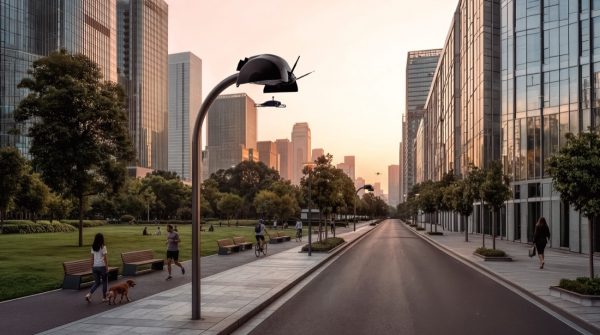
When asked about Dronus’ core products and features, Ballerini detailed:
Our core product is not a single drone, but an autonomous aerial infrastructure.
At the center of this infrastructure is NEST, our docking and operational node.
Around it, we deploy drones with specific capabilities, depending on the use case, and a software layer that allows users to access data remotely, manage missions and receive AI-processed information in a clear and scalable way.
The goal is to give organizations an aerial network that can operate across different points of a facility, a warehouse, an industrial site, a public area or a smart city.
A drone can take off from one NEST, perform a mission, connect to another node and provide images, video or sensor data that are then processed and made useful for the end user.
The applications vary according to the customer’s needs.
In industrial environments, our drones can support inspections and detect fugitive gas emissions around valves and infrastructure.
In warehouses, they can help with inventory and parcel counting.
In security and public-area monitoring, they can perform short- and long-range inspection or surveillance missions.
So the real feature is not just flight.
It is the ability to create a distributed, autonomous and intelligent aerial system that turns drone operations into a continuous source of operational data.
Building A Deep-Tech Company
When asked about recent challenges in the sector and how Dronus has addressed them, Ballerini explained:
Yes, we have faced several challenges.
The sector we operate in is very exciting, but also highly competitive, fast-moving and capital-intensive.
Many companies are entering the drone and autonomous systems market, but turning a strong idea into a reliable, scalable technology that works in real environments is a much bigger challenge.
For us, the first priority was to avoid being just another drone company.
We needed a clear differentiation, so we focused on building an autonomous aerial infrastructure: NEST nodes, specialized drones, software and AI working together as one system.
Another challenge has been growing this kind of deep-tech company from Italy, where capital is available but often more gradual compared to other markets.
This has required discipline, focus and a careful use of resources.
We overcame these challenges by staying very focused on real use cases, strengthening our technology step by step and building relationships with the right investors and industrial partners.
Now our next challenge is acceleration: using the investments we have received to scale faster and bring our infrastructure more strongly to the market.
How The Technology Has Evolved
When asked how Dronus’ technology has evolved since launching, Ballerini said:
Our technology did not start from zero.
When we launched Dronus, the founding team already had many years of experience in drones, unmanned systems and aerospace technologies, so the first prototypes were built on a strong technical foundation.
Since then, the main evolution has been the transition from advanced prototypes to a much more mature and integrated system: drones, NEST nodes, software and AI working together as an autonomous aerial infrastructure.
At the same time, this is a deep-tech and hardware-intensive journey.
Bringing an autonomous system close to a pre-series and industrialization stage requires time, testing and capital.
Growing with progressive funding has made us very disciplined, but it has also slowed down some development steps.
Today, we are no longer in the initial prototype phase.
The priority is to accelerate product maturity, complete the transition toward industrialization and prepare the company for a stronger commercial rollout.
Key Company Milestones
When asked about some of Dronus’ most significant milestones, Ballerini highlighted:
Some of our most significant milestones have been technological, financial and industrial.
The first was the patent behind NEST, which has been granted and validated across key international markets, including Europe, the United States, China, Japan, India, Singapore and the UAE.
This gave us a strong foundation to protect the core technology behind our infrastructure.
Another important step was the arrival of our first external investors only a couple of years after the company was founded.
More recently, a larger funding round has given us the opportunity to accelerate technology development and move closer to industrialization.
On the industrial side, working with major players such as Eni has been a key validation of our technology, especially for applications such as fugitive gas detection and infrastructure monitoring.
The agreement with Qualcomm was also very important, as it increased our visibility in the U.S. technology ecosystem.
Finally, winning a government-backed project in Singapore to test our system in a smart-city context confirmed that our technology has international relevance and can address real operational needs in different markets.
Customer Validation
When asked to share specific customer success stories, Ballerini explained:
At this stage, I would describe them more as customer validation stories than traditional commercial success cases.
One important example is Singapore, where we have been working for more than a year on a government-backed smart-city project.
It has allowed us to test our system in a complex and highly visible environment, with very valuable feedback from the customer.
For us, it is an important success because it confirms the relevance of our infrastructure in an international context and opens a meaningful perspective in the Asian market.
Another key example is the energy sector, where we have developed a drone for fugitive gas detection around valves and industrial infrastructure, including sensitive ATEX-certified environments.
Testing this solution with a major player such as Eni is a strong validation, because it addresses a very concrete need: making inspections safer, more efficient and more scalable.
These are important stories for us because they are based on real operational needs, not theoretical use cases.
Funding
When asked about funding and revenue metrics, Ballerini revealed:
We can discuss funding at a high level.
Dronus recently completed a €15 million funding round, which represents an important step for the company.
This capital is helping us refine key technological components, strengthen the team and move closer to pre-series maturity.
For a deep-tech and hardware company like ours, this phase is essential to reduce technology and industrialization risk before moving toward broader production and commercial adoption.
In terms of revenue metrics, we are not yet at the stage where mature commercial revenues are the main indicator.
Today, our focus is on technology validation, industrial partnerships and real-world use cases.
Looking ahead, we are preparing for a new funding round to support the next phase: completing industrialization, strengthening the product and bringing autonomous aerial infrastructure closer to market readiness.
Total Addressable Market
When asked about the total addressable market Dronus is pursuing, Ballerini explained:
The total addressable market is not easy to define with a single number, because part of what we are building belongs to an emerging category: autonomous aerial infrastructure.
There are already significant opportunities in drone-in-a-box systems, docking stations, industrial inspection, security, warehouse automation and smart-city applications.
However, our view is that the opportunity is broader, because many organizations have not yet fully adopted the idea of a distributed autonomous aerial network.
Our focus is on the segments where the need is already clear: energy infrastructure, industrial monitoring, warehouses, public-area security and smart-city operations.
As our technology moves toward industrialization and pre-series maturity, even a small share of these markets would represent a very meaningful opportunity for Dronus.
Competitive Differentiation
When asked what differentiates Dronus from its competition, Ballerini said:
What differentiates Dronus is that we are not simply building drones, but an autonomous aerial infrastructure.
At the core of this infrastructure is NEST, our elevated docking node.
Unlike traditional ground-based docking stations, NEST can be installed on existing vertical structures such as poles, walls, towers or urban and industrial infrastructure.
This makes it lighter, less invasive and easier to deploy in complex environments.
The result is a distributed aerial network where multiple NEST nodes, specialized drones, software and AI work together to support inspection, monitoring and security operations.
So our main differentiation is the architecture: a scalable and autonomous aerial infrastructure designed to fit into real cities, industrial sites and critical environments.
Future Goals
When discussing Dronus’ future goals, Ballerini explained:
Our main goal for the near future is to complete the transition toward pre-series maturity and industrialization, so that our technology can move from advanced development to a more scalable product phase.
At the same time, we want to strengthen our presence in the markets where autonomous aerial infrastructure can create the greatest value: smart cities, energy infrastructure, industrial sites, warehouses and security applications.
International growth is also a key priority, especially in Europe, Singapore and, in the mid term, the United States.
To support this next phase, we are preparing for a new funding round and looking for investors who understand the potential of autonomous aerial infrastructure.
The objective is to accelerate product maturity, support industrialization and prepare Dronus for a stronger commercial rollout.
Funding European Deep-Tech
When invited to discuss another topic, Ballerini concluded:
One topic I would highlight is the importance of funding for European deep-tech companies.
In our sector, having a strong idea and a differentiated technology is essential, but it is not enough.
To compete globally, especially with players from the United States and Asia, companies also need the financial resources to bring complex technologies to a high level of maturity.
For Dronus, the next objective is to move the system toward TRL 8/9, complete the transition to pre-series and industrialization, and prepare the technology for real market adoption.
This is why we are preparing for a new funding round.
We are looking for investors who understand that autonomous aerial infrastructure is not just another drone application, but a new category with international potential.
Our ambition is global, and the next phase is about having the right capital and partners to accelerate that vision.
