

eAgronom is a climate-tech platform that helps farmers and agri businesses manage regenerative farming practices while generating and monetizing high-quality carbon credits. Pulse 2.0 interviewed eAgronom co-founder and CEO Robin Saluoks to gain a deeper understanding of the company.
Robin Saluoks’ Background
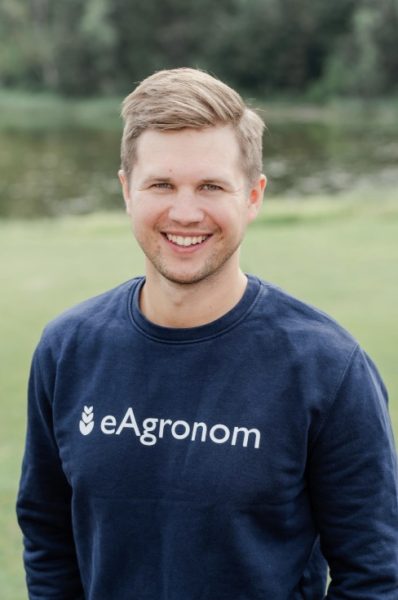
Screenshot
Could you tell me more about your background? Saluoks said:
“I come from a farming family that goes back at least five generations in South Estonia. My father manages a 1,400-hectare organic grain farm, and my grandfather runs a similar-sized conventional farm, so agriculture has always been a significant part of my life. At the same time, I was drawn to technology and entrepreneurship early on. I founded my first company at 17, a science-education business that still operates today.”
“That experience made me realise how fulfilling it is to build something useful from scratch. I later studied computer science, so I’ve always had one foot in the field and the other in the code. Those two worlds finally came together at eAgronom, where we build tools that help farmers manage their farms, report to governments, track GHG emissions, and earn extra income by storing carbon in their soil. Today, 3,500 farmers use eAgronom to manage over 2.5 million hectares – that’s more than twice the total farmland in my home country, Estonia.”
Formation Of The Company
How did the idea for the company come together? Saluoks shared:
“The beginning of eAgronom was quite accidental. My father’s computer broke, and most of his farm operations depended on software that was connected to it. Moving everything to a new system was painfully complicated. I was studying computer science at the time, so I built him a simple cloud-based tool to replace the spreadsheets and desktop software he was using. Other farmers heard about it and wanted to use it as well, and just like that eAgronom was born.”
Favorite Memory
What has been your favorite memory working for the company so far? Saluoks reflected:
“One of my favourite moments was when my co-founder, Kristjan Luha, a former Nike VP and ultramarathon runner, joined the company. We met by chance while traveling and became friends, and it quickly became clear that we shared the same values and drive. When he came on board, his experience and wisdom had a huge impact on the direction of the business and on the culture we’ve built. It was a turning point for eAgronom.”
Core Products
What are the company’s core products and features? Saluoks explained:
“eAgronom combines farm management software with a comprehensive climate program. Farmers use our tools to plan and manage operations, stay compliant with government reporting, measure greenhouse gas emissions, and improve soil health. A major part of our offering is our soil-carbon program, which helps farmers adopt regenerative practices and generate certified carbon credits. The platform also connects software, AI, and remote sensing, giving farmers a single system to run both their business and their sustainability strategy.”
Challenges Faced
Have you faced any challenges in your sector recently? Saluoks acknowledged:
“A big part of our work happens inside the eAgronom Carbon Program, which now covers roughly half of the 2.5 million hectares managed through our platform. To show that farmers are genuinely increasing the amount of carbon stored in their soil, we need high-quality data, detailed records of what happens on the field, strong soil-carbon models, and real soil samples. Collecting that level of data across so many farms is one of the hardest challenges in the sector. We’re talking about millions of data points every year. That’s why we’re investing into automating the whole process. Our goal is that farmers shouldn’t have to enter anything manually or spend time reporting. The system should collect what it needs fully automatically.”
Evolution Of The Company’s Technology
How has the company’s technology evolved since launching? Saluoks noted:
“The first version of eAgronom was a straightforward farm management tool. Today, it has evolved into one of Europe’s leading agri-climate tech platforms. Our tools now cover 2.5 million hectares across 13 countries. Half of the farmers on our platform now participate in our carbon program, which requires advanced measurement, verification, and automation tools that didn’t exist when we started. We’ve gone from helping farmers organise their operations to helping them generate new revenue streams and comply with rapidly emerging climate-reporting requirements.”
Significant Milestones
What have been some of the company’s most significant milestones? Saluoks cited:
“Our most meaningful milestones are the ones that show real progress for real people. Reaching thousands of farmers who rely on our platform because it genuinely makes their lives easier. Another major step has been moving to verified carbon credits, giving farmers a new source of income. And of course, bringing on strong partners like Swedbank and Mondelēz has helped us accelerate the mission. These moments show that when innovation meets purpose, we can move entire sectors forward.”
Customer Success Stories
Can you share any specific customer success stories? Saluoks highlighted:
“One farmer explained that after switching to our newest technology, he reached the end of the season and didn’t have to reconstruct months of field records. Instead, he logged in and saw complete, reliable data ready for analysis. No backlog, no stress, just useful information. That’s the power of automation improving real productivity.”
Funding/Revenue
Are you able to discuss funding and/or revenue metrics? Saluoks revealed:
“To date, we’ve raised around €20 million, including a €10.7 million Series A round led by Swedbank AB. We are now preparing a Series B round in the €15–20 million range, which we expect to be the last round unless we pursue acquisitions.”
Total Addressable Market (TAM)
What total addressable market (TAM) size is the company pursuing? Saluoks assessed:
“Europe is entering the era of climate pragmatism, where you can’t ignore climate reality, but you also can’t ignore the economic reality of tight budgets. High-integrity agricultural carbon credits sit right at that intersection. That’s precisely why the TAM for high-integrity removals is set to grow. The EU needs hundreds of millions of tonnes of removals annually, but it can’t afford to pay €100+ per tonne for engineered solutions. Soil carbon offers a practical, cost-effective path, and the systems that measure and certify it accurately will represent a multi-billion-euro market. That’s the opportunity we’re addressing.”
Differentiation From The Competition
What differentiates the company from its competition? Saluoks affirmed:
“Most companies in agriculture build tools that ask farmers to do more. We do the opposite. We remove work. We take the complexity of sustainability, data collection, carbon programs – all of it – and make it simple, almost invisible. While others focus on software or hardware or carbon, we focus on the experience. A farmer shouldn’t have to think about technology; it should just happen. That’s what eAgronom software does. It just works. And because we make it effortless for farmers, we generate the most accurate agricultural data in the industry – data the whole world can trust. That’s something no one else has.”
Future Company Goals
What are some of the company’s future goals? Saluoks concluded:
One of our main goals is to fully automate on-farm data collection so that farmers don’t need to use a computer, or even our mobile app, to report anything. Everything should happen in the background, and it should actually improve the accuracy and detail of the data, not weaken it. Many companies compromise between data quality and the farmer’s workload; we don’t want to make that trade-off. Getting automation right is the foundation for everything else we’re building: carbon programs, the AI Agronomist, government reporting, GHG accounting, and much more.
We’re also preparing for a major milestone: issuing our first Verra-certified soil carbon credits. This is important because it shows farmers that carbon revenue is real and reliable. Once those credits are issued, it gives us the green light to scale our carbon removal program into new regions.
