

Encube is a deep-tech company that provides an AI-powered visual platform to help hardware manufacturers simulate production steps in real time and catch design flaws early. Pulse 2.0 interviewed Encube founder and CEO Hugo Nordell to learn more.
Hugo Nordell’s Background

Could you tell me more about your background? Nordell said:
“I’ve always been driven by curiosity and a desire to understand both the technical and commercial sides of complex systems. That’s what led me to study engineering physics, economics and quantitative finance.”
“Alongside my studies, I developed a deep fascination with the intersection of software and hardware and with how software can elevate physical products and drive meaningful real-world outcomes. That belief took me to Silicon Valley, where I joined the emerging technology team at Robert Bosch, working on robotics, autonomous driving and the future of mobility. Being in the Bay Area, I built hands-on experience across autonomous drones, real-time computer vision and workflow automation, bridging applied research with the productization of machine learning.”
“That same mindset also led me to take part in projects outside the traditional tech sphere in San Francisco. Together with National Geographic, General Electric and Snapchat, I launched an expedition to connect an active volcano to the Internet to improve early warning systems for communities living in volcanic risk zones. Working across frontier technology, extreme physical environments and real-world risk reinforced my interest in building software that directly interacts with and influences physical systems.”
“When Sandvik Group later reached out, the opportunity enabled me to work much closer to how software decisions translate into real, physical outcomes. Sandvik is a leading global industrial engineering company based in Europe, and I was recruited to help build a new software division. Working inside Sandvik, and later at Aker Group, a major industrial holding company in the Nordics, significantly deepened my exposure to the realities of industrial production at scale.”
“That combination of advanced engineering, industrial manufacturing and Silicon Valley product culture ultimately set the foundation for starting Encube.”
Formation Of The Company
How did the idea for Encube come together? Nordell shared:
“The idea for Encube took shape during my time at Sandvik. Whether I was working with large industrial companies or small job shops, I kept seeing the same fundamental issue. Products were being designed in ways that made them unnecessarily difficult, or sometimes impossible, to manufacture without going back and redoing the design.”
“Up to 80% of the product costs are made early, at the design stage, long before anything is built. If problems only surface once manufacturing begins, you’re addressing them at the most expensive point in the value chain. Teams are then forced into a poor trade-off to either absorb unexpected increases in production costs or kill momentum in favor of a redesign that delays time to market.”
“The core takeaway was simple. Manufacturing complexity needs to be visible at design time, not discovered at the very end of the value chain. Encube was founded to bring clarity to the trade-offs between form, fit and function directly into the design process so teams can de-risk earlier and move faster with confidence.”
Favorite Memory
What has been your favorite memory with the company so far? Nordell reflected:
“One of my favorite memories so far was the first time we saw customers start using Encube not as a handoff between design and manufacturing, but as a shared, real-time decision surface. Seeing teams rely on it to navigate design and manufacturing trade-offs together, and watching our AI take on the work that teams don’t want to do, but have to, was an important moment of validation.”
“What stood out was how quickly teams began to align around the same set of design and manufacturing trade-offs. Instead of decisions being driven by opinion or feedback that arrived weeks later, discussions became immediate and concrete. Manufacturing risks that would normally surface much later, after significant downstream effort and at far higher production cost, were identified within minutes.”
“Seeing both cross-functional teams align around the same decisions, and senior experts use the tool not only to resolve design and manufacturability issues but also to transfer hard-earned know-how to newer engineers in a scalable way, made it clear that we were on the right path. Together, those moments reflected the mission we’ve had from the start, to empower hardware teams to radically transform and accelerate product development, from concept to product launch.”
Core Products
What are the company’s core products and features? Nordell explained:
“At its core, we’re reimagining how hardware products are designed, developed and manufactured by making collaboration seamless and innovative for everyone involved in the R&D process.”
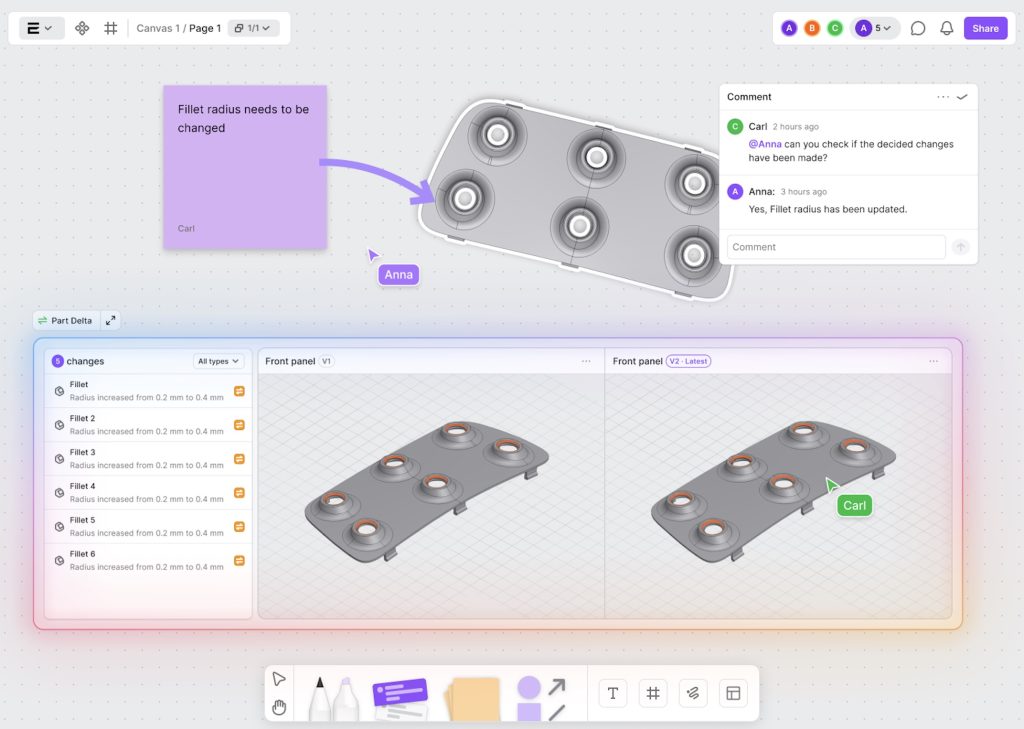
“Encube enables teams to develop a shared understanding of the trade-offs between form, fit and function directly at the point of design. Through real-time, AI-powered analysis in the browser, teams collaborate around the same decisions, quantify manufacturability and cost drivers at design-time, and see how changes between versions of the same CAD models and technical drawings impact the product before designs are frozen.”
“This is enabled by physics-informed and generative AI that combines empirically proven physics with symbolic reasoning to deliver grounded, reproducible outputs. The result is a feedback loop for hardware development that helps teams identify constraints, risks and trade-offs early, much like compilers and linters do in software development. Everything is built around the metrics that actually matter most to customers: time to market, marginal cost of production and R&D productivity.”
“In practical terms, our AI can autonomously analyze a design together with its technical drawing, identify functional changes across revisions, flag deviations from customer preferences, and generate clear, actionable next steps the entire team understands. We recently ran a benchmark with a customer where they had our AI analyze the design lineage for one of their products. They knew they had made a critical mistake that wasn’t caught until final assembly, which cost them significant time and money and jeopardized their end-customer’s trust. Our AI not only caught the issue, but also explained why it mattered and proposed clear action items to solve it. It changes the entire way the customer thinks about deploying Encube: not as a replacement to engineering talent, but as a means for teams to do more of their most impactful work in service of inventing amazing products.”
Challenges Faced
Have you faced any challenges in your sector of work recently? Nordell acknowledged:
“A core challenge in the industry is earning trust. In hardware, the cost of being wrong is high. Decisions don’t just affect timelines or budgets, they affect safety, reliability and long-term performance. For teams to rely on new software, the outputs have to be demonstrably dependable.”
“At the same time, real-world manufacturing data is deeply fragmented and varies widely across contexts. That makes generic AI approaches brittle. Without grounding in how the physical world actually works, models struggle to generalize in ways industrial teams can trust. On top of that, adoption cycles in hardware organizations are naturally long. Teams move carefully, so value has to be proven early through credible pilots and measurable outcomes.”
“We’ve addressed these challenges by being very deliberate about our product and operating principles. We anchor the product in physics-informed methods, focus relentlessly on customer metrics, and co-develop with a small number of ideal customers rather than chasing broad customization. We’re also disciplined about building scalable product capabilities, not bespoke implementations that might win a single deal, but undermine long-term scale. That approach has allowed us to earn trust the only way it’s earned in this space, by proving value where it can move metrics customers care about.”
Evolution Of The Company’s Technology
How has the company’s technology evolved since launching? Nordell noted:
“Since launching, our technology has evolved significantly, largely driven by close interaction with customers. We initially started with a purely immersive, web-based 3D experience. It was powerful, but we quickly learned that for teams to truly take control of trade-offs between form, fit and function, we needed to aggregate all the design collateral they create, not just the 3D model.”
“That insight led us to go much deeper. Instead of trying to cover everything, we decided to focus on a small number of fundamental bottlenecks in mechanical product engineering, the areas where these processes make or break product success. As a result, our value proposition today is far clearer than many other entrants in the space.”
“At the same time, our AI capabilities have accelerated faster than we expected. Now our combination of symbolic and generative AI is capable of delivering very measurable improvements in the product design loop that we expected would take at least another one to two years to accomplish just a few months ago. That pace of progress has reinforced our conviction that we’re building the right things, in the right order.”
Significant Milestones
What have been some of the company’s most significant milestones? Nordell cited:
“Some of our most important milestones have been reaching clear proof points that we’re solving the right problem in the right way.”
“We founded Encube around a well-defined industrial pain point where manufacturability issues are discovered too late, driving delays, cost overruns and unnecessary risk. One of our first major milestones was securing innovation partners and validating that bringing manufacturing insight into the design phase directly protects time to market and cost targets.”
“Another milestone was demonstrating that AI-powered workflows can run fast enough, collaboratively and iteratively, to fit into day-to-day engineering work. Progressing from concept to repeated customer usage, with teams actively using Encube during design rather than as a post hoc check, marked a clear shift in behavior.”
“Underlying these milestones is a differentiated technical approach grounded in methods suitable for high-stakes physical world engineering. Building something people trust, rely on and genuinely want to use in their daily work has been one of the most meaningful achievements so far.”
Customer Success Stories
Can you share any specific customer success stories? Nordell highlighted:
“We’re not yet in general availability, so we’re careful about naming most customers publicly. That said, one good example is a large Swedish truck manufacturer we’re working with to accelerate product development.”
“They are a world-class organization, but like many hardware companies, they face systemic challenges. Projects are delayed, cost overruns are common, and marginal production costs often end up higher than planned. The challenge lies in how difficult these trade-offs are to see early in the process.”
“Encube helps by surfacing manufacturing complexity directly during the design phase. Their teams use it to run fast and accurate manufacturability analysis, analyze technical drawings and incorporate expert feedback while designs are still fluid. This replaces slow, physical feedback loops that would otherwise take weeks or months to complete.”
“Beyond speed and cost, they’re also using Encube to help train the next generation of engineers and capture critical know-how as senior experts approach retirement. For them, it’s not just about moving faster today, but about building resilience into how products are developed over time.”
Differentiation From The Competition
What differentiates the company from its competition? Nordell affirmed:
“What truly differentiates us is how we approach the problem. We focus on grounded reasoning in the physical world, using physics-informed and symbolic methods rather than relying purely on language-driven or pattern-based AI. That grounding is essential when decisions have real-world consequences.”
“This is why we think of Encube as a compiler for hardware. It provides immediate, actionable feedback on manufacturability and cost drivers while teams are still designing, not weeks or months later. This feedback is delivered through real-time, collaborative workflows in the browser, designed to be used continuously as part of everyday work rather than as a periodic specialist check.”
“That way of working shapes both how we measure success and how we build the product. We hold ourselves accountable to hard industrial outcomes such as time to market, marginal cost of production and R&D productivity, not vanity metrics. To make those outcomes repeatable, we build for scale from the start, deliberately avoiding the trap of custom one-off implementations that turn product companies into consultancies and instead delivering consistent value across teams, organizations and industries.”
Future Company Goals
What are some of the company’s future goals? Nordell emphasized:
“Looking ahead, one clear milestone for us is moving into general availability before the end of 2026. Beyond that, our goal is to establish design-time manufacturing intelligence as a standard layer in the hardware development workflow.”
“A big driver behind this is a growing talent gap. In Europe, decades of outsourcing combined with an ageing workforce mean that as manufacturing is brought back, critical production know-how is disappearing faster than it’s being replaced. Embedding expert-level manufacturing reasoning directly into tools that are accessible to the entire team. The idea is that insights that today require years of experience should be available within minutes, so knowledge scales even as teams change.”
“At the same time, we’re very deliberate about where we invest technically. Rather than chasing generic AI features, we’re focused on compounding defensibility around grounded simulation and decision support rooted in the physical world. That’s what we believe will continue to hold up in high-stakes engineering environments and deliver durable value over time.”
Friction Points
What are the biggest friction points in the journey from a product concept to a finished physical unit today? Nordell described:
“One of the biggest friction points is that manufacturing constraints are still discovered too late. By the time problems surface, changes are expensive and schedules are already committed, largely because feedback loops in hardware are slow and physical. Validation relies on prototypes, supplier reviews and shop-floor iteration, which can take weeks or months, while teams continue making decisions without full visibility.”
“As a result, critical trade-offs between aesthetics, function, cost and manufacturability are negotiated with incomplete information until very late stages. Teams don’t really know what their actual risk delta is, or how design changes shift that risk, until it’s often too late to act. At the same time, practical manufacturing knowledge is trapped in a shrinking pool of experts, and organizations lack scalable ways to secure that know-how as experienced engineers retire.”
“All of this is reinforced by fragmented tooling across domains, which creates handoffs instead of continuous collaboration. Taken together, these dynamics make the journey from a product concept to a finished physical unit far slower and more uncertain than it needs to be.”
Industry Focus
Which industries does Encube primarily serve and why? Nordell pointed out:
“We primarily serve industrial companies where precision manufacturing is central and where mistakes are costly. These are organizations focused on mechanical product development, often relying on processes like CNC machining, where small design decisions have large downstream consequences.”
“That naturally includes sectors such as automotive, heavy machinery and advanced industrial equipment, where marginal cost of production and time to market are decisive competitive levers. In these environments, the ability to understand and manage trade-offs early in design directly impacts both profitability and speed.”
“Many of these organizations also sit at the intersection of high complexity and growing talent scarcity. As experienced engineers retire, faster and more reliable design feedback, combined with scalable ways to capture manufacturing know-how, materially changes outcomes. Because these teams operate in high-stakes contexts where failure affects safety, reliability or compliance, they require grounded and dependable reasoning rather than just automation.”
GenAI Opinion
Generative AI is dominating the tech conversation right now. What is your assessment of its current applicability, specifically within hardware engineering? Nordell detailed:
“Generative AI has been a major breakthrough, particularly in language, interfaces and workflow acceleration. It’s very good at helping people move faster. But in hardware engineering, generative models on their own are often insufficient, because many of the hardest problems require grounded reasoning about the physical world.”
“Hardware teams ultimately need to trust the outputs they act on. In software, that trust comes from verification infrastructure such as compilers, test suites and execution environments that tell you whether something actually works. In hardware, much of the work depends on geometry, physics, tolerances and manufacturing constraints, areas where next-token prediction alone struggles to produce dependable results.”
“The real opportunity emerges when generative interfaces are paired with grounded engines that can validate and constrain outputs. Simulation, rules and physics-informed models provide the checks that make AI useful in high-stakes engineering contexts. Our approach is to build that grounded layer so AI can become dependable in high-stakes engineering contexts.”
Addressing The Talent Gap
The manufacturing sector is facing a significant talent gap. What role do you see technology playing in addressing this demographic challenge? Nordell concluded:
“Technology has a critical role to play, but not by trying to replace engineers. The real opportunity is to amplify expert capability by turning tacit, experience-based knowledge into scalable and repeatable decision support. When expertise stops being a bottleneck, teams can move faster without increasing risk.”
“One important shift is moving toward self-driving simulation and automated reasoning for everyday iterations. That reduces the need for scarce specialists to be involved in every design loop, and instead frees senior experts to focus on the hardest edge cases where their judgment matters most. At the same time, good tools can dramatically shorten learning curves for newer engineers by making constraints visible early and providing immediate feedback instead of slow trial and error.”
“Just as important as speed is knowledge retention. As experienced workers retire and fewer people enter manufacturing, capturing institutional know-how becomes essential for business continuity. The goal is to raise the baseline capability across teams, so organizations remain resilient even as their workforce changes.”
