

Ferveret is developing a waterless cooling system for AI data centers using heat-transfer principles derived from nuclear reactor technology. Its proprietary Adaptive Phase Cooling (APC) technology is designed to manage the increasing heat generated by high-performance AI processors while reducing energy consumption and simplifying data center operations. The company’s flagship product is a modular, rack-mounted cooling system designed to fit into existing data center infrastructure without requiring a facility redesign. Pulse 2.0 interviewed Ferveret Co-Founder and CEO Reza Azizian to learn more about the company’s origins, cooling technology, pilot deployments, and plans to support the next generation of AI infrastructure.
Reza Azizian’s Background
When asked about his background, Azizian shared:
I’m the Co-Founder and CEO of Ferveret. I completed postdoctoral research and part of my PhD at MIT, with a focus on thermal hydraulics and heat transfer in nuclear reactors.
From there, I spent more than a decade in electronic cooling in industry. I contributed to the thermal design of Microsoft’s HoloLens and later held senior thermal engineering roles at NVIDIA and Cruise. I’ve spent my entire career at the intersection of high heat flux and tight constraints, and that’s the world I understand.
My co-founder, Matteo Bucci, is an associate professor at MIT, and we originally met there in 2013, working on reactor heat transfer. That shared background is really the foundation of the company, and Ferveret is the natural next step: applying decades of nuclear thermal science and hard-won industry experience to the largest thermal challenge of our time, cooling AI data centers.
How Ferveret Started
When asked how the idea for the company came together, Azizian explained:
It started in 2017, when I walked into my first data center and was struck by the massive, noisy fans cooling the whole facility.
Air cooling can consume up to 40% of the power in a data center, and the underlying technology was essentially 50 years old. Nobody had rethought it because it wasn’t hurting performance yet.
But Matteo and I could see that AI chips were heading toward power densities that air cooling and direct-to-chip simply couldn’t handle, while existing immersion approaches were too complex, too capital-intensive, or required full facility redesigns.
We spent years studying phase-change heat transfer in nuclear reactors, a field with a 50-plus-year operational track record at extreme heat fluxes, where the efficiency with which you move heat directly determines how much energy and revenue you can extract from the core. So we asked a simple question: could we take the physics that cools reactor cores and adapt it to cool AI servers in a form factor that drops directly into existing infrastructure?
That question became Ferveret, founded in 2021. We invented a new cooling category, Adaptive Phase Cooling, that delivers the heat removal of two-phase immersion without the complexity, fluid loss, or pressurized containment.
Favorite Memory
When asked about his favorite memory working for Ferveret so far, Azizian recalled:
The standout was the moment we got Ferveret to cool a fully populated H200 server in the lab and saw 15% higher TFLOPs per watt than direct-to-chip cooling and 55% higher than air cooling.
Watching the bubbles collapse inside the liquid exactly as the physics predicted, while the GPU ran at full power, was incredibly satisfying. That was when our work went from “interesting on paper” to “this is real,” and it validated everything Matteo and I had been working on for years.
Core Products And Features
When asked about Ferveret’s core products and features, Azizian detailed:
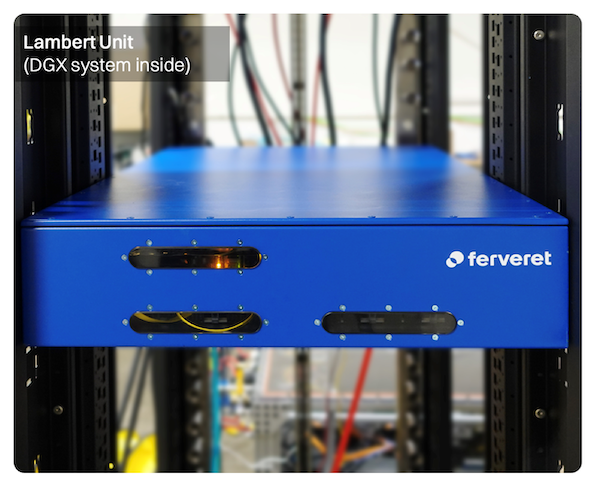
Our core technology is Adaptive Phase Cooling (APC), a new category of cooling inspired by a nuclear reactor process called subcooled boiling. Our flagship product built on it is Lambert, a first-of-its-kind small, modular, rack-mounted unit that drops into existing high-density data centers with no facility redesign.
Each Lambert fits the same form factor as a standard direct-to-chip server and connects to the same inlet and outlet manifolds, so customers can deploy a single unit for evaluation or scale to fully populated racks without touching their underlying infrastructure. We deliver a full-stack system: the cooling chassis, the rack, coolant distribution units, temperature and pressure sensors, and control software that optimizes each unit’s operating conditions in real time to minimize energy use.
It’s entirely closed-loop and waterless, using a low-boiling-point dielectric fluid without the PFAS “forever chemicals” that other immersion approaches rely on. Azizian also highlighted several technical features of the company’s cooling platform:
- Heat Removal: Adaptive Phase Cooling, our proprietary heat-transfer technology, delivers 10 to 100 times the heat removal capacity of air or direct-to-chip cooling.
- Rack Density: More than 300 kW per rack, with headroom for next-generation GPUs like Rubin.
- Water Consumption: Zero water consumption, entirely closed-loop and dry-cooler compatible.
- Operating Temperature: 45°C inlet temperature support, ideal for hot-climate regions.
- Energy Efficiency: PUE of 1.03, compared to 1.20 for direct-to-chip and 1.40 for air-cooled facilities.
- Maintenance: Standard service workflow: each server can be removed, dried, and serviced with no special tooling or hazardous-material protocols.
Navigating Industry Challenges
When asked about recent challenges in the data center cooling industry and how Ferveret has addressed them, Azizian explained:
The biggest challenge in our sector is operator caution. Data centers are risk-averse, and any new cooling architecture raises questions about reliability and maintenance.
We addressed this by designing for minimal disruption: our rack-mounted form factor means a single unit can be pulled and serviced just as operators do today, and our systems can run alongside existing direct-to-chip servers in the same rack, allowing customers to adopt incrementally.
Regarding reliability, even in earlier deployments where a system lost fluid, the temperature rose gradually rather than failing suddenly, so issues were visible and fixable well before they became critical. We’ve also kept our base cost comparable to direct-to-chip to remove the cost barrier to trying us.
How The Technology Has Evolved
When asked how Ferveret’s technology has evolved since launching, Azizian said:
Early immersion cooling meant submerging servers in large tanks, which was hard to deploy and maintain.
The big evolution for us was cracking the form factor. The physics of our subcooled boiling approach let us shrink everything into a small, modular, rack-compatible chassis rather than a tank. We’ve also moved from pure server-level testing to running rack-level pilots in live data center environments, and we’ve layered in our power-control software so the cooling and the compute are optimized together rather than separately.
Key Company Milestones
When asked about some of Ferveret’s most significant milestones, Azizian highlighted:
We’ve been fortunate to hit a number of meaningful milestones. Founding the company in 2021 and getting backed by Y Combinator was the first.
On the funding side, we’ve raised up to roughly $10 million from VCs and investors, complemented by $875,000 in non-dilutive support from the El Paso City Council.
Technically, validating our approach through the independent UCLA study, which confirmed the 15% efficiency gain, was a major proof point. Launching Lambert as the first small, modular, rack-mounted APC solution was another.
And we’ve now moved into rack-level pilots with real customers, including data center operators. We’re also in active conversations with hyperscalers about expanded partnerships.
Customer Engagements And Pilot Results
When asked to share specific customer success stories, Azizian explained that Ferveret is currently working with data center operators and hyperscalers on pilot deployments. We’re currently in the pilot phase, working at the rack level rather than full production, so I’d frame these as active engagements rather than completed case studies. We’re testing with data center operators and hyperscalers, and our pilots have typically gone from start to running in a matter of weeks, since the main work is simply repackaging the server into our chassis. Our financial modeling on a representative 10 MW facility shows a 165% ROI with a 3.8-year payback, versus roughly 80% ROI and a 5.5-year payback for direct-to-chip alternatives.
Funding And Revenue Metrics
When asked about Ferveret’s funding and revenue metrics, Azizian revealed:
We’ve raised $10 million in seed funding from a strong syndicate including Aramco Ventures, TOVC, Baruch Future Ventures, Y Combinator, Cerberus, Acclimate Ventures, E14, Valkyrie, Climate Capital, Verso Capital, and Cathexis Ventures. We’ve also received $875,000 in non-dilutive support from the El Paso City Council for our demonstration facility. On revenue, I’m not able to share specific figures publicly at this stage. We’re now scaling toward our Series A.
Total Addressable Market
When asked about the total addressable market Ferveret is pursuing, Azizian explained:
The data center cooling market is on a fundamental growth trajectory. Global data center capacity is projected to grow roughly 3.5 times by 2030, driven almost entirely by AI workloads, and within that, liquid cooling is the only viable path forward as chip power densities exceed what air cooling can handle.
The total data center cooling market sits at roughly $16 billion to $21 billion today and is projected to reach $40 billion to $56 billion by 2030, while the liquid cooling segment specifically is the fastest-growing slice, with independent research projecting the broader liquid cooling market to grow more than fivefold over the coming decade and exceed $40 billion by 2036.
As Rubin-class and beyond GPUs push past the limits of direct-to-chip approaches, two-phase and immersion approaches are where the growth concentrates.
Competitive Differentiation
When asked what differentiates Ferveret from its competition, Azizian identified five areas:
Underlying technology: APC is a new cooling category we invented. It combines the heat removal of two-phase immersion with the simplicity of single-phase systems. The fluid boils at the chip but condenses inside the surrounding liquid, so there are no pressurized tanks, no fluid loss, and no facility redesign.
Drop-in form factor: Our Lambert units share the exact form factor and manifold interface as direct-to-chip (DTC) servers. A customer running DTC infrastructure today can deploy Ferveret without redesigning anything, and no competing immersion solution offers this.
Lower TCO: Our 10-year economic analysis shows roughly 22% lower total cost of ownership versus DTC, driven by 14% less facility power, zero water, longer GPU refresh cycles from cooler chip operation, and 50% lower maintenance.
Standard service workflow: Our dielectric fluid is non-conductive and non-flammable, and a server pulled from the rack dries within minutes. No special tooling, no hazardous-material training, and no facility shutdown.
Built for next-generation GPU power density: APC scales to more than 300 kW per rack today, with headroom for the chips arriving over the next three to five years, so our customers don’t have to re-platform every time NVIDIA releases a denser chip.
Future Goals
When asked about Ferveret’s future goals, Azizian explained:
Near term, we’re moving from rack-level pilots toward broader production deployment, scaling through OEM and ODM partners who can integrate at hyperscale, and announcing expanded hyperscaler partnerships.
Longer term, because we’re waterless, we want to unlock entirely new geographies, places with abundant solar but little water, like parts of the Middle East, Africa, and the American Southwest, where data centers previously couldn’t be built.
The overarching goal is to help the AI industry keep growing without straining the planet’s power and water resources: getting the maximum number of tokens out of every watt.
Waterless Cooling And Distributed AI Infrastructure
Azizian concluded by highlighting the strategic importance of waterless cooling and the potential for more distributed AI computing infrastructure.
Two things I’d highlight. First, the strategic value of zero-water cooling goes well beyond the environmental story. Water is becoming a hard constraint on where data centers can be built: moratoriums are spreading in Virginia, Oregon, and other regions where data center water use has hit municipal supply limits, and in places like Saudi Arabia and the UAE, water-cooled facilities compete directly with municipal supply.
Ferveret breaks that loop entirely, enabling data centers in locations where water-cooled approaches simply aren’t viable, which unlocks a meaningful portion of the future build-out in high-demand, water-scarce regions. Second, I think we need to rethink scale.
There’s an assumption that you need massive gigascale facilities to do meaningful AI work, but there are many underutilized 5 to 10 MW sites, and a real path toward more distributed compute where what you contribute matters more than the scale you run at. Underlying both points is a bigger shift: cooling has gone from an afterthought to the strategic lever in AI infrastructure, and the operators who recognize that early will pull ahead on both performance and environmental footprint.
