Flux – which recently closed on a new office in San Francisco – is a company providing a browser-based, AI-native hardware design platform that streamlines the creation of printed circuit boards (PCBs) and electronics, aiming to make hardware development as accessible and collaborative as modern software engineering. Pulse 2.0 interviewed Flux founder and CEO Matthias Wagner to learn more.
Matthias Wagner’s Background


Could you tell me more about your background? Wagner said:
“I’ve spent the bulk of my career at the intersection of hardware, software, and product, always drawn to how technology can amplify human creativity. Before starting Flux, I led product teams at Meta, working on projects like the Moments app, AR ads, and Oculus VR. Those experiences showed me how tools that allow customization and creativity can help people build and collaborate on complex systems — and they deeply shaped how I think about hardware development today.”
“Over time, I realized my passion lies in building tools that help engineers, designers, and makers move ideas from imagination to reality.”
Core Products


What are the company’s core products and features? Wagner explained:
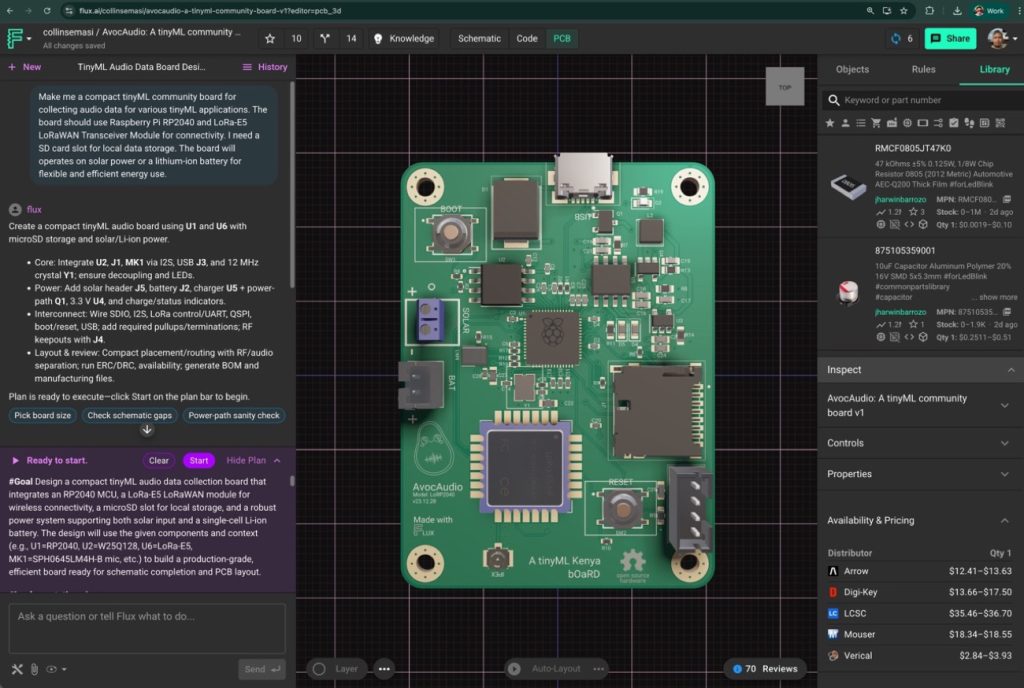
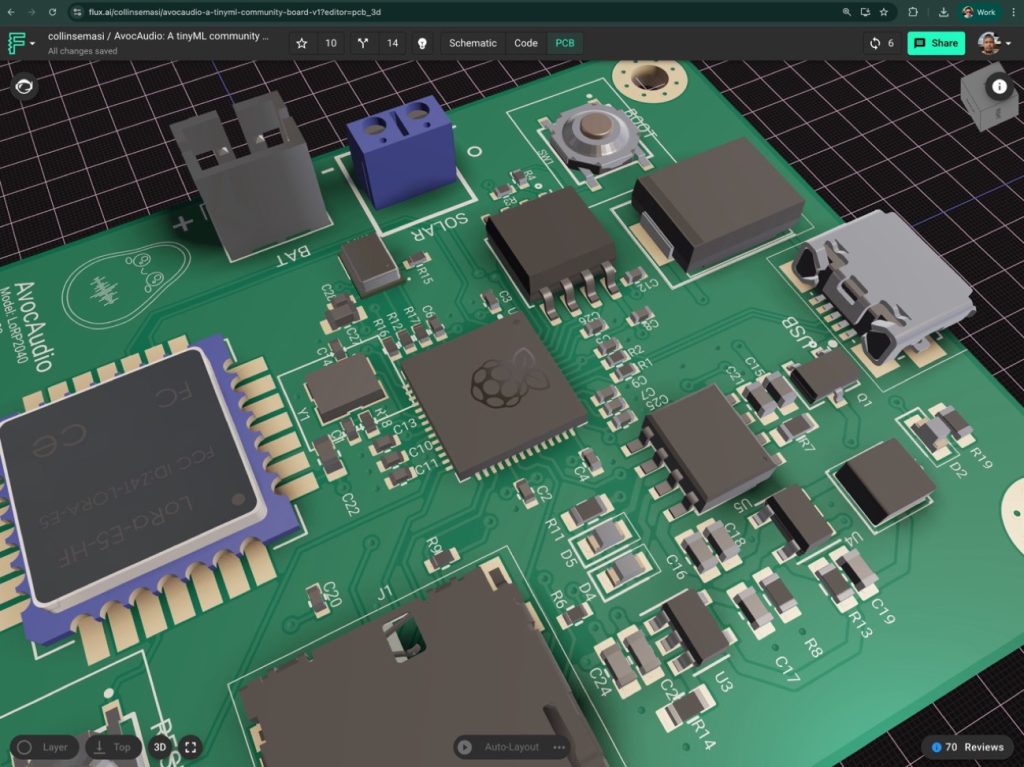
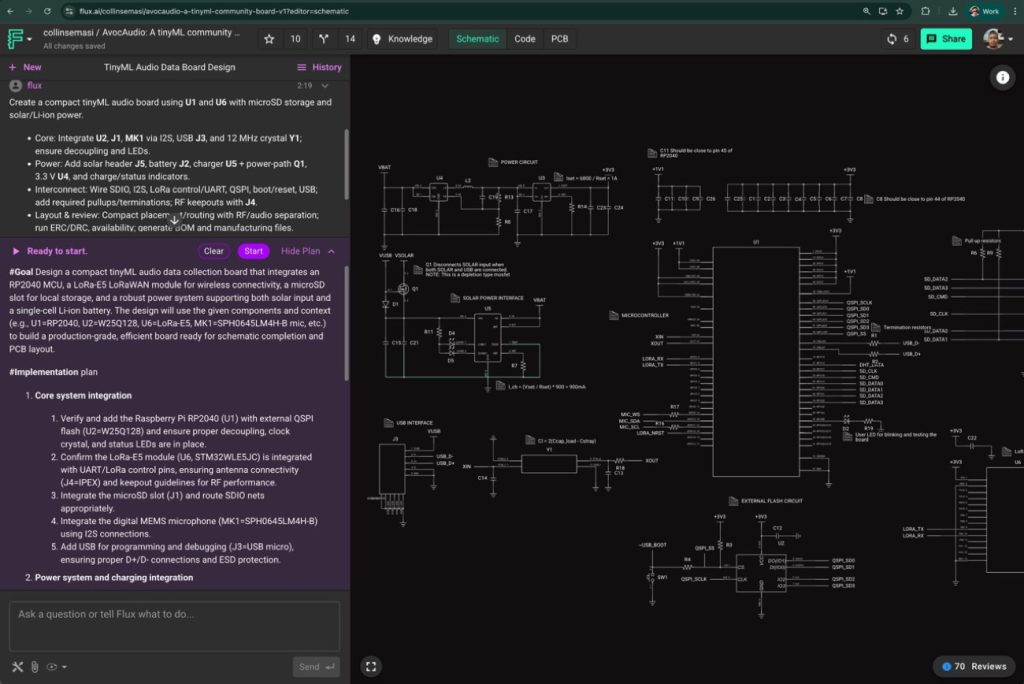
“Flux is the world’s first AI hardware engineer for anyone, whether they have an electrical engineering background or none at all. Flux’s agentic AI works with you to define requirements, create a plan, select components, draw a schematic, check your design for errors, place components, and even route your board. It even suggests ways for users to minimize costs and reduce supply-chain risks.”
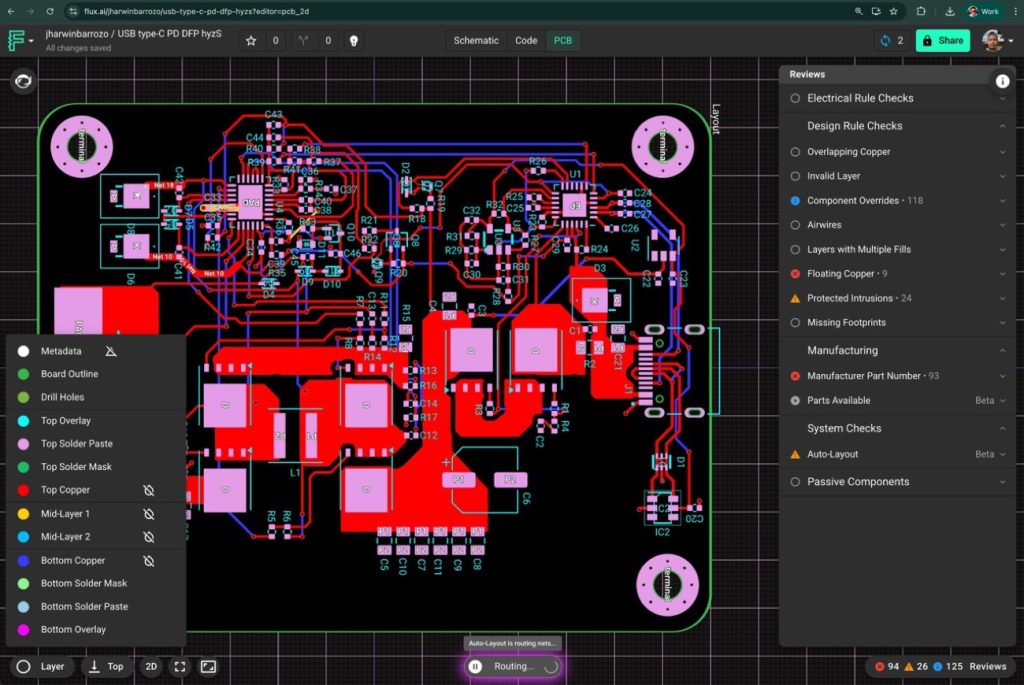
“Earlier this year, we launched a full agentic AI, ‘AI Hardware Engineer’ enabling anyone, from experienced electrical engineers to first-time builders, to design PCBs from start to finish. Users can describe the hardware they want in natural language, and the system automatically analyzes the prompt, breaks it into a multi-step plan, researches part pricing and availability, generates the schematic, and routes and ships the board for manufacturing, all within an AI-powered browser.”
“Our AI Hardware Engineer reviews and improves the design and can work on multiple boards in parallel. By embedding engineering intelligence directly into the workflow, we were able to lower the barrier to hardware innovation and decrease development cycles from months to days.”




Formation Of The Company
How did the idea for the company come together? Wagner shared:
“I was at Burning Man in 2019 and wanted to build a solar-powered PA system that could be used in an off-the-grid situation like that. It led me to build a custom, high-efficiency 20kw sound system. That sparked the idea about customizable hardware. We knew that AI was going to power our idea, but our original assumption was that the path to AI would take much longer. However, to our luck, OpenAI came around and provided those capabilities much sooner than expected. And that’s when everything came together for Flux.”
Favorite Memory
What has been your favorite memory working for the company so far? Wagner reflected:
“A space startup used Flux to design and produce a board for a satellite mission that successfully went to space, which was a very cool moment for us.”
Challenges Faced
Have you faced any challenges in your sector of work recently? Wagner acknowledged:
“LLMs can understand and write code really well because they are large ‘language’ models. But with hardware, they don’t have an innate understanding of physical context, so we need to translate the design into something that the LLM can reason with. It’s a lot different than creating AI for software because there’s far less training data to work with, and the margin for error is even tighter. In order to create an agentic AI that can carry out tasks like simulation or supply-chain integration, we had to spend a lot of time training our own models because we couldn’t rely on LLM training sets.
That was hard.”
Evolution Of The Company’s Technology

How has the company’s technology evolved since launching? Wagner noted:
“When we started, Flux was primarily about making PCB design web‑native and collaborative, bringing a Figma‑like experience to electronics. Over time, the platform has evolved into a full AI-powered hardware design environment with simulation, data‑driven component models, and now agents that sit on top of that stack to help with design, checks, and documentation. Each step has been about transforming Flux from a collaborative set of “drawing tools” into an intelligent design partner that understands constraints, manufacturability, and real‑world behavior.”
Significant Milestones
What have been some of the company’s most significant milestones? Wagner cited:
“One of the most significant milestones at Flux came early on. We were pitching the idea to the founder of Figma, and he stopped us in the middle and said: ‘I believe you can do this. I believe there’s an opportunity in the market. The problem you need to solve is how you’re going to fund yourself to get there. It took Figma five years to get their first paying customer, what you need to figure out is how to raise the funding that will get you to that first paying customer.’”
“There’s a truism in Silicon Valley that “hardware is hard.” So right from the start we had a big challenge getting investors on board with the vision. But thankfully we found backers who saw the potential and believed in our founding team. Once we actually rolled out a product, and customers started building on it, everything started to click. It was especially exciting to see entrepreneurs using Flux to design boards themselves, at a fraction of the cost of hiring a dedicated engineer.”
“We grew steadily from there. But when we launched our agentic technology late last year, everything really accelerated. Our user growth took off, and it felt like we’d reached a major inflection point for the company.”
Customer Success Stories
Can you share any specific customer success stories? Wagner highlighted:
“One of my favorite customer stories is about a vending machine manufacturer we worked with. They started out using several off-the-shelf boards in every machine, which worked, but it was complicated and expensive. We helped them move to a single custom board that did everything they needed, at a lower cost and with less hassle. Their total cost of ownership dropped fast because installation became plug-and-play instead of an all-day wiring project. It is the perfect example of how thoughtful design can be both simpler and smarter, and I thought it was a great use of Flux.”
Funding/Revenue
Are you able to discuss funding and/or revenue metrics? Wagner revealed:
“We just announced $37 million in new funding, including a $27 million Series B led by 8VC and $10M in a previously unannounced Series A led by Outsiders Fund and Bain Capital Ventures. We have an extraordinary group of VCs and individual investors who see Flux’s potential to democratize hardware and reshape the global electronics industry in the process.”
Total Addressable Market (TAM)
What total addressable market (TAM) size is the company pursuing? Wagner assessed:
“Flux is targeting the approximate $80 billion electronics market.”
Differentiation From The Competition
What differentiates the company from its competition? Wagner affirmed:
“Flux is the first AI hardware engineer. Other products use AI to accelerate portions of the design process. We’re the only one with AI that takes the process start to finish: from ideation to layout to testing to sourcing of materials. On top of that, Flux is differentiated by being truly web‑native and real‑time collaborative. Unlike traditional, desktop‑bound EDA tools, Flux treats hardware as a shared, living artifact. Designs can be co‑edited, commented on, remixed, and AI agents can participate in that process. Our community library and emphasis on sharable, reusable designs also set Flux apart from tools that keep everything locked in private, opaque file formats.”
Future Company Goals
What are some of the company’s future goals? Wagner emphasized:
“Looking ahead, the goal is for Flux to be used by anyone that wants to make customized hardware. That means deeper integrations with fabrication and supply‑chain partners, richer simulation and verification capabilities, and more powerful AI agents that understand constraints from requirements all the way through production. Ultimately, the vision is to make building hardware feel as fast and fluid as building software.”
Additional Thoughts
Any other topics you would like to discuss? Wagner concluded:
“At Flux, we love being the hardware design tool for anyone and everyone, no matter their interests or knowledge of engineering. One customer, a radio frequency engineer, uses Flux to create a range of customized wireless devices, including integrated microwave antennas to serial-to-wireless converters. His biggest challenge wasn’t generating ideas, it was getting the fundamentals right. Each time they introduced a new part, they had to recreate it from scratch, that meant carefully copying every single detail — even a tiny typo could break the entire design.”
“Flux removed that friction. By streamlining how core building blocks are created and reused, Flux increased his team’s productivity by two to four times. It also reduced costs by minimizing errors that can turn hardware design mistakes into expensive failures.”

