Fooda is a workplace food platform that partners with both national and local restaurants to bring diverse, daily meal options to corporate offices, hospitals, government buildings, and schools. Fooda has built its own proprietary technology experience – Fooda OS – that is supported by AI and enables data-driven scheduling, demand forecasting, and concept rotation. Pulse 2.0 interviewed Fooda founder and CEO Orazio Buzza to learn more.
Orazio Buzza’s Background


Could you tell me more about your background? Buzza said:
“I’ve spent my career building and scaling tech-enabled B2B marketplace businesses, and Fooda is my fifth startup. Along the way, I’ve had the opportunity to be part of multiple strategic exits and two IPOs. What’s been consistent for me is the appeal of solving hard problems in large markets using technology and marketplace dynamics; and that’s what drew me to Fooda and keeps me excited about where we’re going.”
Formation Of The Company
How did the idea for the company come together? Buzza shared:
“The glimmer of the idea first came in 2007, when I was President of Echo Global Logistics. The company was rapidly growing, and there was practically no time to get food. I remember hearing someone say, “Why not get local restaurants to come into Echo and sell their food directly in the office?” which prompted the launch of the company’s food program. Following the launch, as Echo grew, so did the program. Before long, other companies in the building wanted in and there were lines out the door. Given the immense demand for this service, I realized there was a huge opportunity to develop Echo’s in-house food program into a standalone, nationally scaled business. This led me to start Fooda in 2011 with a vision to redefine food and the workplace, and how it all comes together with technology.”
Solutions

What is Fooda’s solution? Buzza explained:
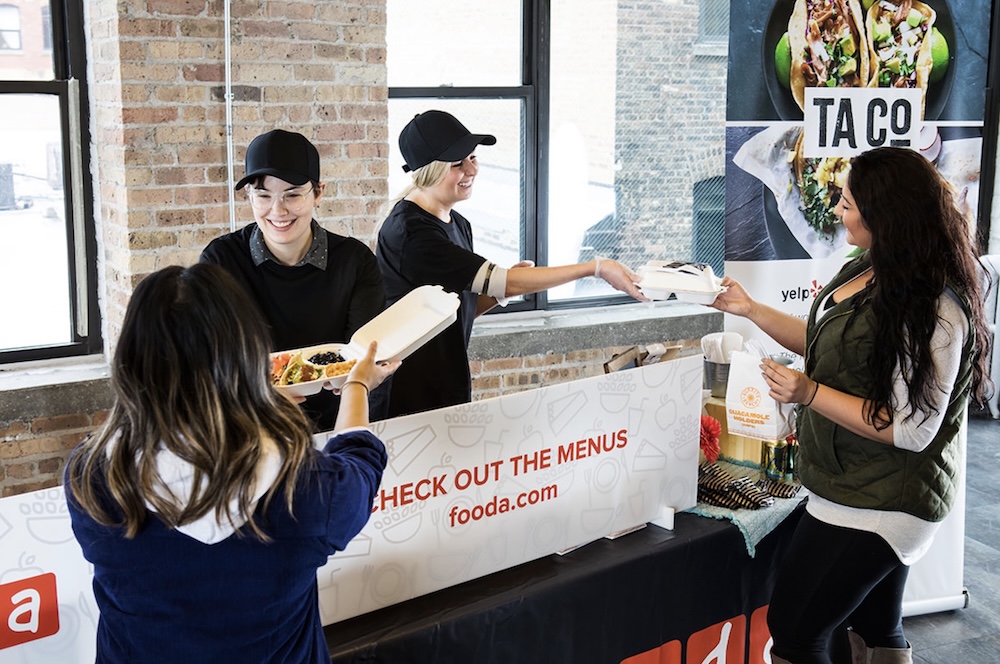
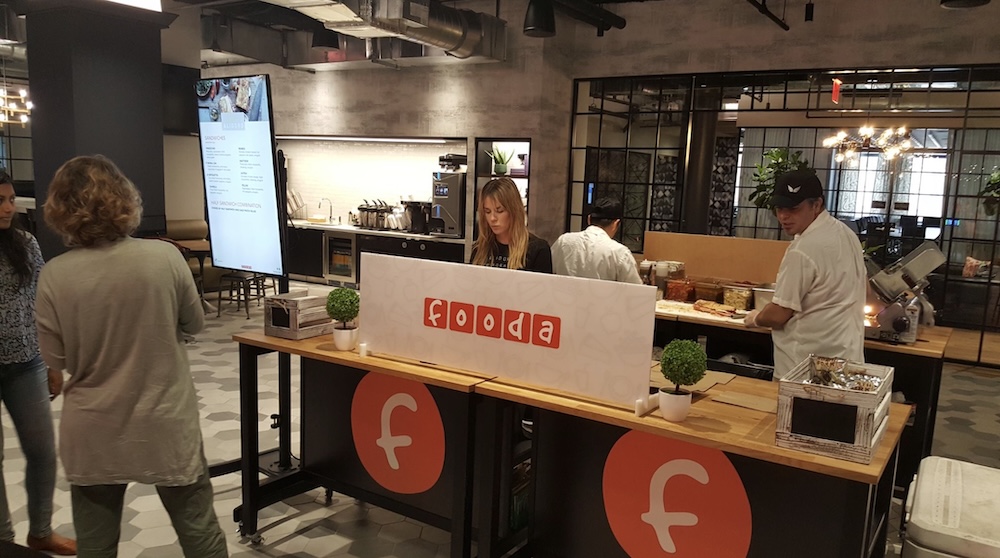
“Fooda is a workplace food platform that connects employers, employees, and restaurants to bring high-quality, reasonably priced food where people work. We work with more than 2,500 corporate and institutional clients and 4,000 restaurant partners across 38 states, serving workplaces through popups, delivery, catering, pantry, and modern café programs. Fooda has served over 125 million+ meals to date.”
“More broadly, Fooda helps employers offer restaurant-quality food at work without adding operational complexity. 80% of employees view Fooda as a top onsite perk. It’s an amenity that helps the return to office process, which is a trend that continues to gain momentum.”

Evolution Of The Company’s Technology
How has the company’s technology evolved since launching? Buzza noted:
“A significant component of our technical evolution has been harnessing the power of AI. Fooda was an early adopter of AI, as we began implementing it in our business as early as 2018. We now use AI forecasting tools to help restaurant partners optimize prep based on factors like cuisine, day of week, and weather, reducing food waste. Through this process, we transformed a manual, error-prone scheduling process into an AI-driven optimization system that predicts consumer demand, balances variety, and generates restaurant prep forecasts. Fooda’s system drives measurable sales lift and major operational efficiency gains, with a current focus on augmenting with LLMs to incorporate qualitative signals and speed up exceptions.”
Customer Success Stories
Can you share any specific customer success stories? Buzza highlighted:
“We have several success stories across many different industries, and our clients include Amazon, Best Buy, Dell, Exxon, Goldman Sachs, JP Morgan, Netflix, Nike, PayPal, Qualcomm, Southwest Airlines, SpaceX, State Farm, T-Mobile, and many more. On the restaurant side, Fooda works with Chick fil A, Cosi, Halal Guys, Jersey Mike’s, Jimmy John’s, Just Salad, Potbelly, Sweetgreen and many more, including independents as well as chains.”
“Taking a deeper look at our work with restaurants, our work with Lettuce Entertain You, a national restaurant group that also got its start in Chicago, is a great example of us scaling with a partner in the long-term. In 2013, Lettuce Entertain You partnered with Fooda, recognizing the potential of our workplace dining solution. The partnership began with Nacional 27, a Latin-inspired Chicago-based restaurant within the Lettuce group, and quickly expanded as Lettuce witnessed the positive impact Fooda had on their business. Impressed by the results, Lettuce introduced other popular establishments such as Big Bowl, Bub City, and M Burger to the Fooda program. One of the most significant benefits of the partnership between Lettuce Entertain You and Fooda is the ability for Lettuce to utilize Fooda’s infrastructure as a testing ground for new concepts and products. Through Fooda’s platform, Lettuce can introduce their latest menu items and restaurant concepts to a diverse audience, obtaining immediate insights. This feedback loop enables Lettuce to refine their offerings and make data-driven decisions based on customer preferences. Through the partnership and leveraging Fooda’s various programs, Lettuce restaurants have expanded their reach, explored new sales channels, and catered to different dining needs.”
Funding/Revenue
Are you able to discuss funding and/or revenue metrics? Buzza revealed:
“Fooda has reached an annualized gross food sales of more than $300 million. Fooda is advancing its growth strategy and expects to reach more than $400 million in annual sales with high double digit EBITDA margins by 2027.”
Total Addressable Market
What total addressable market (TAM) size is the company pursuing? Buzza assessed:
“Fooda is targeting a massive $118 billion TAM for food at work just in the top 50 US cities. We have continued to expand our TAM since our founding in 2011 when we were focused on primary mid-size workplaces and subsidized businesses. We have a history of growing our total addressable market by launching new products and expanding into additional segments.”
Differentiation From The Competition
What differentiates the company from its competition? Buzza affirmed:
“Fooda’s competitive edge is a vertically integrated technology stack built specifically for workplace dining. It combines demand forecasting, intelligent scheduling that matches restaurants to sites, our own POS and mobile ordering with enterprise-grade SSO, and integrated financial settlement. Because we own the full stack, we can deliver multiple food formats across thousands of locations with consistency, efficiency, and unit economics that legacy cafeteria and food service models struggle to achieve.”
Future Company Goals
What are some of the company’s future goals? Buzza concluded:
“We see the evolving workplace, return to the office policies, and hybrid work as a major tailwind for Fooda. Highly populated offices continue to be our foundation, with meaningful growth and diversification across healthcare and industrial locations. We also see strategic expansion as an opportunity, including selective M&A to accelerate density in products and geographies where our playbook and unit economics are proven. Moving forward, we will continue to invest commercially and operationally, doubling down on sales and marketing while also investing in our people and technology to support scalable, profitable growth.”

