

Gold Telegraph is one of North America’s fastest-growing platforms focused on gold, global macroeconomics, and the evolving monetary system. Deluce recently sat down with Dr. Judy Shelton, a conservative economist, former Trump advisor, and occasional WSJ contributor known for her advocacy to return to the gold standard. To learn more, Pulse 2.0 interviewed Alex Deluce, the founder, publisher, and lead voice behind Gold Telegraph.
Interviewing Judy Shelton
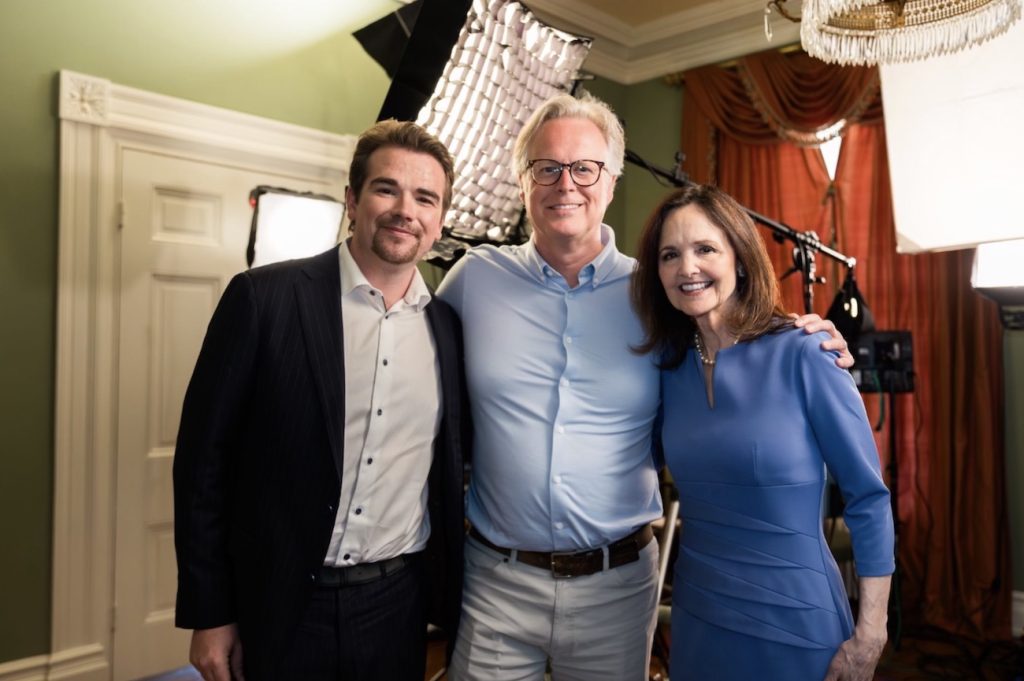
Alexander Deluce, The Gold Telegraph; Johnathan Roth, Roth Multimedia; and Judy Shelton, former American economic advisor to President Donald Trump
What drew you to Judy Shelton as a central voice in this documentary—and why now? Deluce said:
“Judy has been a long-time advocate for sound money and the historical link of gold in the international monetary system. She challenged the system when it wasn’t popular to do so.”
“Now, with trust in fiat eroding globally and governments pushing the limits of debt creation, her ideas are being re-examined as debates on money being dependable for both storing value and a medium of exchange are elevated.”
Judy Shelton is a highly debated figure in economic circles—how did you approach telling her story in a way that invites curiosity rather than takes a position? Deluce shared:
“I went into it understanding the past, but also respecting her career and body of work. Rather than framing her as a highly debated figure, I wanted to help viewers understand why her ideas have sparked debate. When you listen closely, you realize the conversation is bigger than one person or her perspectives only – it’s about trust, money, and the direction of the system itself.”
Key Topics
Can you touch on some of the key topics discussed during the interview? Deluce highlighted:
“We covered much, but rooted in the foundations of the modern monetary system, including how we got here and where it might be going.”
“From Bretton Woods and Richard Nixon closing the gold window 55 years ago this year (1971) and Judy’s insights on Nixon’s mindset and her direct interactions at the time, along with her close relationship with Paul Volcker – who was at the center of that era and its aftermath – give the audience great content. . We then moved into the role of the Federal Reserve, rising debt, and the long-term consequences of currency debasement. And importantly, we explored her proposal for Treasury Trust Bonds, linking government debt back to gold as well as gold’s role as a neutral reserve asset and how new technologies like stablecoins could reshape the system going forward.”
Concerns About Inflation And Currency Stability
There’s increasing concern around inflation, currency stability, and global economic trust—do you see this documentary as part of a broader shift in how people are questioning the system? Deluce pointed out:
“Yes, definitely.”
“I think people are starting to feel that something isn’t quite right. You’re seeing more polarization, growing wealth inequality, and at the same time, a monetary system that feels less reliable as a true measure of value. And naturally, that leads people to ask deeper questions about money, trust, and how the system actually works.”
Larger Shift Or Trend?
Was there a moment during filming where you realized this wasn’t just a story—but part of a much larger shift or trend? Deluce explained:
“There was a moment where it really clicked that this isn’t just a story… It’s part of a much larger shift. When you step back and realize we’re at a pivotal point in the international monetary system, similar to moments like 1944 at Bretton Woods or 1971 when Nixon closed the gold window. Those decisions shaped the system for decades. And today, with rising debt, inflation, and growing questions around trust and currency manipulation, it feels like we may be approaching another milestone moment.”
Real-World Impact
For viewers who may not follow monetary policy closely, what’s the one idea from this documentary that has a real-world impact on their everyday lives? Deluce described:
“It comes down to one simple idea: money is how we store our energy, our time, our work, our effort. And when that system isn’t stable, you feel it. Whether in rising costs, shrinking purchasing power, or the sense that your effort doesn’t go as far as it used to. That’s not abstract, that’s everyday life. Even if you don’t follow monetary policy closely, the documentary helps paint a picture of historically, where we are today, and what might be in the future with one of the world’s most respected economists.”
Additional Thoughts
Anything additional you’d like to add? Deluce concluded:
“I’m grateful for the unique opportunity to have this in-depth conversation with someone like Judy and bring it forward to audiences. If this documentary gets people to think a little differently about money and our global monetary systems, then I think it’s done its job.”
