

Gravity is an integrated carbon and energy management platform designed to help companies measure and reduce emissions while lowering energy costs. The platform combines automated data collection, carbon management, sustainability reporting, supplier engagement, and an Energy Management Marketplace that helps companies move from identifying efficiency opportunities to implementing them. Pulse 2.0 interviewed Gravity Co-Founder and Head of Partnerships & Policy Jay Ruckelshaus, PhD, to learn more.
Jay Ruckelshaus’ Background

When asked about his background, Ruckelshaus shared:
My work has focused on helping organizations navigate complex systems, particularly at the intersection of sustainability, politics, and economic decision-making.
I came to this work initially from an academic perspective, teaching and publishing at Oxford on polarization and economic development. But I grew up in Indiana, and have always been interested in how people from different backgrounds and identities can work together on issues of common concern.
I co-founded Gravity after seeing a consistent challenge across industries: companies were being asked to act on sustainability, but lacked the tools to connect emissions data to real operational and financial outcomes, and often lacked any way to connect sustainability work to things that matter to them.
Today, I lead Gravity’s strategy across partnerships and policy, working with large enterprises and financial institutions to reduce emissions, navigate dynamic regulations, and improve energy and operational efficiency.
How Gravity Started
When asked how the idea for Gravity came together, Ruckelshaus explained:
Gravity started when we noticed a clear gap in the market.
Companies were spending significant time and resources collecting emissions data for reporting, but that data wasn’t translating into action. Sustainability teams had visibility, but not a clear path to reduce costs or operationalize what they were seeing.
Meanwhile, there are dozens of energy efficiency technologies that are completely de-risked to reduce costs as well as emissions, but are nonetheless really under-deployed.
We built Gravity to bridge that gap, connecting carbon and energy data directly to decision-making. That means not just measuring emissions, but identifying cost-saving opportunities and actually helping companies execute on them.
Favorite Memory
When asked about his favorite memory working for the company so far, Ruckelshaus said:
The most rewarding moments are when customers move from measurement to action and actually start to see an ROI from this work.
Through the Gravity platform, our customers have already generated over $20 million in energy savings by identifying and implementing efficiency projects.
For example, companies like Wisconsin Aluminum Foundry are pursuing projects expected to save over $400,000 annually, and dozens more have realized savings through projects ranging from power factor correction to demand response and solar and battery storage.
Tied with impact, though, is getting to work with an extraordinary team. Moving into our new beautiful office in San Francisco and getting the whole team together to celebrate was special.
Core Products And Features
When asked about Gravity’s core products and features, Ruckelshaus detailed:
Gravity is an integrated carbon and energy management platform designed to help companies both measure and reduce their emissions while lowering energy costs.
Core capabilities include:
- Automated data collection: AI reads utility bills, fuel invoices, and other source documents directly, with integrations across more than 9,000 utility providers. That automation substantially reduces the data collection burden that slows down most reporting workflows.
- Carbon management: Track and report emissions across Scopes 1, 2, and 3 with a system designed to make the reporting process faster and less manual, so teams spend less time producing disclosures and more time acting on what the data shows.
- Sustainability reporting: Purpose-built workflows for producing disclosures that meet customer, investor, and regulatory requirements, without the manual overhead that makes reporting feel like an ordeal.
- Supplier engagement: Tools to automate the supplier data collection process, improving the quality and coverage of Scope 3 data without requiring manual back-and-forth across procurement teams.
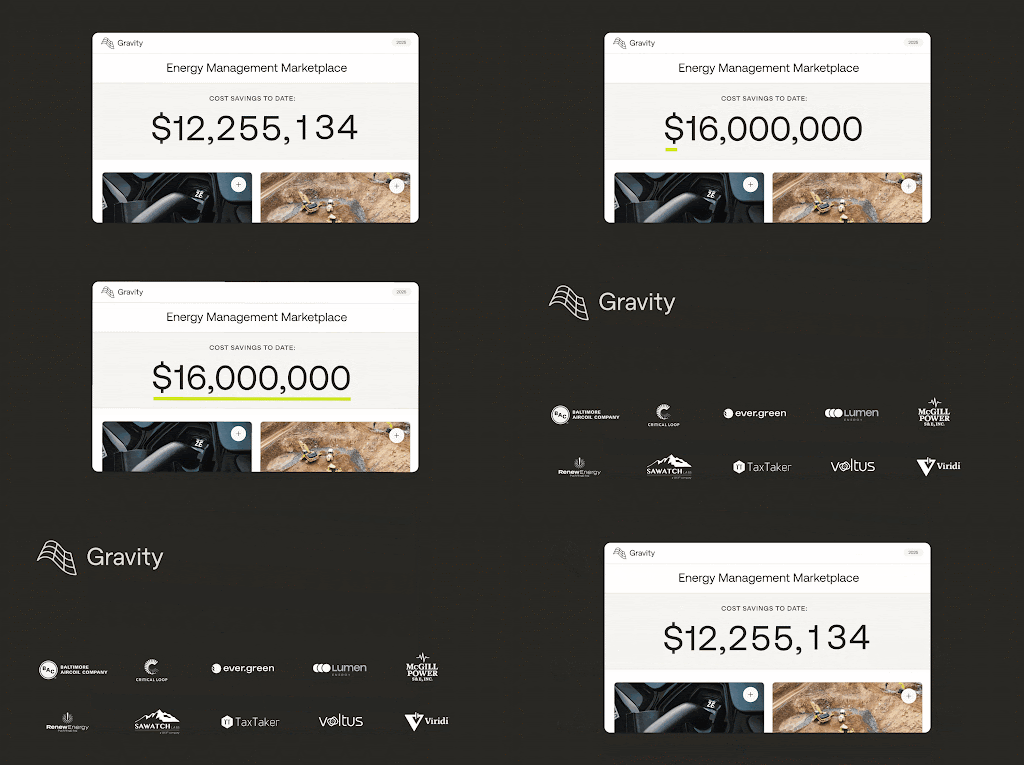
- Energy Management Marketplace: Customers can move from identifying an opportunity to executing on it, connecting with vetted partners to deploy projects across solar, storage, demand response, LED, HVAC, fleet electrification, and more than 50 other project types.
The platform goes beyond reporting by helping companies identify, finance, and implement projects that reduce both emissions and costs.
Addressing Sustainability Data Challenges
When asked about recent challenges in the sector and how Gravity has addressed them, Ruckelshaus explained:
One of the main challenges in this space is that teams spend a significant amount of time on data collection for reporting, but have limited capacity to act on it or identify meaningful opportunities to reduce costs and emissions. And nobody got into sustainability as a profession just to churn out reports.
The reason is many organizations are still relying on manual processes to collect and manage emissions and energy data. This creates a huge bottleneck.
We’ve focused on addressing that by automating data acquisition and consolidating energy and carbon data into a single system, so teams can spend less time gathering data and more time evaluating and implementing projects.
How The Technology Has Evolved
When asked how Gravity’s technology has evolved since launching, Ruckelshaus said:
Gravity was built from day one as an integrated carbon and energy management platform, with a focus on automating data ingestion with AI and empowering users to act on insights embedded in that data.
What has evolved is how we use agentic AI. We’ve moved from automating discrete tasks into more agentic workflows, systems that can handle multi-step work.
That means not just reading a utility bill, but reconciling data across hundreds of sites, surfacing anomalies, and improving Scope 3 accuracy in ways that previously required significant manual effort.
The scope of what an AI agent can take on has expanded rapidly, and what would have seemed impossible even a few months ago is now live in the product.
We’ve also invested heavily in expanding the depth and breadth of our energy and utility management offerings, both in terms of insights the platform can surface and partners available through our Energy Management Marketplace.
Key Company Milestones
When asked about some of Gravity’s most significant milestones, Ruckelshaus highlighted:
A few key milestones stand out.
We were recently recognized by Verdantix for market-leading capabilities in enterprise carbon management software, earning the highest overall scores out of 22 software providers evaluated in a report. That recognition reflects the strength of our platform and the pace of our product development.
Another major milestone was the launch of our Energy Management Marketplace. Through marketplace-enabled projects, our customers have already generated over $20 million in energy savings.
More broadly, continued growth and customer adoption, including over 60% of our customers switching from other providers, have been important indicators of Gravity’s momentum.
Customer Success Stories
When asked to share specific customer success stories, Ruckelshaus said:
Two recent ones come to mind.
McCarthy is a leading construction company managing more than 250 active projects simultaneously, which means thousands of monthly transactions from utilities, fuel suppliers, and equipment rentals.
Using Gravity, they processed 39,000 pages of invoices covering more than 8,500 transactions, work that would have consumed over 10,450 hours if done manually.
Lerman Enterprises is another example. They’re a major steel processor with operations across the U.S., Mexico, and Brazil, and they evaluated 15 carbon management platforms before choosing Gravity.
Within five weeks of onboarding, they had measured Scope 1 and 2 emissions across all their facilities, and they went on to identify more than $281,000 in estimated annual energy savings through demand response programs.
Their sustainability officer said it was “literally a no-brainer” once they saw what the platform surfaced on the energy side.
These examples reflect a broader trend we’re seeing, companies using the platform not just for reporting, but to take action on projects that reduce both costs and emissions.
Funding And Revenue Growth
When asked about funding and revenue metrics, Ruckelshaus revealed:
We raised a $13 million Series A in January 2025, bringing our total funding to over $20 million.
On the revenue side, we don’t disclose specific figures, but we’ve seen 400% year-over-year revenue growth, driven by demand from companies looking for something that goes well beyond reporting.
The business case for what we’re building is proving out, and customers are finding us, increasingly after working with a competing platform first.
Market Opportunity
When asked about the total addressable market Gravity is pursuing, Ruckelshaus explained:
The opportunity we’re focused on sits at the intersection of carbon management and enterprise energy optimization.
There’s roughly $1 trillion in inefficient energy spend every year, and addressing it requires exactly the kind of data infrastructure and execution capability that Gravity is designed to provide.
As more organizations face reporting requirements from customers, investors, and regulators, the market for tools that go beyond disclosure and deliver real cost savings is growing quickly.
Competitive Differentiation
When asked what differentiates Gravity from its competition, Ruckelshaus said:
One of the main differences is that we focus on execution, not just reporting.
Many platforms in this space are centered around measuring and tracking emissions. Gravity is designed to go further: automating data collection, improving data accuracy, and helping companies identify cost-saving opportunities tied to energy.
From there, we enable execution through our Energy Management Marketplace, connecting customers with vetted partners to actually implement projects.
That ability to move from insight to implementation, within a single system, is what sets us apart.
Future Goals
When discussing Gravity’s future goals, Ruckelshaus explained:
Our focus is on continuing to expand the platform’s ability to drive measurable outcomes for customers.
That includes growing the Energy Management Marketplace with additional project types and partner offerings, so customers have more opportunities to reduce energy costs and emissions.
We’re also continuing to invest in automation and agentic AI to further streamline data collection and improve how quickly customers can identify and act on opportunities.
Over time, we want to make it easier for organizations to operationalize sustainability across their entire footprint, not just at the reporting level.
The Business Case For Sustainability
When invited to discuss another topic, Ruckelshaus concluded:
One thing worth noting is how the regulatory landscape has shaped, or in some ways hasn’t shaped, what we’re building.
Gravity was deliberately designed not to be tied to any single regulatory pathway. State-level requirements in California, international frameworks like the EU’s CSRD, and Scope 3 pressure from large enterprise customers all create demand for what we do.
But more fundamentally, reducing energy waste saves money regardless of regulatory requirements, and that’s the case we’ve always led with.
The current environment has reinforced something we believed at founding: the business case for carbon and energy management has to stand on its own. We think it does, and the growth we’re seeing suggests customers agree.
