

Hammerhead AI uses reinforcement learning agents to optimize data center power infrastructure, enabling operators to increase AI token production by up to 30% within existing power limits. Pulse 2.0 interviewed Hammerhead AI founder and CEO Rahul Kar to learn more.
Rahul Kar’s Background
Could you tell me more about your background? Kar said:
“As CEO and Founder of Hammerhead AI, I lead efforts to transform stranded power into AI-ready capacity for AI factories using advanced real-time orchestration technology. Previously, I served as COO at AutoGrid, where I scaled Virtual Power Plant (VPP) and grid flexibility solutions, deploying AI and machine learning to help utilities orchestrate distributed energy resources to deliver grid outcomes. I have also contributed to technology strategy and innovation with the U.S. Department of Energy, helping shape the landscape of sustainable energy management.”
Formation Of The Company
How did the idea for the company come together? Kar shared:
“Over the past decade, my work has sat at the intersection of AI and power systems, and that physical reality has always mattered. At AutoGrid, I saw how software and machine learning could turn a rigid grid into a flexible, intelligent network, optimizing gigawatts of power and proving the value of flexible infrastructure. As the AI wave accelerated, one thing became clear: AI’s trajectory depends not only on better models, but on how intelligently we operate the AI factories that run them. Hammerhead AI was born from that realization and from the conviction that we can do more with the infrastructure we already have and the infrastructure we plan to deploy.”
Favorite Memory
What has been your favorite memory working for the company so far? Kar reflected:
“Some of the people I respected most in earlier chapters of my career chose to join me in building Hammerhead AI. They had seen the same patterns up close, the waste and constraints, and felt the same responsibility to address them. Their decision to come along is one of my biggest sources of confidence: this is no longer just a thesis in my head, but a shared mission for a team that I have come to know in the trenches over the past decade.”
Core Products
What are the company’s core products and features? Kar explained:
“At Hammerhead AI we’ve developed our flagship platform, ORCA (Orchestrated RL Control Agents), to address a critical infrastructure bottleneck for AI factories: power. ORCA delivers real-time orchestration across power, cooling and compute systems, converting underutilized power into productive AI token processing capacity. Key features include:
- Reinforcement-learning agents that dynamically coordinate on-site generation or storage, UPS, cooling distribution units, server racks, and GPUs to maximize token output within a fixed power envelope.
- The ability to boost the utilization of existing infrastructure. Operators typically run at 30-50%; ORCA helps close that gap.
- A software-first solution that embeds into existing data center operations, unlocking stranded megawatts without waiting for additional grid capacity, thus deploying tomorrow’s AI with today’s power.”
Challenges Faced
Have you faced any challenges in your sector of work recently? Kar acknowledged:
“We are an early stage company and this is what we live for! There are challenges, both structural and tactical, that we face every day in an industry that is massively transforming. 90% of the work of the startup is to overcome these challenges.”
Evolution Of The Company’s Technology
How has the company’s technology evolved since launching? Kar noted;
“We launched with the recognition that power, not compute, is the emerging constraint for AI factories. ORCA now learns from operational data, and then orchestrates across power, cooling and compute systems in real-time and drives higher token output per available megawatt from the grid. The product has grown from monitoring into closed-loop optimization tailored for high-density AI deployment environments.”
Significant Milestones
What have been some of the company’s most significant milestones? Kar cited:
“Last year we announced our emergence from stealth and an oversubscribed $10M seed round led by Buoyant Ventures with SE Ventures (backed by Schneider Electric) participating. Since then, we have also published whitepapers with results from our deployments. The first one where we demonstrated unlocking 30% more GPU capacity within the same power envelope and the second one where we demonstrated ORCA performs double-duty to operationalize data center flexibility by maximizing token throughput while listening to signals from utility DERMS or VPP systems like the one that Uplight provides.”
Funding/Revenue
Are you able to discuss funding and/or revenue metrics? Kar revealed:
“Yes! We have received positive feedback since our launch, highlighting the strong demand for our approach to the data center and AI factory market. We have some exciting announcements coming up!”
Total Addressable Market (TAM)
What total addressable market (TAM) size is the company pursuing? Kar assessed:
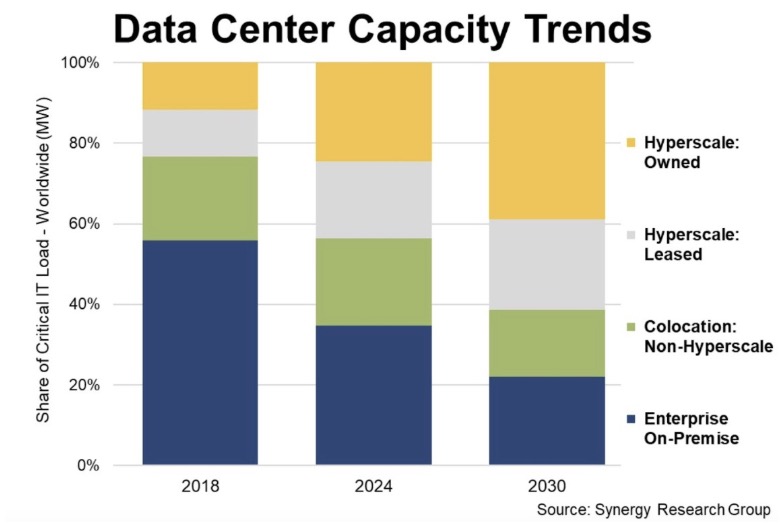
“Hammerhead AI targets both traditional data centers and emerging AI factories, focusing on the fastest-growing AI workloads: inference. According to Synergy Research Group, colocation providers serving hyperscalers and non-hyperscalers along with on-prem enterprise deployments account for over 60% of total data center capacity. The AI-driven growth is driving a 16% CAGR in global power consumption of data centers, and total capacity is projected to reach approximately 415 GW by 2035.”
“By 2030, 80% of AI workloads are expected to be inference, and latency-tolerant inference including batch inference is expected to represent at least a 50% share. These workloads can be delayed by hours to a day with minimal to no impact on the end user experience.”
“Factoring all this in, Hammerhead AI’s TAM represents a $64 billion incremental ARR opportunity, assuming future token pricing at one-tenth of today’s rates.”
Differentiation From The Competition
What differentiates the company from its competition? Kar affirmed:
“While many solutions focus on optimizing power utilization efficiency (PUE) by focusing on specific elements such as cooling, energy management or focus on grid flexibility or workload placement, Hammerhead AI integrates all of these levers to deliver a holistic and proactive approach for data centers and AI factories and targets system-wide token throughput. This allows operators to maximize AI deployment at the system level, enabling enterprises to run more AI workloads, reduce costs and scale operations in ways that traditional point solutions cannot.”
Future Company Goals
What are some of the company’s future goals? Kar emphasized:
“We are scaling Hammerhead AI into the foundational orchestration layer for the next generation of data centers and AI factories. We’re expanding production deployments and building toward multi-site, software-defined infrastructure. A key priority is deepening integrations with OEMs, colocation providers, and AI cloud and service providers, so that stranded power converted into AI-ready capacity becomes a standard capability. On the technology side, we’ll continue advancing our reinforcement-learning agents to anticipate infrastructure constraints before they emerge. Ultimately, our goal is to transform power-limited environments into high-performance, commercially advantaged AI factories.”
Additional Thoughts
Any other topics you would like to discuss? Kar concluded:
“The AI infrastructure landscape is entering a period of rapid transformation and scaling, and Hammerhead AI is positioned to help redefine its economics. Beyond optimizing existing power, we see an opportunity to shape how data centers and AI factories scale responsibly. Our focus is on enabling operators to capture strategic efficiency gains, accelerate AI deployment and unlock entirely new ways to extract value from their infrastructure.”
