HEARTio is developing AI-powered cardiac diagnostic technology designed to extract additional clinical insights from standard 12-lead electrocardiograms. Its flagship product, ECGio, is designed to detect coronary artery disease in under one minute without specialized hardware, radiation, dyes, or invasive procedures. Pulse 2.0 interviewed HEARTio Co-Founder and CEO Utkars Jain to learn more.
Utkars Jain’s Background
When asked about his background, Jain shared:
I grew up obsessed with mathematics and the brain, which led me to a double major in Applied Mathematics and Neuroscience at the University of Pittsburgh. I completed this in three years. I went straight into a Ph.D. in Bioengineering at Pitt, where I dove into machine learning and AI applied to biosignals.
I’m currently an MBA candidate at the Wharton School, which I’m pursuing specifically to take HEARTio to the next level.
But the honest answer to “what drew you to this” isn’t academic; it’s personal. I never got to meet my grandfather because a chest pain misdiagnosis took him before I was born. That loss has driven roughly a decade of work in healthcare AI, and it’s the reason HEARTio exists.
My co-founders and I are honored to be recognized on both the Pittsburgh Business Times’ and Forbes’ 30 Under 30 lists, but none of that means as much as the mission itself.


How HEARTio Started
When asked how the idea for the company came together, Jain explained:
It started with my grandfather’s death from a cardiac misdiagnosis. His passing was a preventable tragedy that I’ve carried with me my whole life.
When I got to Pitt, I met my co-founder Michael Leasure in our first year of undergrad. He had deep cardiology connections. Then in my Ph.D. program, I met my other co-founder Adam Butchy, and we both bonded over knowing that we didn’t want to be lab scientists, we wanted to commercialize technology that changed lives.
The scientific insight was straightforward: for AI to work, you need abundant data and a definitive gold standard. ECGs paired with invasive angiography gave us both.
Dr. Covalesky at Cardiology Consultants of Philadelphia and Dr. Gary Mintz from the Cardiovascular Research Foundation were our earliest clinical believers. We formally incorporated in 2018, and we haven’t looked back.
Primary Responsibilities
When asked about his primary responsibilities, Jain said:
My day looks different every day, and that’s exactly how I like it. In the morning, I might be deep in model architecture, evaluating new training methodologies or regularization techniques to push our AI performance further. By afternoon, I could be in back-to-back meetings with prospective investors, legal counsel, potential hospital partners, or our advisory board.
Currently, we’re at a critical inflection point. We’re finalizing our pivotal FDA study while simultaneously building a commercial pipeline, so moving fluidly between technical and business conversations is a core competence of the job.
I approach every contract, term sheet, and agreement the way I approach a math problem: rigorously, analytically, and without assumptions.
Building HEARTio has required me to be a scientist, an operator, and a storyteller all at once. I genuinely wouldn’t have it any other way.
Favorite Memory
When asked about his favorite memory working for HEARTio so far, Jain recalled:
Without question, it was the moment we raised our first funding, and we could go full-time on HEARTio.
There’s something deeply validating about someone looking at your vision, something you’ve spent years building in labs and pitch competitions and late nights, and saying, “I believe in this enough to write a check.”
That moment made it real. It meant the mission wasn’t just personal anymore; it was a company.
We’ve since won over $140,000 in pitch competitions and raised over $6.5 million, but nothing has matched that first vote of confidence.
Someday, when HEARTio is exactly what we know it can be, I want to pay that feeling forward and show the next generation of young founders that bold ideas in healthcare are worth betting on.
Core Products And Features
When asked about HEARTio’s core products and features, Jain detailed:
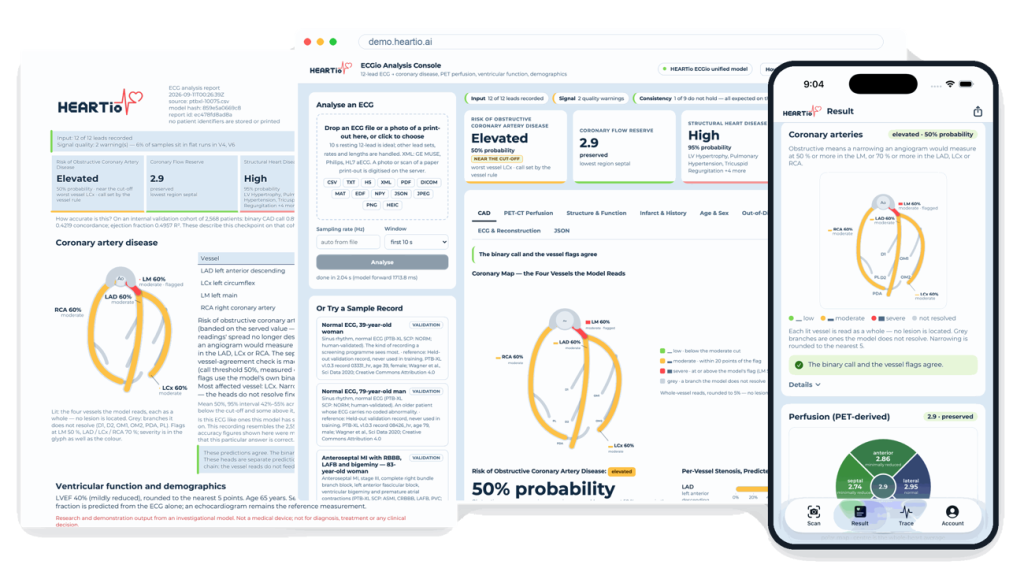
Our flagship product, ECGio, does something no one else can: it analyzes a standard 12-lead electrocardiogram, also known as an EKG or ECG, and uses AI to detect coronary artery disease in under one minute.
No incisions. No radiation. No dyes. And no special hardware.
It identifies plaque levels across all four major coronary arteries, stratifies risk, and delivers results directly into existing electronic health record (EHR) workflows.
The profound thing is that ECGs are already being collected everywhere, and we’re simply unlocking the diagnostic intelligence hidden inside them.
We’re turning a $10 test into something that previously required thousands of dollars in imaging and invasive procedures.
Navigating MedTech Challenges
When asked about recent challenges in the sector, Jain explained:
Every MedTech company navigating FDA clearance knows the challenge: you’re coordinating the FDA, academic institutions, principal investigators, and clinical sites simultaneously but you’re never anyone’s top priority.
You have to maintain relentless focus and keep the pressure on, because your team and your investors are counting on you.
Physician skepticism toward AI was a real barrier early on, but the rise of generative AI has shifted that conversation enormously and clinicians are far more receptive today.
We’ve deliberately built a company that de-risks each of these challenges before they become existential.
How The Technology Has Evolved

When asked how HEARTio’s technology has evolved since launching, Jain noted:
We’ve never stopped pushing. From day one, we’ve committed to staying at the frontier of academic research. We are continuously adopting new model architectures, training methodologies, and regularization techniques as the field evolves.
As our dataset grew to 14 million+ ECGs, two things happened: our possible outputs expanded dramatically, and the clarity of our predictions sharpened significantly.
More data doesn’t just improve accuracy; it unlocks entirely new clinical questions you can answer.
Our platform vision has grown accordingly. We have multiple planned phases spanning different cardiac indications, primarily focused on coronary dysfunction first.
The long-term goal is replicating thousands of dollars of cardiac testing with a single 10-second ECG.
Key Company Milestones
When asked about some of HEARTio’s most significant milestones, Jain highlighted:
We’ve built something rare: a company that has executed capital-efficiently at every step.
In 2020, we received Breakthrough Device Designation, an FDA designation that acknowledges the device is novel and addresses a vital medical problem.
We’ve completed two large clinical studies: our first was published in 2021 on 1,659 patients, and our AI achieved 93% sensitivity and 87% specificity, while our second was published in 2026 with 16,476 patients and achieved 91% sensitivity and 89% specificity.
We have already recruited sites for our third and final study for FDA clearance.
As of 2026, we’ve been issued three patents. We’ve signed an LOI with Cardiology Consultants of Philadelphia, the largest cardiology practice in the United States. Shepherd Ventures III has committed to lead our Series A.
Each milestone has been deliberate, not lucky. We’ve built a clear, de-risked path to FDA clearance and commercialization.
Funding And Revenue
When asked about funding and revenue metrics, Jain shared:
We’ve raised $1.8M in pre-seed funding and are currently in our seed round, having raised $4.25M toward a $7M maximum.
We’ve also secured a Series A commitment from Shepherd Ventures III as lead investor, which is a strong institutional signal for where this company is heading.
On the revenue side, we’re pre-commercial pending FDA clearance, but our pipeline is ready to activate post-clearance.
Our unit economics are compelling, and our projected revenue scales from $5M in 2027 to $170M by 2031. And we’re expecting to announce exciting new funding partners very soon.
Total Addressable Market
When discussing the total addressable market HEARTio is pursuing, Jain explained:
Our initial market is $23B+ globally, representing every applicable ECG performed worldwide.
In the U.S. alone, focusing on ER and outpatient cardiology, the serviceable addressable market is $3B. Our near-term serviceable obtainable market through existing and similar partners is $300M, which is more than enough to build a substantial company.
But that’s just the beginning. Every new clinical indication we add, FFR, ejection fraction, pulmonary embolism, aortic stenosis, opens an entirely new market.
In the next 5 years, we want to expand to wearables and consumer-facing ECGs, which will be at least a magnitude larger.
We’re not just building a product, we’re building the platform that defines the future of cardiac diagnostics.
Competitive Differentiation
When asked what differentiates HEARTio from its competition, Jain emphasized:
Our competitors are either solving a different problem or require expensive specialized hardware that limits where they can be deployed. Most recognized technologies, for example, sit downstream and require CT imaging.
We sit upstream, at the point of care, working from a standard ECG that’s already being collected everywhere.
Our accuracy is roughly 90% versus the 60% standard of care, and we deliver results in under a minute with zero radiation, zero hardware, and zero workflow disruption.
We’ve trained on 14 million proprietary ECGs with 10 years of patient outcome data. This dataset would be extraordinarily costly and time-consuming to replicate.
We hold FDA Breakthrough Device Designation, three issued patents, and are the first product to assess anatomic coronary disease from any ECG. That combination doesn’t exist anywhere else.
Future Goals
When discussing HEARTio’s future goals, Jain said:
Our immediate goal is FDA clearance in 2026 via the 510(k) Breakthrough Device Designation pathway, which shortens and de-risks the regulatory timeline significantly.
From there, we launch commercial sales in 2027, starting with the Cardiology Consultants of Philadelphia (CCP) and the Allegheny Health Network (AHN).
Clinically, we expand our platform from anatomic CAD detection into functional disease assessment, including Fractional Flow Reserve (FFR), ejection fraction, aortic stenosis, pulmonary embolism.
Long-term, we’re targeting a Category I CPT code status, which signals true standard-of-care adoption, and OEM integration with major ECG hardware providers like Philips and GE HealthCare, which would give us instant penetration into thousands of hospitals globally.
The destination is a world where no one suffers a first heart attack. Everything we’re building points there.
Pittsburgh And Philadelphia Innovation Ecosystems
When invited to discuss another topic, Jain concluded:
Pittsburgh and Philadelphia don’t always get the credit they deserve as innovation ecosystems. The University of Pittsburgh, Allegheny Health Network, Cardiology Consultants of Philadelphia, Penn, and the Wharton School have all been extraordinary partners in getting us here.
This company is a product of those institutions believing in us early.
I also want to say something I genuinely mean: the AI that powers HEARTio isn’t theoretical to me. I’ve run our demo on my own friends and family, and they’ve gone on to receive cardiac care they wouldn’t have sought otherwise.
That’s how I know, with absolute certainty, that this technology can save lives at scale. We’re very close to making that a reality and we’re excited to announce new funding partners soon that reflect exactly that momentum.

