

Impinj develops RAIN RFID technology that connects everyday physical items to digital systems, enabling enterprises to identify, track, and understand the movement of products and assets in real time. Its platform combines endpoint ICs, labels, readers, software, machine learning, and data infrastructure to help organizations turn item-level information into operational intelligence for AI and automation. Pulse 2.0 interviewed Impinj VP of Product and Solution Marketing Matt Branda to learn more about the evolution of RAIN RFID, the concept of Physical Intelligence, and how real-world item data can support enterprise AI systems.
Matt Branda’s Background

When asked about his background, Branda shared:
I’ve spent my career in technology, with a particular focus on wireless systems, semiconductors, and IoT.
Over the past two decades, I’ve worked across product management, marketing, and technology strategy. Before joining Impinj, I held leadership roles at Qualcomm and Cypress Semiconductor.
Since joining Impinj in 2018, my focus has been on helping advance RAIN RFID and its role in connecting the physical and digital worlds.
We’re at an exciting inflection point. RAIN RFID has evolved far beyond traditional identification and tracking to connecting billions of everyday items and turning the data they generate into intelligence that can power enterprise systems, AI, and automation.
My experience and focus on how emerging technologies translate into real-world business value has really shaped my perspective on the incredible opportunity ahead for RAIN RFID and Impinj.
How RAIN RFID Works
When asked about the history of RAIN RFID and how the technology works, Branda explained:
RAIN RFID is a passive, battery-free wireless IoT technology that connects everyday items, such as retail merchandise, groceries, and shipping packages, to the AI-powered digital world.
The foundation of this connectivity is tiny endpoint ICs, each about the size of a grain of sand, that can be embedded or attached as RAIN RFID labels to everyday items for pennies.
Reading products and solutions wirelessly identify and track items at speeds up to 1,000 items per second and distances up to 10 meters without line-of-sight.
The resulting data on what items an enterprise has, and when and where these items are moving, can then be shared with enterprise AI systems, applications, and analytics platforms.
Over the past 25 years, RAIN RFID technology has evolved from being primarily utilized as an identification solution that improved the accuracy and speed of manual inventory counting, to enterprise item visibility and traceability solutions that are an essential and trusted data layer to enterprise decision-making, automation, and business outcomes.
Today RAIN RFID products and solutions identify and track tens of billions of everyday items, providing real-time operational insights that enable businesses to visualize everything, waste nothing, and act instantly.
Evolution Of The RAIN RFID Ecosystem
When asked how the RAIN RFID ecosystem has evolved across tags, endpoint chips, readers, software, and cloud platforms, Branda said:
Over the last decade, the RAIN RFID ecosystem has matured into a full-stack technology platform that delivers complete enterprise solutions globally.
Today’s RAIN RFID solutions combine advancements in RAIN RFID ICs and labels to connect more items with autonomous RAIN RFID reading systems that automatically capture item data with manual intervention to deliver real-time operational intelligence.
This evolution has enabled organizations to move beyond simply knowing an item’s identity to instead understanding where it is and how it is moving through their operations and supply chains.
As data volumes have increased, software and cloud platforms have become increasingly important for transforming the item-level visibility RAIN RFID provides into actionable insights and automated workflows at scale.
Enterprise Use Cases
When asked which RAIN RFID use cases are delivering the greatest value for enterprises, Branda highlighted:
The most impactful use cases today are being led by visionary enterprises that are automating their operations using fixed reading solutions for supply-chain chokepoint visibility and automation, automated store replenishment, automated self-checkout and item-level loss prevention.
What we’re consistently seeing is that when organizations can accurately understand what inventory they have and where it is, they can reduce waste, improve availability, and operate far more efficiently.
For example, leading fashion retailer Inditex uses RFID tags on every item it manufactures. That item-level visibility enables more responsive replenishment based on what’s actually selling and in stock, not just last month’s forecast.
As a result, compared with an industry average of 10% to 20% unsold inventory, Inditex cut its unsold inventory to just 0.57%.
In logistics and transportation, UPS has deployed RFID across its U.S. package cars, delivery facilities, and packages shipped from more than 5,500 UPS Store locations to enable automated package scanning. UPS reports that this has decreased misloads by nearly 70%.
When it comes to food traceability, Chipotle uses RFID-based traceability across its supply chain, enabling the restaurant chain to respond to a recall within hours rather than days or weeks.
These are all examples of companies turning better operational visibility into measurable business outcomes.
AI, Automation And Real-Time Data
When asked how AI, automation, and real-time analytics are expanding the value enterprises can generate from item-level information, Branda explained:
As enterprises pour billions into AI initiatives, the conversation is shifting from collecting data to acting on it.
Organizations are using real-time, item-level data to automate workflows, optimize replenishment, improve fulfillment, predict disruptions, and support faster decision-making across the business.
UPS, for example, describes RFID as the “eyes and ears” of its network, generating data from the billions of packages moving through its network, while AI serves as the “brain” that turns that information into decisions, predictions, and actions.
As AI adoption accelerates, the organizations seeing the greatest returns are increasingly the ones pairing AI with trusted, real-world operational data.
Physical Intelligence
When asked to explain the concept of Physical Intelligence and why it matters to enterprises, Branda said:
Physical Intelligence is the data layer that connects the physical world to the AI-powered digital world.
Enterprise AI can only make decisions based on what it can see, but right now, most of the physical world is invisible to AI systems.
That means AI can’t tell when a product is on the wrong shelf in a store, a package never made it onto the right truck for delivery, or a perishable item is approaching expiration.
Physical Intelligence closes that gap, providing a foundational data layer that feeds AI with accurate, real-world data.
It gives individual items a digital identity using RAIN RFID and provides continuous, real-time visibility into what they are, where they are, and how they’re moving.
In other words, it makes the physical world visible to AI systems, giving them the item-level context they need to operate effectively.
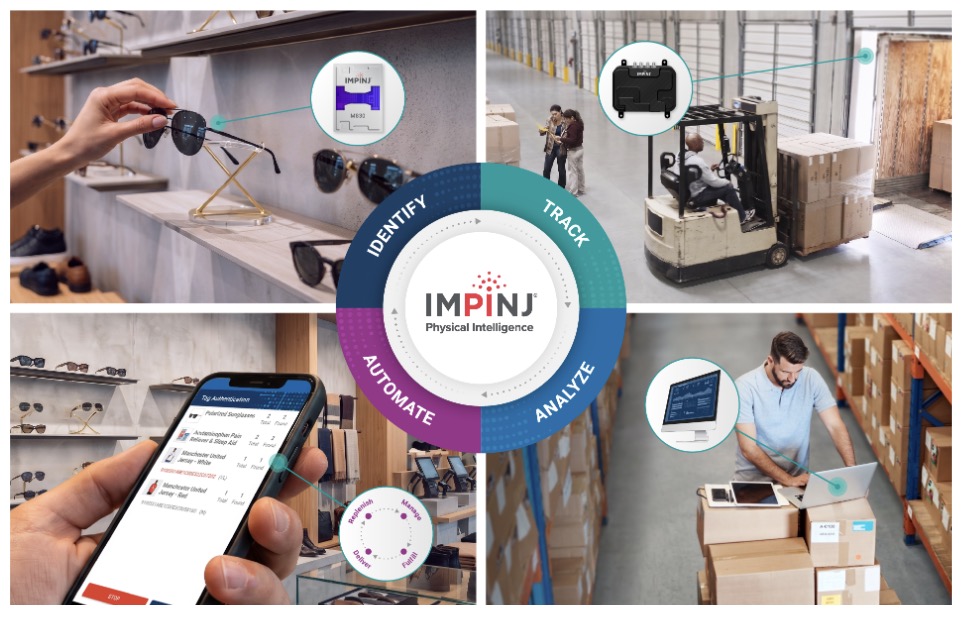
Physical Intelligence identifies and tracks items, enabling enterprises to analyze item-level data for better operational insights, and automate and optimize their workflows.
While enterprise AI investment is accelerating rapidly, exceeding $300 billion over the last year alone, many companies continue to face challenges realizing the full value of that investment.
The companies seeing real returns are the ones feeding their AI not just more data, but better data, so they can be confident their AI is acting on what’s actually happening in the real world, not just guessing at it.
Physical Intelligence Versus Physical AI
When asked whether Physical Intelligence is the same as Physical AI, Branda explained:
Physical Intelligence and Physical AI are not the same thing.
Physical Intelligence is real-time, trusted item data as covered in the previous answer.
Physical AI are AI systems that interact with the physical world rather than operating solely in software or digital environments.
Physical Intelligence fuels Physical AI systems with real-time, item-level data, identity, location, dwell time, authenticity, etc., and business-critical use-case events, item shipped, item expired, item stolen, etc.
Physical AI systems include Agentic AI and machine learning that consume Physical Intelligence to automate workflows, make business decisions, visualize the data, and drive behaviors, both machine and human.
Industries Using Physical Intelligence
When asked which industries are being most affected by Physical Intelligence, Branda said:
Physical Intelligence is already reshaping operations across industries where item-level visibility is mission-critical, including retail, logistics and transportation, food and supply chain.
The technology is also being applied in airports, hospitals and manufacturing, where individual items can range from baggage and packaged medications to electronic components.
Regardless of the industry, the greatest impact is showing up where item-level precision directly drives cost, safety, or speed, reducing waste and misallocated inventory, cutting errors in high-volume logistics, and enabling a fast, targeted response when something goes wrong — a recall, lost package, or stockout.
Future Growth Of RAIN RFID
When asked which industries, applications, and technology developments could drive the next phase of growth for Impinj and the broader RAIN RFID market, Branda explained:
The next major phase of RAIN RFID growth will come as item-level connectivity expands beyond established markets such as retail apparel into more products, use cases, and industries, creating significantly more real-world data for AI and automation.
Enabling that expansion will depend increasingly on autonomous reading and technology that makes RAIN RFID easier to deploy, more reliable, and capable of working across a much broader range of items and environments.
That is where we are focused at Impinj.
Our platform combines machine learning to find moving items and confine read zones, enabling repeatable autonomous solutions that take the RF complexity out of RFID; Gen2X to improve item readability, particularly as connectivity expands to smaller, low-cost labels and more challenging items; and Voyantic label production and origination technologies to help ensure label quality and reliability and establish an item’s digital identity from the point of manufacture.
Just as important is turning those technologies into repeatable enterprise solutions.
Our solutions engineering and sales teams work closely with our global partner ecosystem to develop, deploy, and manage solutions that enterprises can scale.
Together, these innovations position the Impinj platform to deliver Physical Intelligence, the real-time item-level data that connects the physical world to the AI-powered digital world.
