

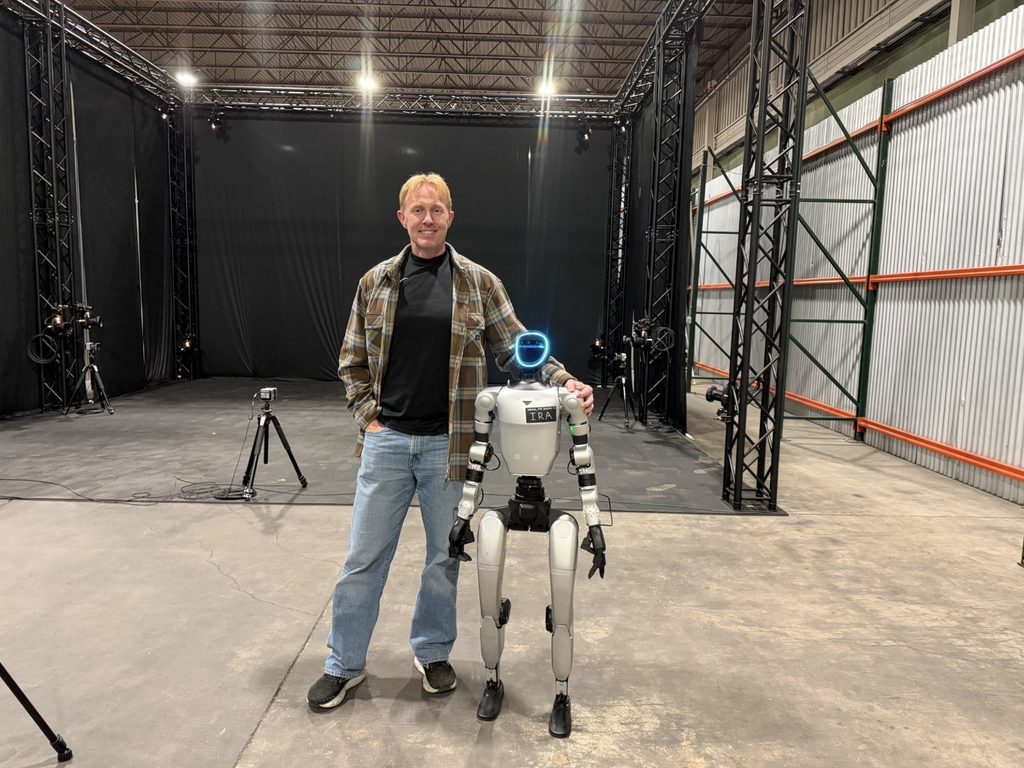
Innodata develops data and engineering solutions that support the training and deployment of artificial intelligence systems, including physical AI applications. Pulse 2.0 interviewed Innodata Vice President of Robotics and Computer Vision Frank Tanner to discuss the company’s new motion-capture facility, physical-world training data, model evaluation, robot safety, and public trust in autonomous systems.
Professional Background
Tanner leads Innodata’s efforts at the intersection of generative AI, physical AI, data-centric systems, and real-world deployment. Over a 30-year career, he has built and led AI programs across government, industry, and research, including leadership roles supporting mission-critical and national security programs at Amazon Web Services, Sandia National Laboratories, and Raytheon Technologies.
His work has contributed to advanced systems supporting the Hubble Space Telescope and the James Webb Space Telescope. Tanner has authored more than 20 publications and is an inventor on 11 patents in artificial intelligence and computer vision. He also serves on the Executive Committee of the Applied Imagery Pattern Recognition Workshop and was lead editor of its 53rd proceedings volume, published in 2026 as part of Springer’s Lecture Notes in Computer Science series.
Physical AI And Motion-Capture Facility
When discussing Innodata’s new facility and the need for high-quality 3D movement data, Tanner shared:
Our new lab is designed to generate precise, three-dimensional data showing how people move and perform real tasks, including body motion, hand movements, and interactions with objects. By combining motion capture with synchronized video and wearable sensor data, we can connect what an AI system sees with how a task is physically performed. We use those demonstrations to support robot training and simulation, then evaluate how well the learned behavior transfers to a physical robot.
High-quality movement data remains a significant gap because the internet’s abundance of images and video does not provide the same abundance of physically grounded demonstrations. A video can show someone picking up an object, but it generally does not provide accurate 3D trajectories, joint positions, or the contact and force information needed to fully describe the action. Human movement also has to be translated to robots with different bodies, capabilities, and constraints. Collecting useful training data therefore requires careful calibration, synchronization, and coverage of different tasks, objects, and conditions, including unsuccessful attempts and recovery behaviors. Our focus is on making that data accurate, consistent, and useful for learning. The goal is not simply to make a robot reproduce a human motion, but to help it complete a task reliably in the real world.
Understanding Human Movement Over Time
Explaining how temporal motion-capture data can improve AI systems and support new applications, Tanner noted:
Temporal motion-capture data helps AI understand how movement unfolds over time: the sequence, timing, coordination, and adjustments that make an action successful. A single pose tells you where someone’s body is at one moment. A continuous 3D recording shows how they reach, establish a grasp, shift their weight, and respond when something changes. That context can help models recognize actions, anticipate what happens next, and learn the relationship between movement and task outcomes.
For our lab, one of the most promising applications is learning from human demonstrations to train robots for manipulation and whole-body tasks. Another is developing physics-based world models that predict how people, objects, and their surroundings will respond to an action. Paired with object tracking and contact information, motion-capture data can help ground those predictions in measured physical behavior, supporting systems that can evaluate possible actions before executing them. Other promising applications include realistic simulation, ergonomic analysis, rehabilitation, sports performance, and digital human modeling. Across these uses, the value comes from connecting movement to context and outcomes, so AI can learn how people adapt their actions to accomplish a goal.
Emerging AI Data Bottlenecks
Looking ahead, Tanner identified physical-world data and model evaluation as two increasingly important bottlenecks:
There are significant data gaps in all of those areas, but two that I see becoming especially important are physical-world data and model evaluation. In physical AI, we need data that connects perception, action, and physical consequences over time: how people and robots interact with objects, how contact and force affect an outcome, and how a system responds when something unexpected happens. Internet-scale images and video provide a valuable foundation, but they often lack the precise movement, interaction, and outcome data needed to train robots and physics-based world models.
Model evaluation is closely connected to that challenge, particularly when it comes to the trust and safety of physical AI systems. When AI acts in the physical world, errors can have physical consequences. As a parent, I’m not going to trust a humanoid robot around my kids without evidence that it can respond safely when my kids do something unpredictable (and they always do something unpredictable). We need to evaluate whether systems complete tasks reliably, recognize their limitations, and respond safely around people, including under unfamiliar conditions and during failures. Building trust requires evidence of consistent behavior across those situations. The biggest opportunity is to connect evaluation directly to data collection, using observed weaknesses to determine what data we need next and then measuring whether that data produces meaningful improvements in capability and safety.
Building Public Trust In Physical AI
When discussing what will be required to earn public trust in physical AI, Tanner emphasized independent evaluation and certification:
Robotics and physical AI has a long road ahead toward earning public trust. Autonomous driving has established oversight through agencies such as NHTSA and independent accident investigation through the NTSB. Robotics has existing safety standards and certification programs, but I believe we need a more comprehensive approach to evaluating the learned behavior of autonomous systems, especially humanoids operating around people. That means independently testing how they handle unpredictable human actions, unfamiliar situations, and failures, with clear boundaries around what has actually been validated. That evaluation will also need to account for adaptation on both sides: robots will need to respond to unpredictable human behavior, while people will likely change how they interact with robots as they become more familiar with them over time. In my view, independent third-party evaluation, and ultimately certification appropriate to the application, will be essential to widespread adoption. People need credible evidence that these systems can operate safely beyond a carefully controlled demonstration.
