INTX Insurance Software is redefining how insurers operate by delivering a modern, unified Insurance Operating System for specialty P&C carriers, reinsurers, MGAs, and fronting programs. The platform connects the full insurance lifecycle from underwriting and policy administration to billing, claims, reinsurance, and reporting within a single operating system.
Pulse 2.0 spoke with CEO Robert Lewis about INTX’s global foundations, its expansion into the U.S. market, and how the company is gaining traction by challenging legacy insurance technology models.


Background About The Company
Could you tell me more about INTX Insurance Software?
Lewis said:
“INTX delivers a modern Insurance Operating System that serves as the system of record, execution, and insight for P&C insurance and reinsurance operations. Rather than stitching together fragmented tools, carriers can manage the entire policy lifecycle–underwriting, billing, claims, reinsurance, accounting, compliance, and reporting–all within a single, unified platform. Coupled with INTX’s open API architecture, insurers can use their existing or any tool they choose to attach to their core operations.
While INTX formally expanded into the U.S. market in 2022, the platform itself has been proven globally for more than two decades. Since 2001, it has supported carriers operating across multiple jurisdictions, including London, Europe, and Africa, and in highly complex specialty and reinsurance environments. That global operating experience is foundational to how the platform was designed.”
Formation Of The Company
How did the idea for the company come together?
Lewis shared:
“My co-founder Devon Ellett and I both come from deep operational backgrounds in the P&C insurance and reinsurance markets, particularly in London and international specialty lines. Over the years, we repeatedly encountered the same issue: insurers were being forced to run critical operations on fragmented, outdated systems that simply weren’t built for the complexity of modern insurance.
What began as frustration evolved into conviction. The industry didn’t need incremental tools or point solutions, it needed a fundamentally better operating system. We invested in building a platform that could support real-world insurance operations across geographies, products, and regulatory environments. That foundation became INTX.
When we looked at the U.S. market, the opportunity was clear. Despite its size and sophistication, core insurance technology had not kept pace. We believed we had both the responsibility and the experience to bring a proven, modern operating model to U.S. carriers.”
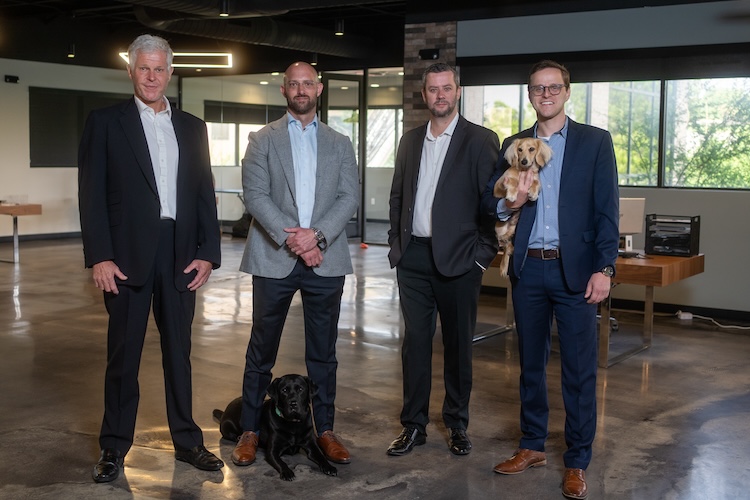

(INTX executives left to right: Rob Lewis, CEO; Nick Squier, CFO, Devon Ellett, COO; Will Perrone, Chief Experience Officer. Non-officers left to right, Lady and Roma.)
Core Products
What are the company’s core products and features?
Lewis explained:
“INTX Insurance Software is redefining how insurers operate by delivering a modern, unified Insurance Operating System for specialty P&C carriers, reinsurers, MGAs, and fronting programs. The platform connects the full insurance lifecycle from underwriting and policy administration to billing, claims, reinsurance, and reporting within a single operating system.”
Challenges Faced
Have you faced any challenges in your sector of work recently? Lewis acknowledged:
“The biggest challenge isn’t technology… it’s inertia. Many insurers continue to operate on legacy systems because the cost, risk, and disruption of change feel overwhelming. As a result, even carriers with PAS contracts often rely heavily on spreadsheets and manual processes to run core operations.
Ironically, Excel has become one of the most common “systems” we compete against. That reliance highlights how poorly legacy platforms support real operational needs. It also reinforces why a unified operating system approach is so important.
To address this, INTX offers a zero-cost implementation model. By removing large upfront fees and opaque contracts, we’ve lowered the barrier to change and enabled carriers to evaluate modern technology on its merits rather than sunk costs.”
Evolution Of The Company’s Technology
How has the company’s technology evolved since launching?
Lewis noted:
“When we entered the U.S. market, we treated it as a strategic reset. We rebuilt the platform line by line as a modern, cloud-native, API-driven Insurance Operating System, without the pressure of active U.S. clients.
That allowed us to modernize the architecture, improve scalability, and ensure the platform could support continuous integration with partners, data providers, and analytics tools. The result is a system designed not just for today’s requirements, but for how insurance will operate in the future.”
Significant Milestones
What have been some of the company’s most significant milestones?
Lewis cited:
“Market validation has been the most meaningful milestone. 2025 marked our first full year in the market and we were able to partner with 10 clients across specialty, P&C, and reinsurance, including sophisticated organizations with rigorous security, compliance, and operational requirements.
Those early implementations confirmed that our model works, not just technically, but commercially and operationally. Each successful deployment strengthens our credibility and reinforces that carriers are actively looking for alternatives to legacy systems.”
Customer Success Stories
Although you have just launched in America, can you share any specific customer success stories?
Lewis highlighted:
“One recent example involved a reinsurer that had previously cycled through multiple systems and was frustrated by the lack of transparency and control. From the outset, they were demanding, but entirely reasonable. Their expectations aligned with what modern software should deliver.
While still early in the implementation, the client has already expressed strong confidence in both the platform and their ability to scale with it. For us, success is measured by whether clients feel empowered operationally—and whether the technology fades into the background so they can focus on underwriting and growth.”
Total Addressable Market
What total addressable market (TAM) size is the company pursuing?
Lewis assessed:
“The addressable market for core insurance and reinsurance platforms is approximately $14 billion today and is expected to grow to around $20 billion by 2030. Our focus is specialty carriers and reinsurers—organizations with complex needs that are poorly served by legacy systems.
Our goal is disciplined growth. If we reach 20 clients by 2027, we believe we’ll be on a strong trajectory toward meaningful scale and long-term revenue growth.”
Differentiation From The Competition
What differentiates the company from its competition?
Lewis affirmed:
“First, INTX is a unified Insurance Operating System, not a collection of loosely connected modules. Second, it’s purpose-built for specialty P&C and reinsurance complexity. Third, the platform is modern, configurable, and API-driven, allowing carriers to evolve without constant re-implementation or limited integration options.
We also remove many of the traditional friction points: zero-cost implementation, transparent pricing, and flexible contracts. Finally, our team brings deep insurance operating experience, which means we understand our clients’ challenges at a practical level, not just a technical one.”
Future Company Goals
What are some of the company’s future goals?
Lewis concluded:
“Our goal is to fundamentally improve how insurance operates, making carriers more agile, more profitable, and better equipped to serve policyholders. We want insurance professionals spending time on risk, insight, and growth rather than reconciliation and workarounds.
Based on our current momentum, we’re well ahead of plan and focused on scaling thoughtfully while continuing to deliver measurable operational value to our clients.”

