

Jeh Aerospace is a software-driven manufacturing company that provides high-precision aerospace and defense components—specifically aerostructures and aero-engine parts—using AI and robotics to accelerate supply chain production for global customers. Pulse 2.0 interviewed Jeh Aerospace founder and CEO Vishal Sanghavi to learn more.
Vishal Sanghavi’s Background

Could you tell me more about your background? Sanghavi said:
“I’ve dedicated over two decades to aerospace and defense, starting with the Tata Group, where I helped establish and lead joint ventures with Boeing, Lockheed Martin, and Sikorsky. That experience taught me how to build factories from the ground up, scale global programs, and deliver to the uncompromising standards of a safety-critical industry. I was fortunate to be part of the Tata Administrative Services, flagship leadership cadre program for the Tata Group, and was later nominated to Boeing’s Organizational Leadership Program—both of which shaped my perspective on building at scale with purpose.”
“Jeh Aerospace is the natural extension of that journey. It’s my response to a fragile global supply chain: a company designed to fuse India’s engineering talent with America’s aerospace market depth, creating a resilient, digitally driven manufacturing backbone for the future.”
Formation Of The Company
How did the idea for the company come together? Sanghavi shared:
“The idea for Jeh Aerospace was born out of two realities. First, Tier-1 and Tier-2 precision manufacturing—the muscle between system integrators and raw-material vendors—remained underserved. Second, India’s role in aerospace was too often reduced to low-cost supply, when in fact the country could be a true reliability engine if its engineering talent were combined with digital manufacturing.”
“Then came two back-to-back black swan events: the Boeing 737 Max crisis and the COVID-19 pandemic. Both fractured global supply chains—factories shut down, talent was displaced, and yet demand came roaring back in a V-shaped recovery. The result was a widening gap between what the industry needed and what existing supply could deliver.”
“During our time at the Tata Group, we had unlocked India’s potential for OEMs like Boeing, Lockheed, and GE. But no one was addressing the Tier-1 and Tier-2 layers, where most of the real bottlenecks lay. We saw a clear white space. That’s why we founded Jeh Aerospace: a new-age manufacturing company that leverages talent and technology across the U.S. and India to build resilience in this industry and ensure that flight-critical supply chains can keep pace with global demand.”
Favorite Memory
What has been your favorite memory working for the company so far? Sanghavi reflected:
“My most cherished memories are always tied to moments of genuine customer appreciation. For GS Precision—a leading Tier-1 to GE and other aero-engine OEMs—we were entrusted with flight-critical, hard-metal components that demanded extreme precision. In just six months, we built an entire shop from scratch—machines, materials, people, and processes—and delivered those parts on time. The day we received a letter from their VP of Operations and Quality, acknowledging that not only had we met their exacting standards but exceeded expectations on our very first delivery, was unforgettable.”
“Another milestone that stands out came with RH Aero, the world’s largest aero-engine tooling manufacturer. At their 2024 supplier symposium, out of 100 suppliers, they recognized our team at Jeh Aerospace as “Best New Supplier of the Year.” That recognition reflected not just quality and delivery, but also the transparency and trust we strive to build with every customer.”
“Moments like these—earning trust, delivering on promises, and being celebrated by the very customers we exist to serve—are what define Jeh Aerospace for me.”
Core Products
What are the company’s core products and features? Sanghavi explained:
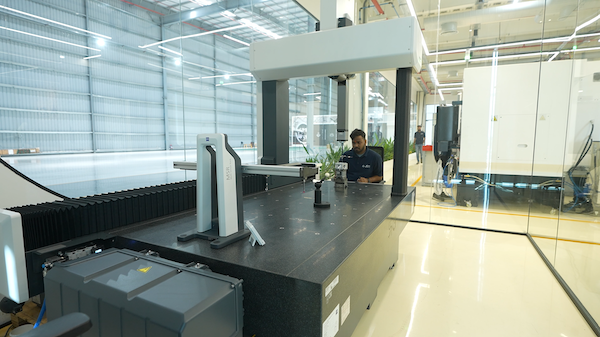
“At Jeh Aerospace, our core strength is precision machining—any geometry, any complexity, any material. From aluminum to titanium to Inconel, we consistently deliver flight-critical components that meet the most demanding aerospace standards.”
“We’ve transformed the new product introduction (NPI) cycle—reducing average lead times from the industry norm of ~15 weeks to just 15 days. Our On-Time Delivery (OTD) and First-Time Quality (FTQ) consistently meet or exceed global aerospace benchmarks. In practice, that means customers get conforming parts, delivered on time, every time—with speed and certainty.”
“What makes this possible is our proprietary, software-defined manufacturing system, which integrates people, processes, and machines into a closed-loop platform. This not only ensures repeatability and zero-defect execution today but also creates the foundation for future exponential growth as we expand into more complex parts and advanced special processes.”
Challenges Faced
Have you faced any challenges in your sector of work recently? Sanghavi acknowledged:
“Credibility is earned part by part. As a young company, we had to prove zero-defect intent with zero-defect outcomes. We built teams with a safety-first mindset, instrumented processes digitally, and prioritized external qualifications—AS9100, customer approvals, and program audits. The payoff is that we’ve delivered 200,000+ flight-critical parts, grown to 150+ engineers and technicians, and secured $150M+ in long-term contracts in ~18 months—evidence that consistency scales.”
Evolution Of The Company’s Technology
How has the company’s technology evolved since launching? Sanghavi noted:
“From day one, we operated ‘software-up.’ Our shop-floor system started as a way to spot bottlenecks; it’s now the nervous system for traceability, predictive analytics, and process automation across planning, inspection, and delivery. The goal isn’t dashboards—it’s trust when customers see precisely how their flight-critical parts move through our lines and why we’ll hit quality and OTD. We continue to layer AI, advanced inspection, and spatial/AR workflows as we scale.”
Significant Milestones
What have been some of the company’s most significant milestones? Sanghavi cited:
– Long-term partnership with GS Precision to manufacture precision aero-engine components at a dedicated facility.
– Series A of $11M led by Elevation Capital with participation from General Catalyst.
– IndiGo Ventures’ investment from the airline’s new CVC fund.
– Operational traction: 200k+ parts delivered; 150+ team; $150M+ in long-term contracts.
Customer Success Stories
Can you share any specific customer success stories?
Please refer to the GS Precision customer press release here
Funding/Revenue
Are you able to discuss funding and/or revenue metrics?
“We cannot discuss revenue at this time, however, we’re proud to share that we received Series A and IndiGo investments this past summer. Details are here: Series A and IndiGo.
“We also received this article in TechCrunch from our US funding news.”
Total Addressable Market (TAM)
What total addressable market (TAM) size is the company pursuing? Sanghavi assessed:
“We operate inside the aircraft machining / machined components slice of the broader aerospace parts market. Recent estimates size aircraft machining at approximately $31–32 billion in 2024 and growing toward $40 billion by 2032. The broader aerospace parts manufacturing market is ~$950B–$1T+ in 2024–2025, growing mid-single digits. Our near-term SAM focuses on commercial aero-engine and aerostructure metallic components sold to Tier-1/2 suppliers serving Airbus and Boeing programs.”
Differentiation From The Competition
What differentiates the company from its competition? Sanghavi affirmed:
– Precision: Flight Critical complex parts, hard-metal capability, special processes—built for aero-engine tolerance stacks.
– Digital: Proprietary shop-floor system that surfaces issues early, enforces traceability, and gives customers program-level transparency.
– Culture: Zero-defect mindset backed by certifications, global qualifications, and a bias for delivering proof over promises.
It’s why we can scale quickly without compromising standards—and why Tier-1s trust us with flight-critical work.”
Future Company Goals
What are some of the company’s future goals? Sanghavi concluded:
“Our focus is on scaling deliberately and sustainably. In aerospace, speed matters, but only if it’s matched by precision and trust. That’s why we’ve built a modular production model—dedicated customer lines with their own planning, quality gates, and workflows, all anchored to a common digital backbone. This allows us to add capacity without disrupting ongoing programs.”
“In the near term, we are expanding into larger and more complex components, advanced special processes, and integrated assemblies, while deepening our presence with leading Tier-1 and Tier-2 partners. Over the next few years, our goal is to make Jeh a preferred partner for aero-engine and aerostructure manufacturing, with India as the execution hub and the U.S. as the demand center.”
“Moving ahead, we aspire to make ‘Jeh = resilience’ in global aerospace supply chains. We want to be recognized as a company known not just for parts delivered, but for de-risking programs, enabling transparency, and creating confidence for OEMs and Tier-1s across the world.”
