

KODE Labs develops a cloud-native, vendor-agnostic operating system for smart buildings and real estate portfolios. KODE OS connects building management systems, IoT devices, energy systems, controls, analytics, and operational data into a unified platform that gives operators, engineers, and owners one place to manage buildings and portfolios. Its capabilities span centralized BMS control, fault detection and diagnostics, digital commissioning, portfolio analytics, machine-learning-driven optimization, asset management, work orders, sustainability, and AI assistance. Pulse 2.0 interviewed KODE Labs Co-Founder Etrit Demaj to learn more about the company’s origins, its approach to building data, and how AI could enable increasingly autonomous building operations.
Etrit Demaj’s Background

When asked about his background, Demaj shared:
I came to the U.S. from Kosovo in 1999. I was 10. My brother Edi was 14. We were refugees. We’d lost everything, and a program brought us to Detroit.
The first thing I remember as the plane came into New York was the Empire State Building out the window. I didn’t know what it was. I just remember thinking it was the most extraordinary thing I’d ever seen.
Before KODE, I spent a few years in the smart building space, boots on the ground, working with controls, sensors, front ends, third-party analytics packages, seeing exactly what worked and what didn’t at the building level.
Edi and I had also started learning what successful exits looked like as we built and rebuilt from scratch.
In October 2017, we founded KODE Labs in Detroit. KO for Kosovo, DE for Detroit. The two places that made us.
I think about that 10-year-old on the plane a lot. My hope is that my kid sees what you can actually build in this country if you just refuse to stop. That’s the fuel.
How KODE Labs Started
When asked how the idea for KODE Labs came together, Demaj explained:
Every building on the planet generates more data than almost anything out there.
Temperature sensors, energy meters, air quality, occupancy, etc. Thousands of data points per building, all day, every day.
Almost none of it was usable. It was locked in proprietary systems, fragmented across vendors, impossible to compare from one building to the next, let alone across a portfolio.
Before KODE, we were trying to build smart buildings by stitching together multiple third-party platforms, building by building.
It was expensive, manual, with very little scale, and no way to deliver impactful client service.
There was no enterprise-grade platform you could deploy across a portfolio. There was no Palantir or Salesforce equivalent in real estate.
The industry continued to believe the cloud wasn’t safe for buildings. You had to stay on-premises.
We believed the opposite.
We knew the cloud was the only way to scale, reuse logic across buildings, and make smart building technology work at an enterprise level.
So we built KODE OS, a vendor-agnostic platform that could sit on top of whatever systems a building already had, normalize all that data, and let operators run their entire portfolio from one place.
Seven years later, cloud-based building management is the industry standard. We just got there first.
Favorite Memory
When asked about his favorite memory working for KODE Labs, Demaj said:
My favorite memory of KODE isn’t a single moment. It’s a chapter that started on day one and is still evolving.
In the early days, I’d sit down with young team members in their early twenties and a few in their 40s who were new to startups.
I’d paint them a picture, not a pitch deck. What this company will look like. How buildings will run differently because of what we build. How the people in that room will grow with it.
Basically, asking them to bet on something that didn’t exist yet.
For some, I’d go sit down with their families.
When you’re asking someone to commit long-term to something unproven, you’re not just asking them. You’re asking the people who depend on them to be all in.
Those conversations mattered. That trust, once earned, became the foundation of everything.
Those same people helped us sign Bedrock in Detroit, our first client, when nobody believed the cloud was the right path for buildings.
They helped us win the world’s largest commercial real estate portfolios.
And they helped us earn a multi-million-dollar contract from the United States government. Serving the best government in the world as immigrants who came to this country with nothing.
People ask me about milestones. The milestones are real, but this is the one I keep coming back to.
A group of young people who believed in a picture before it was real, stayed through the hard parts, and are still here now that it is.
We’re still early. That’s the part that keeps us bonded together and going.
Core Products And Features
When asked about KODE Labs’ core products and features, Demaj detailed:
Most building portfolios today are running six or more disconnected systems and software.
One for monitoring HVAC, another for fault detection, another for energy, another for work orders, etc.
The data doesn’t talk to each other, and the system and software are purchased separately.
The AI on top of it doesn’t work because the foundation is completely broken.
And the people running those buildings are drowning in alerts with no real insight, so they just don’t even log in.
KODE OS is the operating system that replaces all of that.
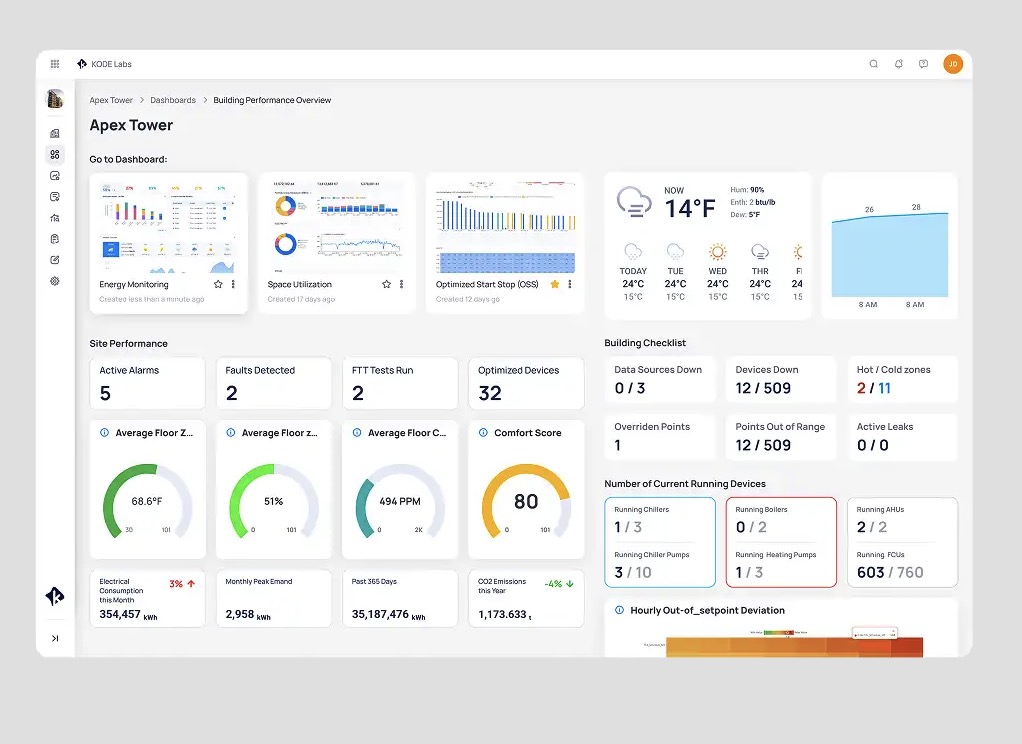
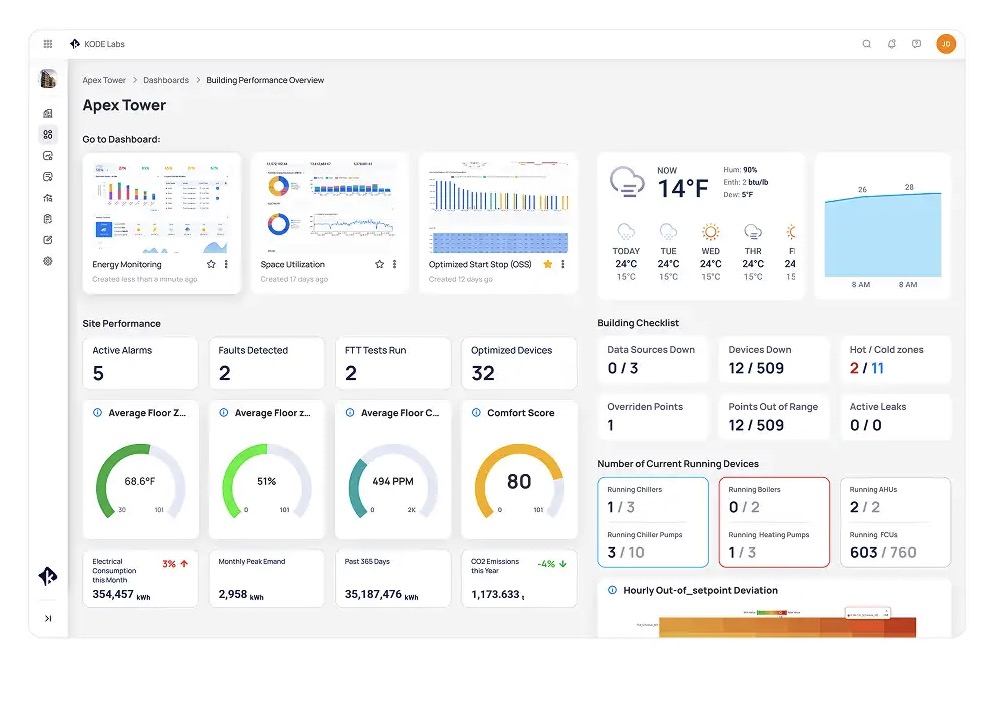
It’s cloud-native and vendor-agnostic. It sits on top of whatever BMS, IoT, and operational systems a building already has, normalizes everything into a single data layer, and gives operators, engineers, and owners one place to run their building and their portfolio.
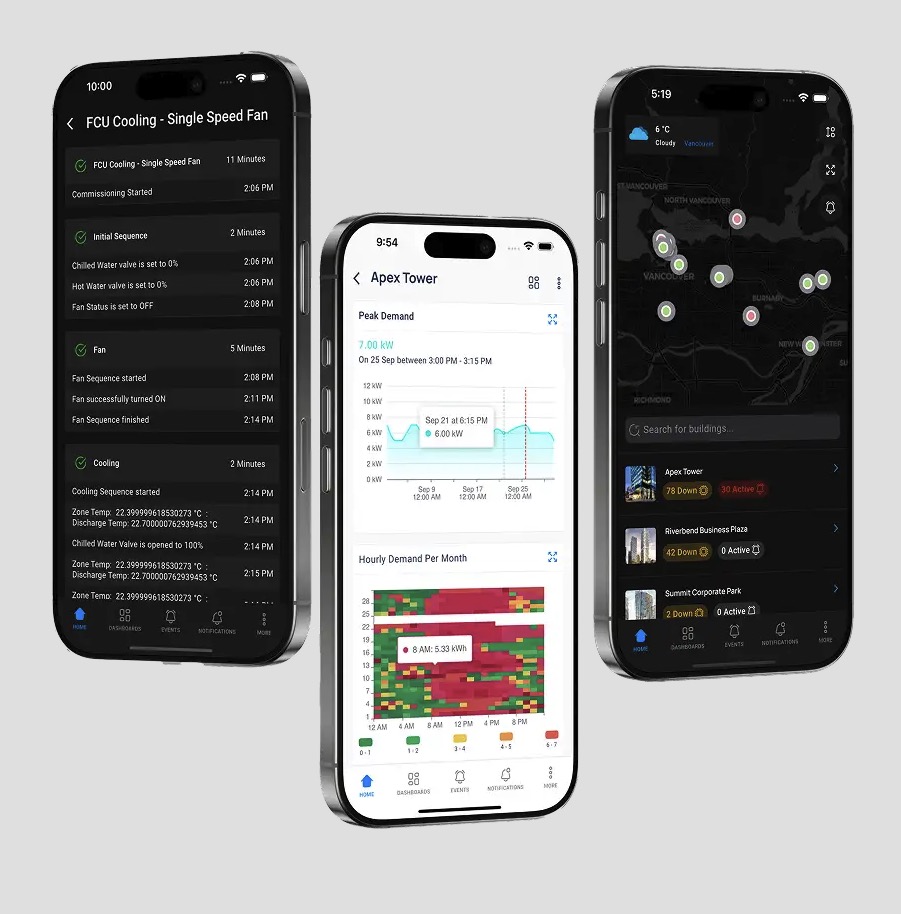
The platform has modules for everything: centralized BMS control, fault detection and diagnostics, digital commissioning, portfolio analytics, machine-learning-driven optimized start/stop, asset management and work orders, and EnerG, our AI-enabled utility and sustainability platform, which we launched earlier this year.
But beneath it all, the single most important thing we’ve built is a trusted data layer.
Buildings generate massive data, but most of it is fragmented and unreliable.
A sensor says equipment is running when it’s been off for six hours. A power meter reads zero while energy is being consumed.
AI cannot deliver real results on a broken foundation.
We fix the foundation first. Standardized, contextualized, continuously validated.
Then we layer intelligence and action on top.
That’s the difference between AI as a talking point and AI that actually runs buildings.
Everything runs on 250-plus pre-built integrations, available on iOS and Android, and accessible through a partner platform that lets system integrators deploy and build on KODE without writing code.
Overcoming Cloud, AI And Fundraising Challenges
When asked about challenges in the sector and how KODE Labs overcame them, Demaj identified three:
Three challenges.
First, the cloud.
When we raised our first round, we couldn’t get a meeting without someone telling us a cloud OS had no chance against on-prem servers that were embedded in specifications and into buildings around the world.
They weren’t wrong that it was hard, but got it wrong by saying it couldn’t be done.
Every chance we got, we proved it, building by building.
We created a new industry, so we have plenty of white space to go as it continues to catch up.
Second, AI.
It only works if the data beneath it is clean. AI built on bad data is just a confident wrong answer.
We tackled this from day one by fixing the foundation first.
That’s also why we continued to build more solutions to enable agents that work alongside different roles in buildings, helping them operate with the same brain and data.
Third, fundraising.
Our initial Series A round in 2022 was a challenge, even though Proptech was booming.
We weren’t just delivering analytics or simple solutions that investors thought could scale fast because the decks and spreadsheets looked good.
We were actually tackling the real problem that everyone avoided because no one believed we could make OEMs less relevant in buildings.
In 2023 and 2024, Proptech startups were bleeding from the losses and losing most of their value. Most were doing down rounds or emergency bridges.
This time, we had six offers to lead our Series B within the first five weeks.
This happened because of the team we built and the discipline we kept from day one.
Cash-flow positive since year one, and a fortress balance sheet for a company that showed major potential.
We never built a business that needed the next round to survive.
When the market collapsed around us, we had leverage.
The round reflected that.
How The Technology Has Evolved
When asked how KODE Labs’ technology has evolved, Demaj explained:
We started in 2017 with one conviction: software leads hardware, the platform stays open, and the client owns their data.
Everything we’ve built since has been an extension of that.
In the early years, we were one platform, deploying one building at a time, proving that the cloud works for buildings.
By 2019, we’d integrated our first large-scale portfolio.
2020 was when we started layering in machine learning and going to market, reaching out to thousands of people a week during COVID, and, back in the office, with most of the team at it 24/7.
By 2021, we were operating across North America.
In 2022, we productized the channel partner program and expanded into Australia and England.
Buildings are local, and the only way to scale globally is to train and certify the people who are already trusted in those markets.
Technically, we’ve kept extending what “single pane of glass” actually means.
250-plus API integrations now.
A normalized ontology we started with Google’s Digital Buildings and expanded to cover more systems and use cases than anyone else in our space.
Digital commissioning that tests thousands of devices in hours, instead of weeks.
FDD, AssetOps, machine-learning-powered optimization, and portfolio analytics that work at the portfolio level, not just the building level.
And then AI, embedded throughout the platform today.
FDD AI that detects equipment issues and ranks probable causes. FTT AI for commissioning diagnostics.
And our KODE AI Assistant, KAI, gives operators context-aware answers right on their screen.
EnerG extends the same rigor into utility and sustainability data.
The through-line hasn’t changed: software leads hardware, the platform stays open, and the client owns their data.
Key Company Milestones
When asked about some of KODE Labs’ most significant milestones, Demaj highlighted:
Bedrock, October 2017. Our first client.
They took a chance on a cloud-based platform when nobody believed the cloud was safe for buildings.
Without them, there’s no KODE.
QuadReal. They told us their mission was to be the smartest portfolio in the world.
We did one building, and they expanded us globally across their real estate in Austin, Toronto, Melbourne, and beyond.
It was the moment we knew global enterprise deployment was real.
Series B, April 2024. Thirty million dollars led by Maverix Private Equity, with TELUS Ventures and I Squared Capital.
Closed in 60 to 90 days in a market where our peers were struggling.
Brings total funding to $38 million, and we still have the capital available.
The GSA contract, 2024. The U.S. General Services Administration selected KODE to implement a unified smart building interface across 150 federal buildings.
For Edi, Gentrit, me, and many of our team members whose families were given safety by the United States, this one is like a lifetime achievement.
It wasn’t a business win. We look at it as a chance to say thank you to the country that gave us everything.
Empire State Realty Trust.
I’ll let you do the math on what that means for a kid who first saw that building out of a plane window in 1999.
Customer Success And Portfolio Results
When asked to share specific customer success stories, Demaj said:
We have buildings running on KODE globally.
No client churn since day one.
In enterprise software, that doesn’t happen by accident. It happens when you treat client service as the product.
The organizations that trust KODE span every major sector.
Government, commercial real estate, financial services, corporate campuses, retail, and real estate services.
That breadth is intentional.
Buildings are buildings. The physics doesn’t change because the logo on the door does.
Honestly, it’s hard to pick specific stories because every single client on this platform has a major impact.
That’s not a talking point. That’s just what happens when the technology actually works.
These are not pilots.
These are long-term, enterprise-wide commitments from institutions that do not make decisions lightly.
That’s the proof point I’m most proud of.
Across the portfolio: up to 30% energy and carbon reduction, payback under a year, ROI under six months.
Funding And Growth Metrics
When asked about funding and revenue metrics, Demaj shared:
Total capital raised: $38 million.
Series A led by I Squared Capital, QuadReal, and others.
Series B led by Maverix Private Equity with TELUS Ventures, I Squared Capital, QuadReal, and other notable investors.
Here’s what actually matters.
We still have most of our Series B funds.
We’ve been cash-flow positive since year one and have achieved 3-digit YoY growth.
We were never raised because we had to survive.
We’re deploying capital to accelerate what’s working and to create a new industry with real potential.
Most companies in this space burned through rounds trying to find product-market fit.
We found it early and stayed disciplined.
We have a long way to go, but definitely proud of what we are building so far.
Total Addressable Market
When asked about the total addressable market KODE Labs is pursuing, Demaj explained:
Buildings are the single largest source of carbon emissions on the planet. 39% of global emissions.
Every commercial, government, corporate, retail, and industrial building on Earth either already pays for management, analytics, energy, and reporting software or will be forced to do so as decarbonization mandates hit.
This is not a bet. It is already happening.
The smart building market is moving from roughly $100 billion today to somewhere between $800 billion and $1.8 trillion by 2034.
The range exists because analysts can’t agree on how fast. They all agree on the direction.
KODE sits at the center of it.
We built the operational layer first, building management, controls, and IoT.
We are the data infrastructure that makes AI and analytics possible across entire portfolios.
Two massive converging markets, one platform positioned at the intersection of both.
The opportunity is enormous, and we intend to own it.
Competitive Differentiation
When asked what differentiates KODE Labs from its competition, Demaj explained:
Let me be direct about what actually separates us.
The incumbents in this space are Honeywell, Siemens, Schneider Electric, Johnson Controls.
Great companies.
They built hardware first and added software to support and extend their equipment.
That shapes how their platforms are built.
KODE started on the software side, which means we can stay neutral about the hardware underneath.
We have never sold hardware. Not once.
That means we have one interest: making the client’s building run better, on whatever systems they already own.
Clients keep their existing investments. We make it all work together.
That alignment is everything.
Second: enterprise scale from day one.
Anyone can deploy one building.
Very few can deploy global portfolios with consistent data, ontology, and reporting across continents.
We are running on 20,000-plus sites across government, commercial real estate, financial services, corporate campuses, retail, and data centers.
That took years to earn, and it is not easy to replicate.
Third: our channel partner model.
Buildings are local.
We train and certify system integrators, controls companies, and master system integrators to deploy and build on KODE.
That is how you scale globally without losing quality or client trust.
Fourth: zero percent client churn since day one.
In enterprise software, that number does not exist.
It exists for us because we treat client service as the product. Full stop.
Most important is our team.
Controls engineers, commissioning agents, building engineers, software developers, data scientists, ontology engineers, and cybersecurity professionals who understand both IT and operational technology.
Most software companies have never set foot in a mechanical room.
That combination makes us dangerous, and it drives the best results.
Future Goals
When asked about KODE Labs’ future goals, Demaj said:
The vision has not changed since day one.
Build the best platform, deliver the best service, and think in decades, not quarters.
AI makes everything we have built faster and more powerful.
Buildings that detect their own problems, optimize in real time, and eventually run themselves.
That is where this goes, and we intend to lead it.
Building Between Detroit And Kosovo
When invited to discuss another topic, Demaj concluded:
The story of KODE is not just a tech story.
It is a story about what this country makes possible.
Edi, Gentrit, and I came from a place where, as kids, our homes and neighborhoods were being blown up.
America gave our families a second chance to build something that has an impact.
We are building tech that runs the Empire State Building, federal buildings, clothing stores, and some of the largest real estate portfolios in the world.
We do not take that for granted for a single day.
But there is another part of the story I want people to know.
We did not just build a company in Detroit. We built one in Kosovo, too.
Kosovo’s tech ecosystem is one of the fastest-growing in Europe right now, and KODE is one of the central pieces of this.
We are building something that impacts Detroit and Kosovo.
That matters to us as much as anything on the business side.
Our kids are growing up watching this happen.
All of our family’s support is helping make this happen.
That is what keeps us going.
The fact that we get to prove every single day that you can get it wrong sometimes, but where you come from does not determine where you end up!
