

Mavryk is a specialized Layer-1 blockchain designed to bridge traditional finance with decentralized finance by tokenizing real-world assets and bringing them on-chain for seamless trading, lending, and yield generation. Pulse 2.0 interviewed Mavryk founder Alex Davis to learn more.
Alex Davis’ Background
Please tell me more about your background.
“I’m Alex Davis, founder and CEO of Mavryk. I specialize in building decentralized applications, and I lead the development of the Mavryk blockchain, a Layer 1 network designed for interoperable Real World Assets.”
“Before this, I co-founded Blockchain Alpha VC and served as Chief Innovation Officer for the Tezos blockchain’s MENA office. My background in government and defense has shaped how I think about strategic planning and operations, giving me a macro-level perspective that’s often missing in crypto.”
“My interests have always centered around the intersection of libertarian ideals, geopolitics and defense, fintech, and finance. That diverse background helps me spot long-term trends and understand how to deploy the right micro-level tools to reach broader goals. It’s less about chasing short-term hype and more about positioning for where the industry is headed.”
Formation Of The Company
How did the idea for Mavryk come together?
“Early on, I founded the first VC-backed DeFi application, Maven Finance, on the Tezos blockchain and co-founded Blockchain Alpha, a fund backed by a real estate billionaire,” Davis shared. “Through that fund, we built a portfolio of hotel assets that we aimed to tokenize and support via Maven Finance. My vision was to create the first DeFi platform on Tezos operating as a lending bank, utilizing security token offerings (STOs), now RWAs, as collateral.”
“As our deal flow grew and the STO sector stagnated, we realized that everyone in the industry was building in silos. There was a need for a blockchain that actively supported DeFi and seamlessly integrated real-world assets, operating in a crypto-based environment that would be the future for RWAs. Our goal was to bring these tokenized assets onto Maven and use them as collateral for loans.”
“During the 2022–2024 bear market, we faced a critical decision: stay on our existing blockchain and risk failure, migrate to another chain and rebuild from scratch, or expand to deliver our vision for a fully integrated RWA economy by building our own Layer 1. We chose the third path,” Davis explained.
“We decided to build Mavryk to solve the fundamental problems that hindered STOs and stunted the growth of the RWA sector. Our goal is to create a fully integrated RWA economy that guarantees interoperability across secondary markets, lending, and borrowing platforms through seamless integration with data oracles, rather than building in silos.”
Favorite Memory
What has been your favorite Mavryk memory so far?
“There are so many.”
“Last January, we flew the Mavryk team in from all over the world to Dubai. After years of building remotely, being in the same room with everyone was a powerful moment,” Davis reflected.
“Signing the MAG–MultiBank–Mavryk deal was another standout. Seeing years of work crystallize into a $10 billion partnership was deeply validating.”
“More recently, I flew to Ghana to attend His Royal Majesty Otumfuo Osei Tutu II’s 27th anniversary ceremony. It’s not every day that you meet a king, so that was a remarkable experience.”
Core Products
Please tell me about Mavryk’s core products and features.
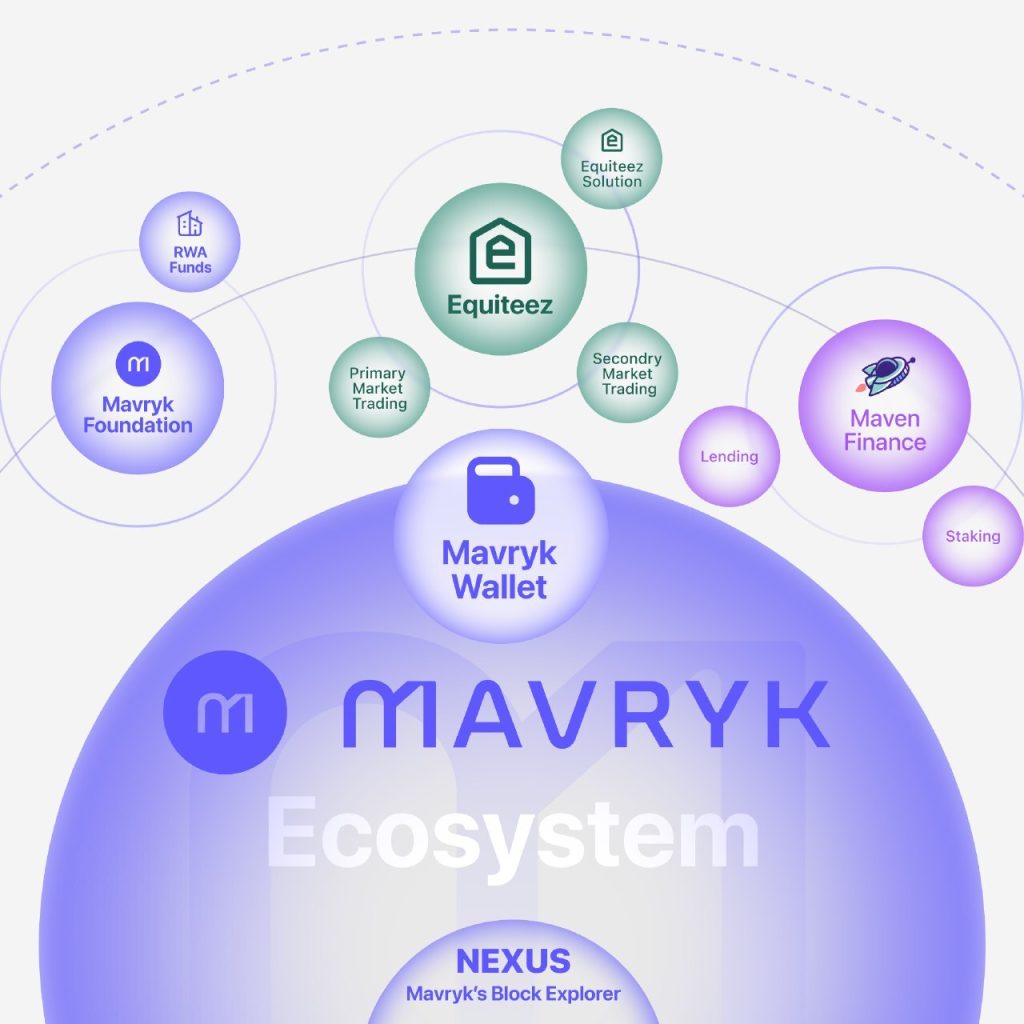
“Mavryk is a vertically integrated ecosystem with three core pillars: Mavryk Network, Equiteez, and Maven Finance,” Davis explained.
“Mavryk Network is our Layer 1 blockchain, purpose-built for RWAs. It provides settlement, security, and execution for tokenized assets that carry real-world constraints—compliance rules, transfer restrictions, valuation logic, and regulated settlement flows. The native token, $MVRK, secures the network through Liquid Proof-of-Stake and enables validator participation and onchain governance.”
“Equiteez is our tokenization and market infrastructure layer. It enables asset issuers, platforms, and exchanges to issue compliant RWA tokens using the MRC-30 standard, operate primary and secondary markets, and support onchain order books, market-making, and OTC settlement. Equiteez powers the issuance and trading infrastructure used in the MultiBank RWA platform and other tokenization programs across real estate, hospitality, and structured assets.”
“Maven Finance is our lending and borrowing layer,” continued Davis. “It enables collateralized lending against tokenized RWAs, oracle-driven valuation and risk frameworks, and structured credit mechanics. Users can deposit multiple RWAs into smart contract vaults as collateral and borrow against their combined value.”
“Beyond these three pillars, we have mDEX, the Mavryk-EVM Bridge for cross-chain asset movement, Oddity, and institutional infrastructure through partnerships with Fireblocks and Dynamic. The entire stack is secured by aerospace-grade methodologies with audits by CertiK and Hashlock.”
Enabling This Interoperability
Can you elaborate on the core technical innovations that enable this interoperability and how they address existing limitations in RWA tokenization?
“One of the biggest challenges, or rather limitations, in RWA tokenization today is fragmentation,” noted Davis. “Most projects operate in silos, focusing on a single layer of the value chain, such as digitizing an asset or running a primary offering. Still, they often overlook the critical infrastructure needed to support liquidity, secondary markets, lending, and ongoing utility.”
“After tokenization, you need robust secondary markets so investors can exit when they choose. Then there’s lending and borrowing, which are especially important in real estate and private equity, where assets are often leveraged. These assets are yield-bearing and can service debt, but without an integrated lending infrastructure, they remain underutilized. Then comes global distribution and accessibility, which Multibank bolsters.”
“At Mavryk, we’ve built a vertically integrated ecosystem inspired by Apple’s end-to-end design philosophy,” explained Davis. “At the core of this is our MRC-30 token standard, purpose-built for RWAs. This token standard accounts for compliance requirements and everything related to RWAs, and also integrates with the three permissioned DEXs we’ve built for RWAs, as well as the launchpad. The RWA token is also integrable with Maven Finance, our lending arm. All assets tokenized on the MRC-30 token standard can be integrated into the smart contract vaults we have on Maven. Through Maven Finance, users can deposit multiple RWAs in vaults as collateral and borrow against the combined value of their assets.”
Funding/Revenue
Can you share/discuss any funding and/or revenue metrics?
“We’ve raised $5.2 million in venture funding led by Ghaf Capital, Big Brain, MetaVest Capital, Cluster Capital, Collective Ventures, and Atlas Fund, with additional commitments from Draper Goren Holm and others,” Mavryk’s founder revealed. “More recently, MultiBank Group led a $10 million strategic investment to expand our RWA tokenization capabilities.”
“On the revenue side, our model is evolving toward a B2B2C SaaS approach. Equiteez generates revenue through white-label licensing and tokenization fees. The REIT fund we’re structuring with partners creates a revenue-generating model for the Layer 1 itself, an industry first. When Maven Finance goes live on mainnet, we’ll earn fees from lending and borrowing activity.”
Total Addressable Market
What total addressable market (TAM) size is Mavryk pursuing?
“The TAM is enormous. According to Ernst & Young, the private equity market alone is expected to reach nearly $28.7 trillion by 2030. Deloitte forecasts the global tokenized real estate market could be worth $4 trillion in 10 years,” Davis assessed. “McKinsey and BCG have suggested the broader tokenized RWA market could grow to trillions through this decade.”
“We’re targeting the intersection of these markets: yield-bearing real assets that generate regular income through dividends, rent, or interest. These are historically illiquid, institutionally dominated markets that tokenization can democratize. Our immediate pipeline is $10 billion with MAG and MultiBank, but the long-term opportunity is scaling to $40 billion in onchain assets by 2030.”
Differentiation From The Competition
What differentiates Mavryk from its competition, direct and indirect?
“The problem with many RWA L1s is that they’re just vaporware,” stated Davis. “They spin up a centralized L1/L2 chain and claim it’s for RWAs, using it for marketing purposes, without building the required RWA infrastructure for tokenization, secondary markets, or loans. If you look at many RWA L1s out there, they don’t have the technology stack, they don’t have primary offerings like launchpads for RWAs, they don’t have secondary markets, and they don’t have lending.”
“Mavryk is building an integrated economic network where RWAs can interact seamlessly with DeFi platforms for lending, borrowing, and secondary trading,” he affirmed. “What sets us apart is Equiteez, our dedicated tokenization and market infrastructure layer that handles the full asset lifecycle, not just the initial minting.”
“In our partnerships, we handle the RWA technology and marketplace operations from a technical perspective through Equiteez, while Multibank manages sales distribution and regulatory compliance.”
Davis continued stating, “Our value proposition goes beyond just building a Layer 1. We’ve created an interoperable ecosystem that includes:
- The MRC-30 token standard is designed for regulatory and data requirements;
- Equiteez, powering three different types of RWA exchanges: a launch platform for initial creation, an onchain order book for trading, and an OTC desk for large block orders; and,
- Maven Finance for lending and borrowing against RWAs
Mavryk’s role is facilitating seamless technology integration that connects primary offerings where we sell assets, secondary markets where you can trade them immediately or years later, and the lending infrastructure that makes it all work together.”
Future Company Goals
What are some of Mavryk’s future goals?
“Our immediate focus is threefold: fully stabilizing the Mavryk Network mainnet, launching the MultiBank RWA platform powered by Equiteez, and graduating Maven Finance to mainnet,” emphasized Davis.
“Beyond that, we’re expanding our asset classes beyond real estate into hotels, insurance-linked securities, bonds, and cash-flowing businesses. We’re building out a full DeFi stack, including a DEX, perpetuals, mobile adaptations, and Layer-2 integrations.”
“Long-term, we envision personalized, bespoke ETFs where investors can curate exposure across geographies and asset types—hotels in Europe, real estate in Asia, private equity in the Americas—all tokenized and composable,” the founder explained. “The goal is to move from a $10+ billion pipeline to $40 billion in tokenized assets by 2030, creating a self-reinforcing cycle where yield generates liquidity, liquidity enables borrowing, and borrowing drives reinvestment.”
Additional Thoughts
Any other topics you would like to discuss?
“I’d emphasize that tokenization isn’t just about putting assets on a blockchain; it’s about fixing a broken financial system,” Davis stated. “The middle class is shrinking. Homeownership is slipping out of reach. Traditional markets are at historically high valuations. Tokenization gives regular people access to high-quality, income-producing assets that were previously reserved for the ultra-wealthy.”
“There’s also a misconception that you can just mint an NFT and bypass regulation. Technology doesn’t change the nature of the asset. A tokenized house is still a house.”
“The future isn’t about speculation; it’s about ownership, yield, and accessibility,” concluded Davis. “Everything will be onchain, but most users won’t even realize they’re using tokens; they’ll just be buying assets, receiving payouts, and building wealth.”
