MEAVO designs and manufactures acoustic office booths and meeting pods for companies seeking more flexible ways to use workplace space. Its product range includes single-person phone booths, larger focus pods, and meeting pods, with customizable colors, independently certified acoustics and ventilation, and delivery and installation services. Pulse 2.0 interviewed MEAVO Co-Founder Todor Madzharov to learn more.
Todor Madzharov’s Background
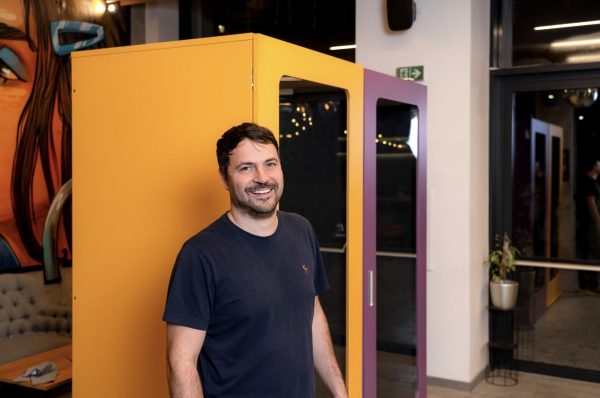

When asked about his background, Madzharov shared:
I’m a digital marketer who accidentally became a manufacturer. I spent my career in growth: PPC Director for Europe at Ogilvy, where I ran digital acquisition for Ford of Europe, then Chief Marketing Officer at JOB TODAY, a fast-scaling recruitment app. Before that I founded a small social media agency in Europe. I have an MSc from Bayes Business School in London (City University) and a BSc from the University of Duisburg-Essen.
Nothing in that CV prepares you for freight forwarding. But the instincts transfer better than you’d expect: I came into furniture asking demand-generation questions that the incumbents weren’t asking, and that turned out to be the advantage.
How MEAVO Started
When asked how the idea for the company came together, Madzharov explained:
My co-founder Thomas Anselmino and I were working out of a coworking space in London, and the running joke was the queue for the one quiet corner. People took calls in stairwells. We looked at what was on the market, got quoted three times what we expected after 10 days emailing back and forth with distributors, and had the classic founder’s thought: how hard can it be?
Turns out reasonably hard. We spent most of 2017 prototyping and didn’t launch commercially until 2018. But the thesis held: the problem was universal and the solutions were priced for headquarters and large corporations, not for the 60-person companies that had the same problem.
The First Prototype
When asked about his favorite memory working for the company so far, Madzharov recalled:
Early 2017, long before there was anything you could call a company. Thomas and I were prototyping with factories in a few different countries, and we’d had one built in London. I was living in Luxembourg at the time, so I flew over, we collected it, and hauled it back to Thomas’s house: an enormous wooden crate we could barely get through the door.
We unpacked it in his living room. It took hours to assemble, and by the end the room was buried under packaging, cardboard, and tools. The booth itself was terrible. Genuinely bad. But it was standing, and we had built it.
Then Thomas’s wife came home from work. She stood in the doorway, taking in the wreckage of her living room, and the two of us next to a questionable wooden box, grinning, thoroughly pleased with ourselves. I’m fairly sure she thought we’d lost our minds.
That’s still my favorite memory of the whole thing. Everything since has been a bigger version of that afternoon.
Core Products And Features
When asked about the company’s core products and features, Madzharov detailed:
Three models. The Soho is our flagship single-person booth: ISO certified noise reduction, LED lighting with a motion sensor, power, USB-A and C, a Qi charging pad, and two near-silent fans that exchange the air inside every minute. The Workstation is a larger focus pod for longer conference calls and deep work. The Camden is our meeting pod, in two- and four-person configurations.
Two features matter more than the spec sheet suggests. First, thousands of colors allow you to make each pod unique, and today, most of the industry treats customization as an afterthought. Second, we deliver and install the booth ourselves and take the packaging away with us. The customer does nothing except find a socket.
Office Real Estate And Commoditization
When asked about challenges in the company’s sector, Madzharov noted:
Two. The first is that office real estate has been in a strange place since hybrid work settled in: companies are taking less space but asking more of it. That sounds like bad news for office furniture. It’s been the opposite for us: when you have fewer square meters, you can’t afford to burn an eight-person meeting room on a one-person call. Density makes our case for us.
The second is commoditization. As the category has grown, a lot of cheap look-alikes have entered: boxes that look like a booth in a photograph and leak sound in a room. Our response was to over-invest in independent proof rather than argue about it: certificates, coupled with thousands of happy clients, do the talking for us.
Technology Evolution
When asked how the company’s technology has evolved since launching, Madzharov explained:
The first booth was essentially a very well-made quiet box. Everything since has been an iteration. Our booths get a new feature or improvement every few months.
The biggest advances have been in the unglamorous parts. Ventilation is the one nobody asks about until they’ve sat in a badly designed pod for twenty minutes. Ours is independently certified to exchange the air every minute.
Acoustics moved from “sounds quiet” to formally measured under the standard specifically written for enclosures like ours, and which a surprising number of manufacturers still don’t test against.
And we’ve also built out the parts designers actually need, so specifying a MEAVO booth into a floor plan takes minutes rather than tons of back-and-forth emails.
Major Company Milestones
When asked about some of the company’s most significant milestones, Madzharov highlighted:
- 2017: first working prototype.
- 2018: commercial launch, and the decision to manufacture in the EU rather than import.
- Early traction and enterprise adoption: Google, Barclays, H&M, Viber and DHL among others, which gave a young brand credibility it couldn’t have bought.
- Range expansion: from one booth to three models covering solo calls, focus work and team meetings in 2021-2022.
- EcoVadis Gold: placing us in the top 5% of assessed companies for sustainability, alongside the full ISO suite (9001, 14001, 27001, 45001).
- Building our own factory: moving from outsourcing the manufacturing process to building our own plant. This has allowed us to accelerate our R&D and control our quality and costs much better.
- International footprint: showrooms in London, New York, San Francisco, Los Angeles, Berlin, Paris, Madrid, Zurich, Vienna and Brussels, run by a fully remote team of around 30.
Customer Success Stories
When asked to share specific customer success stories, Madzharov said:
Hard to pick one, because they vary so much in scale. A couple of years ago we supplied more than a hundred booths to a French power grid operator moving into a brand-new, multi-story headquarters. Being part of equipping a building like that from nothing, making it modern and genuinely usable for the people working in it, brings a particular kind of satisfaction.
But I enjoy the small companies just as much. A twenty-person business that spends a week working through our colors to get the booths exactly on brand is using the product the way we intended it to be used.
The one we’ve had the most fun with recently is Cubo, a UK coworking operator. They have dozens of our booths across their sites: London, Birmingham, Derby, Leeds, Manchester, Glasgow. The spaces are beautifully built and very thoughtfully designed, and each location takes something from the city it sits in rather than rolling out a single template.
Watching them use our logistical capabilities to supply booths across the UK and make all their spaces feel unique has been the clearest proof I could ask for that our investment in customer support and operations isn’t a gimmick.
Funding And Revenue Growth
When asked about funding and revenue metrics, Madzharov shared:
We’ve built MEAVO without institutional funding, which shaped the company more than any strategic decision we made deliberately. When there’s no runway to burn, you get disciplined about unit economics early.
In terms of revenue, we don’t disclose these numbers, but I can say we are growing strongly, around 15% YoY.
Market Opportunity
When discussing the total addressable market MEAVO is pursuing, Madzharov explained:
I’ll be honest that the analysts’ numbers vary enormously depending on where you draw the line. What I’d rather point at is an underlying number. There are millions of open-plan desks in the UK, EU and US, and the sensible ratio is roughly one booth per 15 to 20 people. Almost no office is anywhere near that.
The category isn’t constrained by demand, but rather by price and lead time, which is precisely the constraint we exist to remove. North America alone accounts for roughly 63% of current revenue in the category, which is why our expansion has gone in that direction.
Competitive Differentiation
When asked what differentiates MEAVO from its competition, Madzharov emphasized:
Certification without the premium. The top of the market makes genuinely excellent products, but they’re priced and paced for large enterprises. We hold the same class of independent testing and sell at a fraction of the ticket, with a lead time measured in weeks rather than months. This is because we hold stock locally rather than shipping from the factory on every order.
Then three things that sound small and close deals: our vast color portfolio to choose from; delivery and installation sorted, with the packaging taken away; and sustainability we can evidence rather than assert.
The last one matters commercially, not just morally: a large share of our business comes through architects and design & build firms who have sustainability targets written into their briefs. We hand them the paperwork that closes that requirement.
Future Goals
When discussing the company’s future goals, Madzharov said:
The office isn’t disappearing; it’s being asked to do more with less floor space. We want to be the default answer to that by moving from standalone booths toward a modular acoustic system that lets a company reconfigure a floor in an afternoon instead of a renovation cycle, at a price a 60-person business can sign off on.
Geographically, going deeper into North America. Structurally, more of our growth comes through the specification channel, because a product that gets designed in gets designed in repeatedly.
Building A Remote Hardware Company
When invited to discuss another topic, Madzharov concluded:
One, if there’s room: we’re a fully remote team of around 40 selling a physical product across two continents, which people still tell me shouldn’t work.
It works because remote work forced us to focus on enabling people and having good, lean processes. Most founders I know in hardware assume they need everyone in one building.
We haven’t found that to be true, and I’d encourage more physical-product founders to test the assumption rather than inherit it.

