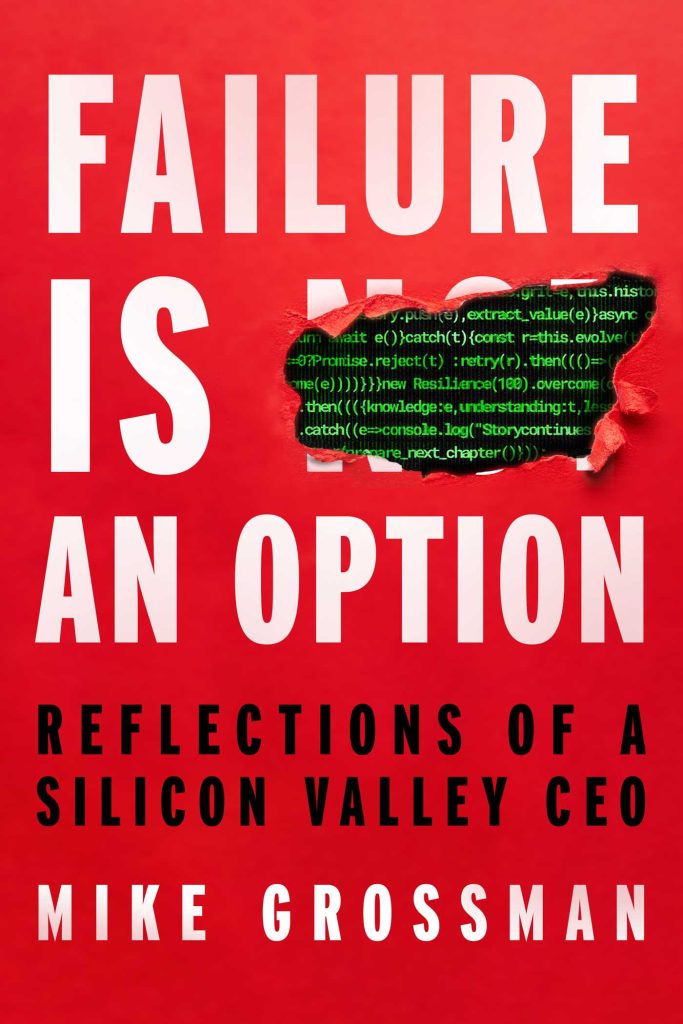
Failure Is An Option examines the less visible realities of building and leading venture-backed technology companies, including failure, uncertainty, luck, difficult ethical decisions, emotional pressure, and the limits of even strong execution. Drawing on roughly 30 years running early-stage, venture-funded technology companies in Silicon Valley, Mike Grossman presents those experiences through candid essays intended to capture what entrepreneurship can actually feel like from the CEO’s seat. Pulse 2.0 interviewed Grossman to learn more about the ideas behind the book and the lessons he has drawn from decades of company-building.
Mike Grossman’s Background
When asked about his background, Grossman shared:
I spent the first part of my career working for big companies: McKinsey & Company, Johnson & Johnson, and Intuit.
But I then pivoted to entrepreneurship.
I’ve spent the last 30 years running early-stage, venture-funded, technology companies in Silicon Valley.
Why He Wrote Failure Is An Option
When asked what inspired him to write Failure Is An Option and why he chose a collection of candid essays rather than a traditional business memoir or startup playbook, Grossman explained:
A lot of books have been written about business, but I’ve never read any that bring to life what it’s really like to run an entrepreneurial technology company, emotionally, ethically, and practically.
I thought that was a story worth telling, and that I was well positioned to tell it.
I decided to frame the book as a collection of candid essays because I thought it would make the book more interesting both to write and to read.
I hoped that approach would be less dry and more engaging, and hopefully more relatable.
Preparing For Failure
When asked how founders and CEOs should mentally prepare for failure as a constant operating condition, Grossman said:
I actually think it’s hard to prepare for the reality if you haven’t lived it.
I think that most first-time founders and CEOs tend to be naively optimistic. And then they learn the truth.
Things go wrong all the time.
When that happens, coping requires a gritty, level-headed approach.
I’ve found that it’s better to not get too high or too low. Be like sand.
Why Strong Ideas And Hard Work Do Not Guarantee Success
When asked why strong ideas, hard work, and solid execution do not necessarily result in success, Grossman explained:
You can control your effort but you can’t control the outcome.
Often companies fail because of macroeconomic conditions.
Other times they fail because, even though the idea seems strong, customers don’t agree.
And other times they fail because the economics of the business don’t work as well as hoped, meaning the cost of acquiring customers is higher than anticipated, and the revenue generated by customers is lower than anticipated.
The Role Of Timing And Luck
When asked about an experience where timing or luck had an outsized impact on a company, Grossman recalled:
My second company grew revenues very rapidly, from nothing to a $30 million run rate in less than a year.
And then Congress passed a law that effectively legislated our business model out of existence.
A company that would likely have been acquired for hundreds of millions of dollars ended up selling for only $250,000.
It was very painful, and still is!
I’ve also had situations where timing and luck have had an outsized positive impact on the outcome.
Silicon Valley Myths
When asked about the biggest myths surrounding Silicon Valley and startup life, Grossman identified three:
Here are three of the biggest myths about Silicon Valley: 1) success is common, 2) hard work determines success, and 3) skill is more important than luck.
The Emotional Challenges Of Being A CEO
When asked about the emotional pressures CEOs face when a company is struggling, Grossman explained:
When things aren’t going well, the emotional toll on the CEO is significant.
The consequences include severe anxiety, a sense of profound isolation, and depression.
And what makes things even more difficult is that when you’re a CEO, you have to hide all of these negative feelings and project optimism and confidence.
Creating A Culture Where Bad News Surfaces Early
When asked what CEOs can do to encourage employees to share bad news rather than hide or minimize problems, Grossman said:
If, as a CEO, you want people to feel comfortable sharing bad news, there are several things that you need to do without exception.
First, when things go wrong, focus on working the problem rather than looking to assign blame.
Second, when people hide information, politely but firmly explain why that is a destructive way to operate.
And third, when people reveal bad news, proactively compliment them for having the best interests of the company at heart.
Staying Resilient
When asked what advice he would give founders trying to remain resilient without losing their sense of humor, Grossman concluded:
To quote the lyrics of a Mel Brooks song, my advice would be to “hope for the best, expect the worst.”
In my experience, when things aren’t going well, they will inevitably improve over time.
And the inverse is also true. When things are going well, they will inevitably take a turn for the worse.
So stay the course and recognize that adversity is inherent to the experience.