

Northstar Security is an AI-native cybersecurity company developing a Security Context Graph that connects fragmented enterprise security data to help organizations identify vulnerabilities, understand risks, and automate remediation. Pulse 2.0 interviewed Northstar Security Co-Founder and CEO Amer Deeba to learn more about his background, the company’s origins, its graph-based security architecture, $7 million seed funding, enterprise adoption, and plans to advance autonomous security operations.
Amer Deeba’s Background

When asked about his professional background and experience building cybersecurity companies, Deeba shared:
I’ve spent most of my career building and scaling enterprise software and cybersecurity companies. My journey started at Adobe in the late 1990s, where I worked on technologies that helped shape the early digital era.
I later joined Qualys, where I spent many years helping build and scale the business, including expanding its international presence and taking the company public in 2012. More recently, I helped build Normalyze, a cloud data security company that was acquired by Proofpoint.
Throughout my career, I’ve had the opportunity to work closely with enterprise security leaders and see firsthand how the cybersecurity landscape has evolved. One problem has remained remarkably consistent: organizations continue to struggle with fragmented security data and the inability to connect the dots across their environments.
That experience, combined with the rapid advancement of AI, ultimately led me to co-found Northstar Security with Ed Rowe, a longtime colleague and exceptional technology leader.
How The Idea For Northstar Security Came Together
Reflecting on the origins of Northstar Security, Deeba described two observations that shaped the company’s approach to cybersecurity:
The idea for Northstar came from two important observations.
First, during my years at Qualys and Normalyze, I saw enterprises invest millions of dollars in security tools yet still struggle to answer fundamental questions about their security posture. Their data was scattered across dozens of disconnected systems, making it extremely difficult to understand how assets, identities, vulnerabilities, and business systems were related.
Second, we recognized that AI was about to fundamentally transform enterprise software. We’re moving from Software as a Service, where humans operate applications, to what we call Software as an Agent, where intelligent agents perform work and deliver outcomes autonomously.
Cybersecurity is one of the industries that needs this transformation most urgently. AI-powered threats are accelerating, and human-driven security operations simply cannot keep pace.
But there’s a fundamental problem: AI agents cannot make reliable decisions or take meaningful action without accurate, real-time context about the environment they’re protecting.
Ed and I realized that solving this context problem would be foundational to the next generation of cybersecurity.
That’s why we started Northstar: to build the Security Context Graph that makes enterprise security data AI-ready and enables agents to identify risks, understand their impact, and autonomously drive remediation.
Favorite Memory Working At Northstar Security
Recalling some of his favorite experiences building Northstar Security, Deeba highlighted reuniting with longtime colleagues and seeing early customers benefit from the platform:
One of my favorite moments has been bringing the founding team back together.
Ed and I first worked together at Adobe nearly three decades ago. We’ve taken different paths since then, but we’ve always shared a passion for building ambitious technology and solving difficult problems.
Having the opportunity to reunite with Ed and work alongside incredibly talented engineers like Alexander Macdonald and Chris Brichford has been especially rewarding.
Another memorable moment was seeing our early customers use Northstar to connect information across their security environments and uncover insights that previously required significant manual effort.
When you see a customer realize that something they’ve struggled with for years can now be answered in seconds, it validates why you started the company.
And, of course, coming out of stealth and introducing Northstar to the world has been an exciting milestone for the entire team.
Core Products And Features
Discussing Northstar Security’s core products and capabilities, Deeba outlined the company’s Security Context Graph and its primary enterprise security applications:
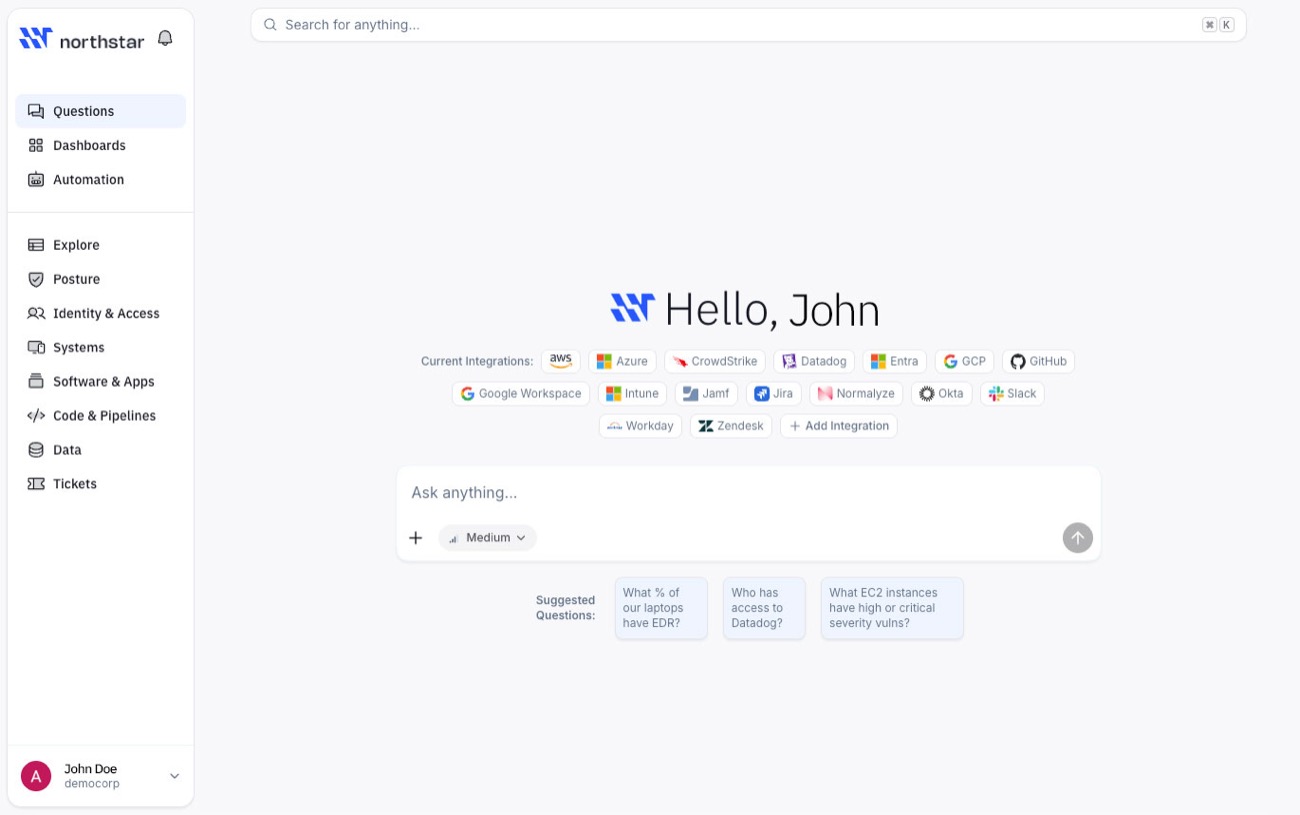
Northstar is an AI-native security platform built around our Security Context Graph, which unifies fragmented security and business data into a real-time, connected understanding of the enterprise.
We integrate information across cloud security, endpoint protection, identity and access management, vulnerability management, and enterprise systems such as IT asset databases and help desk platforms.
Rather than simply aggregating data, Northstar understands the relationships between assets, identities, vulnerabilities, permissions, and critical business systems. This allows organizations to identify hidden risks and toxic combinations that individual security tools often miss.
Our platform focuses initially on four high-value use cases:
- Identity Security: Identifying excessive privileges, orphaned accounts, and risky access, then driving remediation.
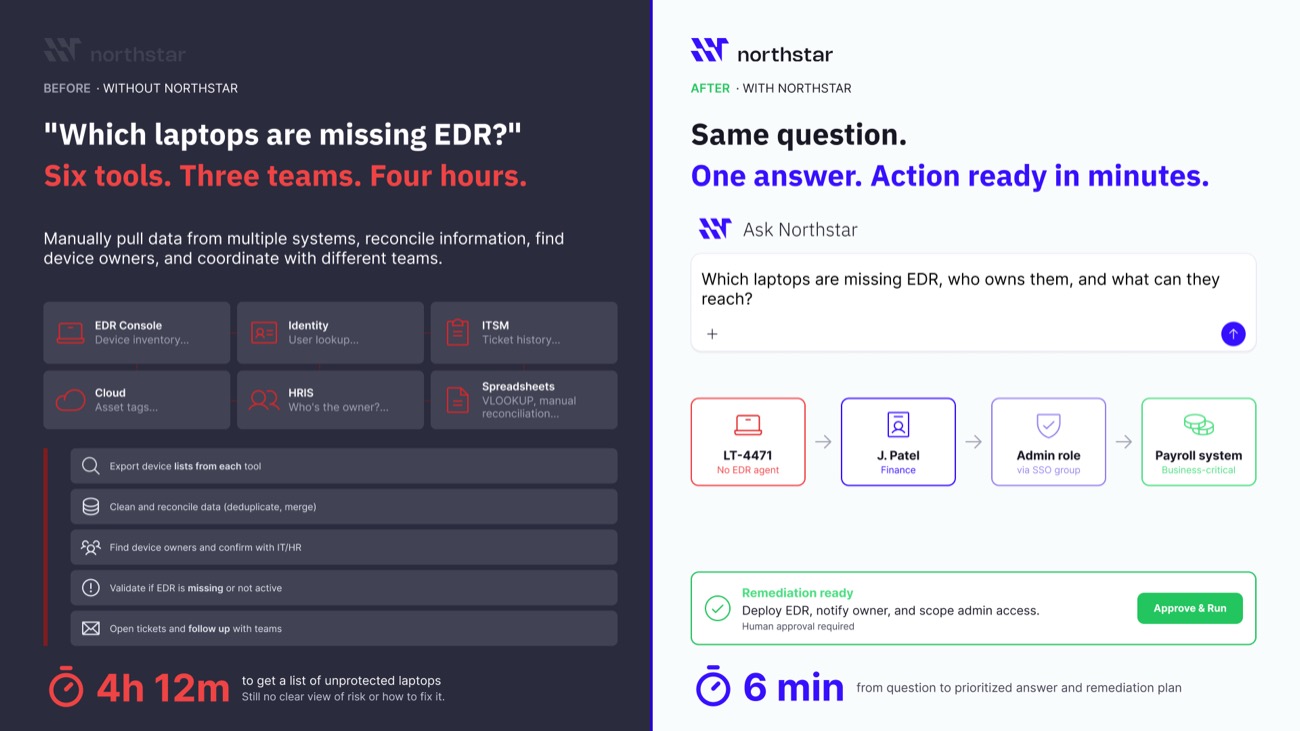
- Endpoint Security Hygiene: Finding unmanaged devices, missing security agents, and gaps in endpoint protection, then automating corrective actions.
- Cloud Security Hygiene: Identifying dangerous misconfigurations, excessive permissions, and exposed cloud workloads.
- Vulnerability Management: Prioritizing vulnerabilities based on actual exposure, asset criticality, identity relationships, and business impact.
We also provide an intelligent AI assistant and agentic workflows that allow security teams to ask complex questions, investigate risks, and automate remediation.
Importantly, our context graph can also be accessed through MCP, enabling other AI agents and enterprise applications to leverage Northstar’s intelligence.
Our goal is to move security teams beyond visibility and alerts toward continuous, autonomous security outcomes.
Challenges In Enterprise Cybersecurity And AI Adoption
Addressing challenges facing cybersecurity teams and how Northstar is responding, Deeba emphasized the increasing complexity of enterprise security environments:
One of the biggest challenges in cybersecurity today is the growing gap between the speed of threats and the ability of security teams to respond.
AI is making attacks faster and more sophisticated, while enterprise security environments are becoming increasingly complex. Organizations have accumulated dozens of security tools, each generating its own data, alerts, and view of the environment.
The industry has attempted to address this through dashboards, data lakes, and automation platforms, but the fundamental context problem remains largely unresolved.
We’ve approached this challenge differently.
Rather than building another point solution or adding AI capabilities to an existing architecture, we designed Northstar from the ground up around a real-time context graph.
Building and maintaining accurate relationships across large, constantly changing enterprise environments is a difficult engineering challenge. We’ve invested heavily in the underlying data architecture, integrations, and contextual intelligence needed to make this work at scale.
We believe this foundation is what will ultimately allow AI agents to operate reliably and safely in complex enterprise environments.
Customer Success Stories
Highlighting an early customer deployment, Deeba discussed how Cequence Security uses Northstar to connect security information and support remediation workflows:
One great example is Cequence Security, where CISO Randy Barr and his team are using Northstar to connect fragmented security data, understand risks in context, and drive remediation through agentic workflows.
Like many organizations, Cequence recognized that the challenge wasn’t a lack of security tools or data, but the difficulty of connecting information across systems and translating that intelligence into action.
Northstar helps address this by providing a unified Security Context Graph that enables the team to continuously identify security gaps, understand their impact, and automate remediation workflows.
As Randy Barr, CISO of Cequence Security, shared in our launch announcement:
“Northstar lets us do exactly that, using agentic workflows to continuously identify and remediate security issues.”
For us, this is particularly meaningful because it validates our core vision: the future of cybersecurity isn’t about generating more findings. It’s about giving security teams and AI agents the context to continuously identify and fix problems.
Funding And Revenue Metrics
When asked about Northstar Security’s funding and commercial development, Deeba disclosed details of its seed financing and plans for further expansion:
We recently announced $7 million in seed funding led by Wing Venture Capital, with participation from MVP, Outliers, and a group of experienced cybersecurity investors.
We’re fortunate to have investors who understand both the challenges facing enterprise security teams and the transformative opportunity created by AI.
We’re still in the early stages of commercialization, with a few enterprise design customers and growing interest from mid-market and large enterprise customers.
Our focus today is on delivering strong customer outcomes, expanding adoption, and building a scalable enterprise business before we start raising our next round of financing in 2027.
Total Addressable Market
Discussing the market opportunity for Northstar Security, Deeba identified several established cybersecurity categories and the potential emergence of a broader autonomous security ecosystem:
Our ambition is to build a platform that participates in the broader portion of enterprise security operations spending as it gets transformed with agentic AI.
Our initial use cases span established markets such as cyber asset management, identity security, endpoint security, cloud security posture management, and vulnerability management. Together, these represent tens of billions of dollars in annual enterprise security spending.
As cybersecurity transitions from human-operated SaaS applications to autonomous AI agents, organizations will need a shared intelligence layer that connects their security and business environments.
We believe the Security Context Graph can become foundational infrastructure for this emerging agentic security ecosystem, supporting not only Northstar’s own applications but also third-party agents and enterprise-developed workflows.
What Differentiates Northstar Security From Its Competition
When asked what distinguishes Northstar Security from traditional cybersecurity visibility and automation platforms, Deeba identified its AI-native architecture and focus on contextual intelligence:
Our biggest differentiator is that Northstar was built from day one for a world where AI agents, not just humans, are the primary consumers of security intelligence.
Traditional security visibility platforms were originally designed around asset visibility, inventory, and human-driven security workflows. While these capabilities remain important, they don’t fully address what AI agents need to operate autonomously.
Agents require accurate, real-time context. They need to understand not just which assets exist, but how identities, vulnerabilities, permissions, cloud resources, and business systems relate to one another. Northstar was architected specifically to solve this problem at enterprise scale.
Our graph-first architecture continuously connects security data, identifies relationships, and makes that context available to AI agents for investigation, decision-making, and remediation.
We’re also building Northstar as an open intelligence layer that other agents can consume through MCP.
While we may compete with existing platforms on initial use cases such as asset visibility and security hygiene, our long-term vision is fundamentally different: to become the context foundation powering autonomous security operations.
Future Company Goals
Outlining Northstar Security’s future priorities, Deeba described plans to expand enterprise adoption and develop more autonomous security capabilities:
Our immediate focus is to expand enterprise adoption, deepen our core security use cases, and advance our AI agents’ ability to autonomously identify and remediate risks.
As we scale, we’ll continue investing in our platform and building our go-to-market organization.
Longer term, our ambition is to establish Northstar’s Security Context Graph as the foundational intelligence layer for agentic security, powering not only our own agents but the broader ecosystem of autonomous security applications.
The Future Of Agentic AI In Cybersecurity
Sharing his broader perspective on the future of cybersecurity, Deeba underscored the transition from traditional software toward autonomous AI systems:
We are witnessing one of the most significant transformations in enterprise software: the shift from Software as a Service (SaaS) to Software as an Agent, where AI agents move beyond assisting humans to autonomously performing work and delivering outcomes.
Cybersecurity is ripe for this transformation. For decades, the industry has been largely reactive, focused on detecting threats, generating alerts, and relying on humans to investigate and respond.
AI presents an opportunity to turn this model inside out, moving toward proactive, continuous, and autonomous security that identifies and fixes risks before they can be exploited.
But for agents to operate effectively, they need accurate, real-time context about the environments they’re protecting. That’s the foundation we’re building at Northstar.
Our vision is to help transform cybersecurity from a reactive, alert-driven industry into one that is proactive, autonomous, and resilient by design. This is Northstar for security in the era of AI.
