Octopus Deploy has released its 2026 AI Pulse Report: AI adoption and its impact on developer productivity, finding that while AI tools are delivering measurable productivity gains for software teams, they are also accelerating a structural shift in junior hiring that could result in a senior developer shortage within the next three to five years.
The report, based on a mix of primary survey data and third-party research, examines how AI is being integrated into developer workflows and how those patterns are influencing hiring, skill development, and long-term talent pipelines.
According to the report’s executive summary, organizations are broadly experimenting with AI across development tasks, often prioritizing short-term productivity gains over long-term workforce sustainability. The authors outline a three-phase model: an experimentation era from 2024 to 2025, a junior hiring freeze from 2025 to 2027, and a potential senior talent crisis between 2027 and 2030.
A Three-Phase Trend In The Software Delivery Workforce
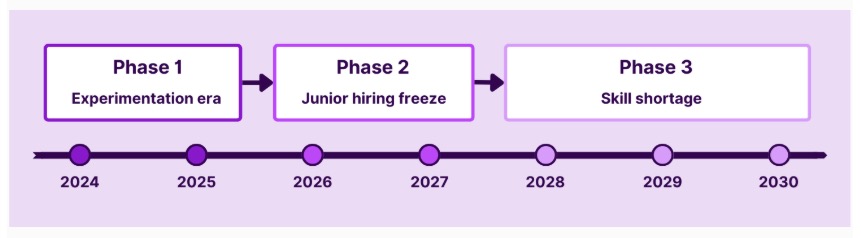

At the center of the report is a three-phase prediction model that maps how AI adoption is likely to reshape the software delivery workforce over the remainder of the decade.
Phase 1, described as the experimentation era, reflects the current environment in which organizations are broadly adopting AI tools across coding, testing, and documentation tasks. The focus during this phase is on optimizing individual productivity gains while simultaneously uncovering deeper systemic bottlenecks, particularly in review, testing, and deployment processes.
Phase 2, the hiring freeze, is characterized by a reevaluation of junior developer roles. As AI systems handle more high-volume routine work, organizations begin reducing entry-level hiring while retaining senior engineers to oversee architecture, code reviews, and strategic decisions. This shift is already visible in declining junior hiring ratios and a growing emphasis on “seniors with AI” operating models.
Phase 3, the projected skills shortage, emerges as a downstream effect of sustained reductions in junior hiring and AI-mediated learning pathways. With fewer juniors entering the pipeline and less hands-on exposure to foundational problem-solving, the supply of future senior developers narrows. The result is widening skills gaps, intensified competition for experienced engineers, and potential wage inflation between 2027 and 2030.
The report emphasizes that these phases are interconnected, with decisions made during the experimentation era directly influencing workforce stability later in the decade.
Productivity Gains Mask System Constraints
Developers report clear productivity benefits from AI adoption. Industry data cited in the report shows that 67% of developers spend less time searching for information and 58% say they code faster when using AI tools. Organizations are investing heavily, with annual AI tool spending ranging from $500 to $1,000 per developer and in some cases up to 1% to 8% of total revenue.
However, despite these gains, only 1% of leaders describe their organizations as “mature” in AI deployment. The report attributes this gap to systemic bottlenecks, particularly in code review processes.
On page 11, the report explains that AI reduces task hours across most stages of the software delivery pipeline except for code review, which becomes an increasingly severe constraint as AI-generated code volumes rise. With senior developers typically responsible for reviewing changes, increased throughput at the coding stage can lead to longer queues and slower end-to-end delivery.
The authors argue that focusing on local optimization, such as faster code generation, without addressing workflow constraints can degrade overall system performance.
AI Adoption Highest Among Junior Developers
The experimentation phase is characterized by widespread AI use. The report cites data showing that 90% of technology professionals use AI at work, with 60% reflexively turning to AI as their first response when solving problems.
Usage patterns differ significantly by experience level. Developers with 0 to 2 years of experience show the highest AI use across foundational tasks such as learning new technologies, understanding codebases, and debugging. In contrast, developers with 20+ years of experience exhibit lower overall AI use but rely on it for staying current with emerging technologies.
Research cited in the report indicates that junior developers may complete tasks up to 55% faster when assisted by AI tools. However, the authors caution that perceived productivity gains can be misleading. Some studies show developers believe they save 20% to 24% of their time using AI, while performance on complex tasks may actually be 19% slower.
The report also highlights growing frustrations. According to 2025 survey data, 44% of respondents are frustrated with AI solutions that are “almost right, but not quite,” and 30% say debugging AI-generated code is more time-consuming. Additionally, 13% report reduced confidence in their own problem-solving abilities.
Junior Hiring Declines As “Seniors With AI” Strategy Emerges
As AI tools increasingly handle routine tasks traditionally assigned to entry-level developers, organizations are rethinking hiring strategies.
The report finds that 73% of organizations have reduced the number of junior developers over the past two years. Survey data also shows a decline in developers with 0 to 4 years of experience as a share of respondents between 2024 and 2025.
On page 28, the authors describe an emerging “seniors with AI” strategy, where companies rely on experienced developers augmented by AI rather than investing in junior talent. Given that senior salaries are typically 1.4 to 2.1 times higher than junior salaries, organizations view AI tools as a cost-effective substitute for entry-level hiring.
The report warns that this shift may undermine traditional mentorship and knowledge transfer models. A visual comparison on page 29 shows how AI-mediated communication can reduce direct interaction between junior and senior developers, potentially limiting skill development pathways.
Risk Of A Senior Talent Shortage
Developer progression typically requires five to seven years to reach senior level, and up to 10 years for specialized roles. By cutting junior hiring today, organizations may face a constrained senior talent pool by 2027 to 2030.
The report notes that 62% of developers surveyed expressed concern that AI could negatively impact their own role, compared to 9% of DevOps professionals. At the same time, mid-career developers are considering role transitions, with 44% somewhat or strongly considering a career change.
As senior developers transition into management roles, the technical talent pool shrinks further, increasing the risk of wage inflation, burnout, and architectural fragility if replacements are not adequately trained.
Automation And Continuous Delivery As Foundations
A central conclusion of the report is that AI alone does not guarantee improved outcomes. On page 13, the authors state that 74% of companies struggle to scale AI value, and only a minority of AI pilots reach production.
The report emphasizes Continuous Delivery practices as foundational for unlocking AI’s potential. Organizations with mature automation pipelines are better able to convert individual productivity gains into organizational results, while those relying on manual processes risk amplifying bottlenecks.
Rather than replacing skill development, the authors argue that AI should be integrated strategically, with investment in automation, mentorship, and upskilling to preserve long-term talent pipelines.
The full 2026 AI Pulse Report provides detailed data, methodology, and recommendations for industry leaders, organizations, and individual developers navigating AI-driven transformation.

