OptiGrid is a U.S.-based company specializing in innovative electric vehicle (EV) charging solutions that integrate battery storage to enable ultrafast charging without extensive, costly, time-consuming grid infrastructure upgrades. Headquartered in Kansas City, Kansas, OptiGrid focuses on delivering modular, scalable, and sustainable charging technologies for fleet operators and commercial properties. Pulse 2.0 interviewed OptiGrid CEO Tyler Phillipi to gain a deeper understanding of the company.
Tyler Phillipi’s Background


Could you tell me more about your background? Phillipi said:
“I’ve spent the past decade working at the intersection of EV charging, grid infrastructure, and fleet operations. Before OptiGrid, I was at FlexCharging, helping utilities and fleets better manage EV charging loads. That experience gave me a front-row seat to the grid constraints holding back fleet electrification and demonstrated the urgent need for faster deployment and more flexible infrastructure solutions.”
Formation Of The Company
How did the idea for OptiGrid come together? Phillipi shared:
“OptiGrid began with a clear problem: fleets are transitioning to electric vehicles, but the necessary infrastructure to support them is lacking. Utility upgrades take forever, and operators are stuck, in some cases literally rolling in diesel generators to charge their electric fleets.”
“A group of industry veterans came together, combining deep manufacturing expertise from Orange EV, hard-won IP from earlier FreeWire efforts, and a vision for modular, battery-integrated DC fast charging. I was brought in to help shape the business and scale the solution.”
Favorite Memory
What has been your favorite memory working for the company so far? Phillipi reflected:
“My favorite memory is visiting all three of our offices in Longmont, Colorado, Newark, California, and Kansas City, Kansas. It was the first time I met many of the team in person, and what really struck me was the level of talent and pride in their work. These folks aren’t just building chargers; they’re building something that represents a new kind of American manufacturing. You see the grit, the creativity, and the belief that we can do hard things — and do them here, in the U.S. That trip made it clear how special this company is.”
Core Products
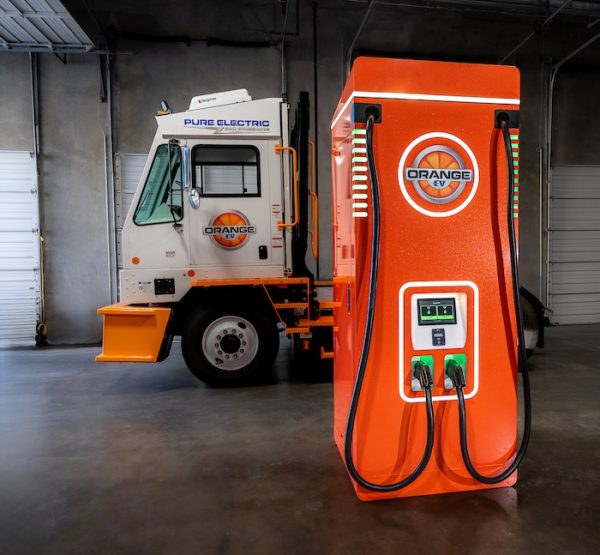

What are the company’s core products and features? Phillipi explained:
“OptiGrid’s core product is a compact, battery-integrated DC fast-charging system specifically designed for fleet applications. It combines onboard energy storage, fast charging, and smart load management in a single UL-certified unit, eliminating the need for costly upgrades or lengthy installation and site development timelines.”
“The system can be installed in weeks, not months, and has a footprint up to 90% smaller than conventional solutions. Key features include dynamic power output, grid-agnostic charging, software for intelligent scheduling and load control, and compatibility with a wide range of EVs.”
“Flexible financing options, including leasing and Charging as a Service (CaaS), make it easier for operators to electrify their fleets without incurring major capital investments.”
Challenges Faced
Have you faced any challenges in your sector recently, and how did you overcome them? Phillipi acknowledged:
“One of the biggest challenges is the misalignment between fleet timelines and utility readiness. As fleets are rolling out, they quickly reach the capacity of available power. Many customers are ready to deploy EVs now, but are told they’ll wait 18+ months for sufficient power. We addressed this head-on by designing a product that doesn’t depend on massive infrastructure upgrades to deliver value.”
Evolution Of The Company’s Technology
How has the company’s technology evolved since launching? Phillipi noted:
“We started with proven IP from FreeWire’s earlier product generations, but re-engineered the hardware for manufacturability, serviceability, and simplicity in deployment. This effort was made easier by Orange EV’s experience in profitably building and selling both EV fleets and charging infrastructure for more than a decade.”
Funding/Revenue
Are you able to discuss funding and/or revenue metrics? Phillipi revealed:
“While we’re not disclosing exact figures publicly, I can say we’ve secured strategic backing and manufacturing partnerships that position us well for scale. Our revenue model includes equipment sales, service contracts, and energy-as-a-service deployments.”
Total Addressable Market (TAM)
What total addressable market (TAM) is the company pursuing? Phillipi assessed:
“We’re targeting a much larger opportunity than just fleet charging. By addressing all applications of battery energy storage systems (BESS), battery-buffered charging, and the broader shift to DC fast charging infrastructure, we’re pursuing a global TAM of over $300 billion by 2030.”
“In North America alone, this opportunity is expected to exceed $150 billion, driven by rapid growth in electrification of transportation, commercial and industrial energy resilience, and grid-scale storage. Our solution directly competes across these segments, unlocking value wherever power constraints or speed-to-deploy are critical.”
Differentiation From The Competition
What differentiates the company from its competition? Phillipi affirmed:
“Most charging providers are either hardware companies focused on public charging or software platforms focused on network operations. OptiGrid bridges that gap with a hardware-software platform purpose-built for fleet needs, delivering fast, flexible energy without waiting on utility upgrades.”
“Unlike ‘piecemeal’ approaches, we offer a fully integrated system: energy storage, power conversion, and managed charging in one modular box.”
Future Company Goals
What are some of the company’s future goals? Phillipi emphasized:
“We are focused on scaling deployments across fleet, logistics, and industrial applications, then expanding into broader DC fast charging use cases.”
“Longer term, we see ourselves shaping how energy and transportation intersect, becoming the standard for distributed high-power charging infrastructure. This involves scaling up manufacturing, enhancing software integration for energy management, and expanding operations across North America and into select international markets.”
Additional Thoughts
Any other topics you’d like to discuss? Phillipi concluded:
“One thing I’d highlight is how transformative this technology can be beyond just ‘charging.’ By integrating storage directly with high-power charging, we’re effectively decoupling electrification timelines from utility upgrade schedules. That’s a massive unlock for fleets and property operators trying to go electric today, not in five years. It’s also a step toward a more resilient grid.”
“We’re excited about partnerships where our systems can play both roles – fueling EVs and supporting broader site or grid stability.”

