OTSAW Robotics is a Singapore-based company that develops and manufactures AI-enabled autonomous mobile robots (AMRs) for security, healthcare, logistics, and disinfection applications. Pulse 2.0 interviewed OTSAW Robotics founder and CEO Ting Ming Ling to learn more.
Ting Ming Ling’s Background


Could you tell me more about your background? Ling said:
“In the mid 2010s, I was in Silicon Valley pondering what my next move would be after handing off my previous technology company to my successors. Following some inspiration of the other tech companies born in that part of the country, I began working with some of my technology partners to create robotic solutions for both security, healthcare, and logistics. That was when OTSAW was born.”
“During the 2020 COVID-19 global pandemic, we saw an increased need and use case for our robotics solutions in the healthcare industry and pivoted to address the rising need for effective solutions to assist with key staffing and logistical issues. Today, OTSAW is a robotics & AI company revolutionizing hospital logistics through the use of advanced robotics. The company’s team operates globally with installments in Singapore, Boston, Munich, and more with clients in more than 20 countries, 1000+ robots deployed, and over three million days of robot operations.”
Formation Of The Company
How did the idea for the company come together? Ling shared:
“Founded in 2015, we established OTSAW with a clear mission: to enhance operational efficiency, safety, and overall quality of life with a key eye on creative robotic solutions. Today, the company specializes in designing and building autonomous robots that address real-world operational challenges, with a strong focus in healthcare, security, and logistics sectors. By integrating modular designs and intelligent automation, OTSAW’s solutions are scalable and adaptable, offering businesses real-time monitoring, streamlined processes, and lower operational costs.”
“As a company, we are focused on addressing two key challenges. First, the growing manpower shortages in sectors that rely heavily on manual labor — such as the delivery industry. Second, we aim to support hospitals globally in reducing their operating costs, especially in light of the increasing number of hospitals closing due to financial constraints.”
“Our goal is not to replace these jobs entirely, but to supplement the existing workforce with robotic solutions. Over time, we also hope to support the upskilling of workers—empowering them to take on new roles as robot operators or supervisors.”
“In countries like the United States, many hospitals are currently operating at a loss. Healthcare is a fundamental pillar of any society—people’s lives depend on its availability and sustainability. By introducing our autonomous robotic solutions, we aim to help ease this financial burden, improve operational efficiency, and ultimately contribute to making healthcare more accessible and resilient.”
Core Products
What are the company’s core products and features? Ling explained:
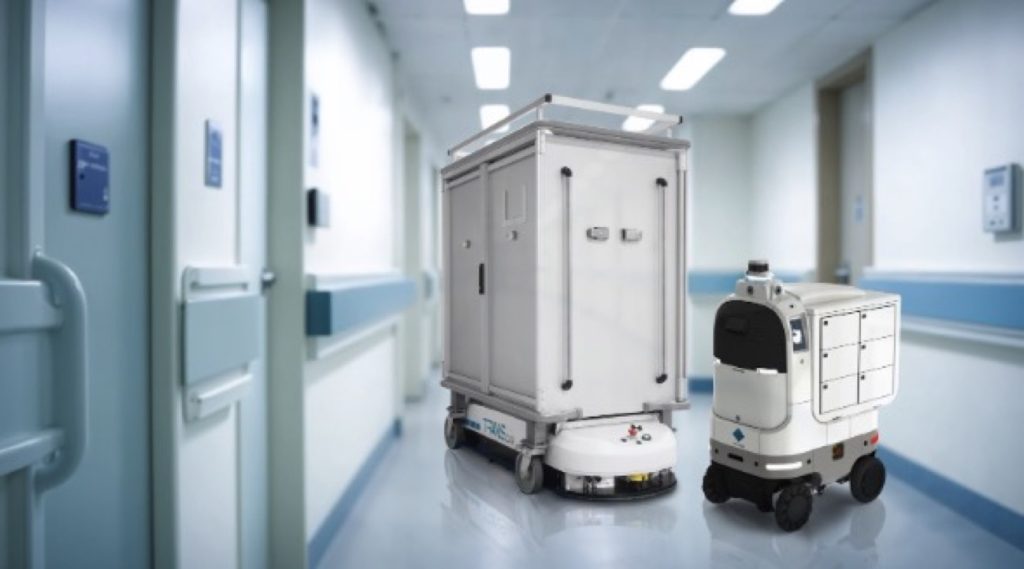
“OTSAW offers a suite of robotics solutions built to enhance hospital logistics and streamline essential operations. Our key products include the Transcar AGV/AMR and the Camello+ AMR.”
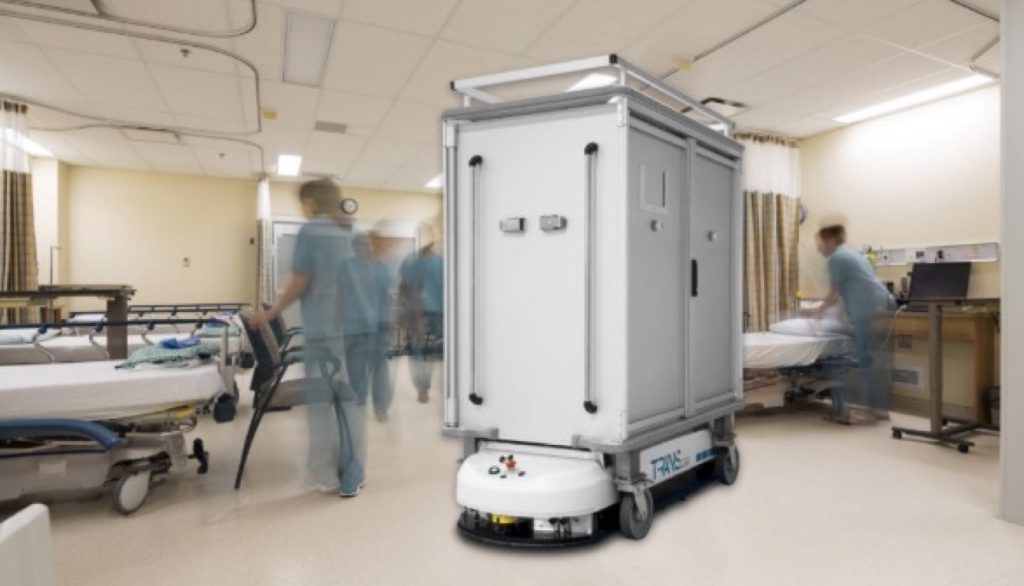
“The Transcar is a heavy-duty autonomous guided vehicle (AGV) and autonomous mobile robot (AMR) designed to transport large trolleys carrying food, linen, waste, and medication. These advanced robots are capable of carrying loads of up to 500 kg and are engineered for robust, continuous operation in demanding hospital environments. The Transcar AGVs are equipped with advanced navigation systems, ensuring precise movement within shared hospital spaces while maintaining high safety standards through sensors that prevent collisions with staff or obstacles. The Transcar Management System optimizes fleet performance by managing routes, schedules, and vehicle speeds in real-time. This system integrates seamlessly with hospital infrastructure, including elevators and automatic doors, enabling efficient vertical and horizontal transport without significant construction.”
“The Camello+ AMR is a fully autonomous, multi-purpose delivery and security robot designed for both indoor and outdoor environments. Camello+ offers a versatile platform capable of seamlessly transitioning between delivery and surveillance roles based on the selected mode. In delivery mode, Camello+ can be equipped with various modular attachments, enabling it to handle a diverse range of delivery tasks, such as transporting packages, medical supplies, or other goods. In surveillance mode, Camello+ is equipped with advanced security features such as warning lights, high-definition cameras, and real-time two-way communication capabilities. These features enable the robot to monitor its surroundings effectively, detect unusual activities, and interact with human operators during emergencies. Unlike many other robots that specialize in only one role, Camello+ integrates both seamlessly without compromising performance.”


Challenges Faced
Have you faced any challenges in your sector of work recently? Ling acknowledged:
“There’s a common belief that robots and automation will take away human jobs. However, if we look at history, automation and technological advancements have consistently helped transform and modernize industries—improving productivity, creating new job categories, and raising overall living standards.”
“From the invention of the washing machine, which greatly reduced domestic labor, to industrial robots in factories, and more recently, precision surgical robots in healthcare — technology has played a key role in enhancing human capabilities rather than replacing them entirely. While automation may displace certain roles, it also creates new types of jobs that require higher skills, often leading to increased income and better career opportunities.”
“It’s natural for people to resist change, but change is the only constant — and it’s accelerating faster than ever. Rather than seeing technology as a threat, we need to embrace it and ensure we bring everyone along by reskilling and educating the workforce. That’s how we shape a future where technology works for all of us.”
Evolution Of The Company’s Technology
How has the company’s technology evolved since launching? Ling noted:
“We have evolved tremendously since we launched in 2015, and we are in a very different world now than we were 10 years ago. OTSAW has introduced ****multiple impactful technological advancements in recent years. We’ve progressed from pandemic-response tools such as disinfection and concierge robots, as well as security robots, to versatile, modular systems like the Camello+, multi-purpose robot. We continue to monitor the labor shortage situations at healthcare institutions and make decisions on our robots with their needs in mind.”
Customer Success Stories
Can you share any specific customer success stories? Ling highlighted:
“OTSAW’s robots are extensively deployed in prominent healthcare facilities across Asia and Europe, holding a commanding 90% market share in Singapore’s government hospitals. Almost all of the Singhealth Group hospitals are using our Transcar AGVs to transport food, linens, waste, and pharmacy medications.”
“One of our most recent hospital installations, a part of the National Healthcare Group (Singapore), includes a fleet of 14 Transcar AGVs that play a critical role in automating material handling processes. These vehicles streamline the transportation of medical supplies, linens and meals throughout the facility, reducing the strain on manual labor and freeing up healthcare staff to focus on patient care.”
Total Addressable Market (TAM)
What total addressable market (TAM) size is the company pursuing? Ling assessed:
“Healthcare manpower costs are rising globally, fueled by labor shortages, increasing demand for services, and the need to offer higher wages to attract and retain skilled workers. Meanwhile, the cost of robots has been steadily decreasing, thanks to advancements in technology, economies of scale, and growing competition in the robotics industry. This downward trend in robotic costs positions them as a highly cost-effective solution for automating repetitive tasks, enabling healthcare facilities to reduce their reliance on costly human labor while improving efficiency and productivity.”
“In addition to that, the growing aging population is intensifying the manpower shortage in the healthcare sector. At the same time, younger generations are showing less interest in taking on lower-skilled, repetitive roles—such as trolley-pushing in hospitals. Robotics offers a solution by automating these routine tasks, enabling healthcare professionals to focus more on other critical, high-value duties.”
“Lastly, robots can gather large volumes of real-time operational data, offering healthcare organizations valuable insights. This data can help streamline workflows, boost productivity, and improve patient outcomes. By automating routine tasks and delivering AI-powered analytics, robots help lower operational costs while enhancing the overall efficiency and effectiveness of healthcare facilities.”
Differentiation From The Competition
What differentiates the company from its competition? Ling affirmed:
“Our technology is designed to directly tackle the inefficiencies and resource constraints faced by both labor-intensive industries and healthcare institutions.”
“In the case of hospitals, our autonomous robots handle repetitive and labor-intensive tasks such as the transportation of medical supplies, linens, medications, and waste. These are critical functions that typically require multiple shifts of manpower across a 24/7 operation. By automating these tasks, we help hospitals significantly reduce operational costs, minimize human error, and allow healthcare staff to focus more on patient care—where the human touch is irreplaceable.”
“Similarly, within hospitals, our robots are designed to support intra-facility logistics traditionally handled by transporters (or just porters)—such as transporting medications, lab samples, meals, linens, and medical waste. With increasing patient loads and a limited pool of support staff, our solutions provide consistent and reliable performance around the clock, unaffected by shift limitations, sick leave, or staff shortages. This not only enhances operational efficiency and responsiveness but also helps healthcare workers focus on more critical, patient-facing responsibilities. Importantly, we see our technology as a tool to augment, not replace, human roles. By taking over mundane or physically-taxing tasks, we open opportunities for workers to be upskilled into higher-value roles such as robot operators, technicians, or system managers—creating a more future-ready workforce.”
“In short, our technology addresses the immediate pain points of cost and labor shortages, while laying the foundation for a more sustainable, resilient, and people-centric future.”
Future Company Goals
What are some of the company’s future goals? Ling concluded:
“There are over 200,000 hospitals in the world. Yet, today, fewer than 200 hospitals globally have adopted such solutions. We want to change that. As adoption grows and volumes increase, we can drive costs down — my vision is to reach a price point where every hospital in the world can afford this technology, just like a washing machine or vacuum cleaner in our homes.”
“Humans should no longer be doing these mundane and physically demanding tasks in the next decade. Factories and warehouses are already highly automated with robots—hospitals should be no different. In fact, hospitals operate 24 hours a day, 7 days a week, 365 days a year. It’s mission critical.”
“In my view, hospitals need this technology even more than factories and warehouses. Our goal as a company is to empower hospitals to make that transition.”

