Patchworks is a no-code/low-code integration platform (iPaaS) that helps eCommerce and retail businesses automate and manage data flows between systems like their storefront, ERP, WMS/3PL, finance, and other back-office tools. Pulse 2.0 interviewed Patchworks CEO Jim Herbert to gain a deeper understanding of the company.
Jim Herbert’s Background
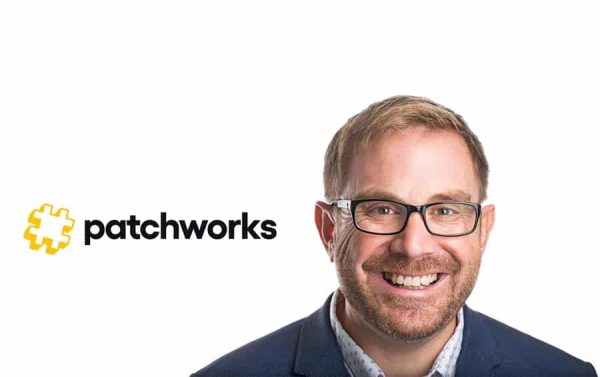

Could you tell me more about your background? Herbert said:
“I started programming when I was eight on a Sinclair ZX Spectrum, the day it was released, which set the course for everything that followed. I studied computer science at Loughborough, then moved into integration work at investment banks, connecting to New York and London Stock Exchanges, where stability and scale are non-negotiable. I built my first website in 2000, right at the point when e-commerce was taking off, and spent the early part of my career working as a partner of ATG, one of the first e-commerce platforms. In 2007, I co-founded a systems integration firm, Sceneric, to deliver e-commerce sites, which pivoted into hybris delivery in 2010. Sceneric was sold to LBi and then Publicis and grew internationally, growing to £17 million turnover before I left in 2015. After some non-exec roles, I joined BigCommerce as GM for EMEA and took the business from roughly nearly fourfold ARR. I left in December 2022 with a very clear sense that integration was becoming the real bottleneck and the real opportunity in retail.”
Formation Of The Company
How did the idea for the company come together? Herbert shared:
“Patchworks began with Juno, a large library of integration code one of our founders, Dave, had built through years of work in the Shopify ecosystem. He saw retailers wanting a productised way to buy integration capability off the shelf, while still having partners customise it for their exact systems. That idea became Patchworks. A specialist integration platform built as SaaS from day one, giving retailers a plug-in foundation that partners can extend in a structured, scalable way.”
Favorite Memory
What has been your favorite memory working for the company so far? Herbert reflected:
“Leading the transformation from a services-heavy business into a true SaaS platform has been the standout moment for me. We now have over one hundred agencies trained to deliver Patchworks, many of whom built their own businesses off the back of that expertise. Seeing brands like Belstaff, Castore, Gymshark and Goodyear run global operations on top of Patchworks, and knowing the platform can scale with them, is incredibly satisfying.”
Core Products

What are the company’s core products and features? Herbert explained:
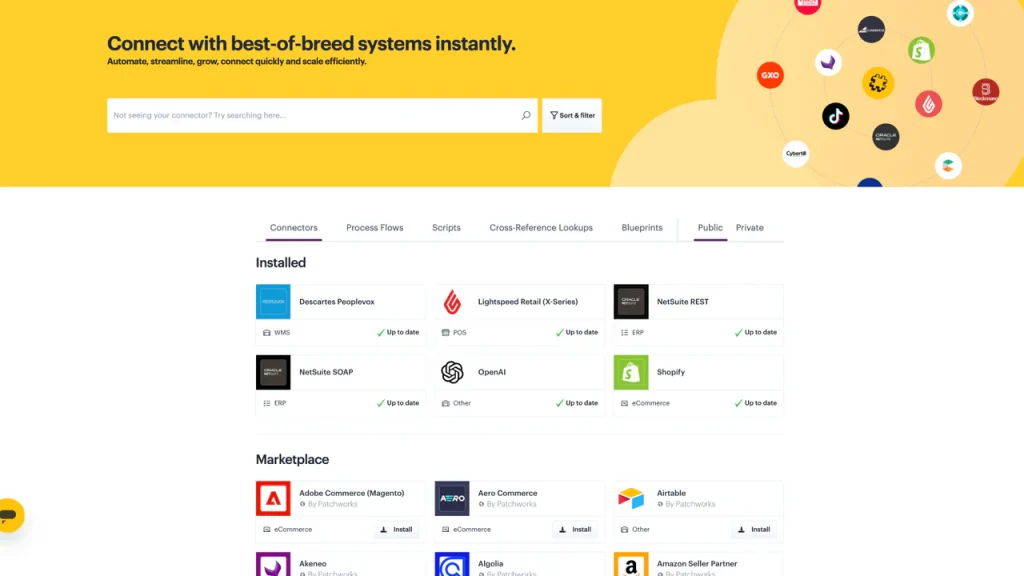
“Patchworks is an API-first integration platform that connects ecommerce systems, ERPs, WMSs, CRMs, marketplaces, and anything else a retailer needs to run behind the scenes. It offers no-code and low-code orchestration, multi-language scripting, a modern dashboard, and a backend designed to handle data movement at speed and scale. Everything is built to let retailers automate their back office reliably and without constant development work.”

Challenges Faced
Have you faced any challenges in your sector recently? Herbert acknowledged:
“The hardest challenges are always on the human side. I came in as a new CEO with a new vision for partner-led delivery, which means a lot of negotiation, shared decision-making, and clear communication. We also had to transform our support performance. At one point, our NPS was sitting around minus seventy, and only about twenty percent of SLAs were being met. Today we’re at 99 percent CSAT, an NPS of 83, a class-leading internal eNPS, and an uptime of over 99.9% over the 3 years I’ve been here(100% over BFCM 2023, 2024, 2025). That shift came from rebuilding processes properly and caring deeply about the quality of the work.”
Evolution Of The Company’s Technology
How has the technology evolved since launching? Herbert noted:
“The pace of change is fast. We release new platform updates every two weeks, and all customers receive them instantly, all designed to make integrations quicker and easier. Our first AI feature was released this year,AI scripting, which lets users describe a problem and generate working integration scripts in any coding language. Adoption is already at forty-five percent after just 5 months. We’ve built an MCP server based on the Anthropic standard so customers can plug Patchworks into their own AI or run it alongside their LLM. Half of our roadmap now comes directly from customers and partners, and features like virtual environments for dev, staging and production came directly from enterprise feedback. The UX improves weekly, and the direction of travel is shaped by real-world needs.”
Significant Milestones
What have been some of the company’s most significant milestones? Herbert cited:
“Passing £5 million / $7 million ARR last year was an important marker for the SaaS transformation. Expanding into North America with Jon Rodgers leading the region has also been key, with the SEEQ protein powders launch being a strong early proof point.”
Funding/Revenue
Are you able to discuss funding and revenue metrics? Herbert revealed:
“The business is funded to reach profitable growth. Our first round was £3 million from Gresham House Ventures in 2021. They followed with £4 million in March 2023, then another £2 million in December. Our most recent totalled £5m with Palantine alongside existing investor Gresham. That puts us in a strong position for the next phase.”
Total Addressable Market (TAM)
What total addressable market are you pursuing? Herbert assessed:
“We focus primarily on retail, while many competitors chase multiple industries like pharma and financial services. The broader iPaaS market is predicted by Gartner and Forrester to grow from roughly £10–15 billion today to around £60 billion by 2030. Retail itself represents about 46 percent of global GDP, so the TAM even within our chosen vertical is extremely large.”
Differentiation From The Competition
What differentiates the company from its competition? Herbert affirmed:
“Patchworks is the most modern retail-focused integration platform. It’s API first, designed to connect everything to everything, with a full no code and low code interface so users don’t need to be developers to build or maintain integrations. The front end is clean, but the back end is engineered to handle real retail volumes and cool use cases like resyncing failed orders via other systems like Slack. We’re also the only platform offering a true multi language backend dashboard. It’s built for reliability, speed and usability rather than legacy complexity wrapped in a new UI.”
Future Company Goals
What are the company’s future goals? Herbert concluded:
“Our ambition is to be the easiest way for retailers automate their entire back office so they can protect margin, reduce waste and expand without heavy overheads. Retail is a tight margin industry, so every operational improvement matters. We’re introducing features that let brands cut costs, integrate new technology quickly and sell more with less friction, and to maintain this themselves. A good example is our work with Bollin Group helping them mitigate US tariff exposure with a self built script solution, and also MAUVAIS Group who were able to launch a mitigation strategy through a Patchworks integration in only 15 days. There is huge headroom for retailers to run leaner and smarter, and Patchworks is designed to make that achievable.”

