Permutable is a London-based AI-driven market intelligence company that analyzes global narratives, macroeconomic developments, and real-time news flows to generate explainable market intelligence for institutional investors, hedge funds, and commodities trading teams. Pulse 2.0 interviewed Permutable founder and CEO Wilson Chan to learn more.
Wilson Chan’s Background
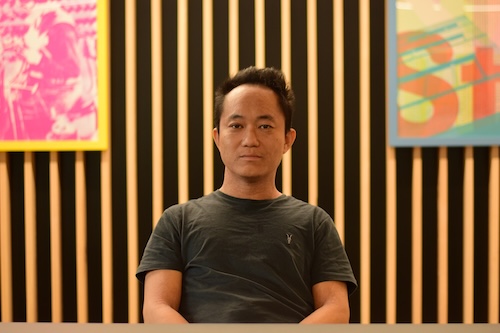

Could you tell me more about your background? Chan said:
“I started as a quant trader on the fixed-income derivatives desk at Merrill Lynch, where we were already experimenting with early machine learning techniques to identify relative-value opportunities across the yield curve . Later, I moved to Citibank where I advised sovereign wealth funds across Asia. But throughout that time, I was watching how markets were evolving – from traditional software with hand-coded rules to neural networks, and now to large language models capable of interpreting and structuring large volumes of unstructured financial and macroeconomic information.”
“What became obvious was that the future of markets would be shaped by AI-native systems capable of interpreting global information faster and more holistically than any traditional stack. That’s what drew me out of traditional finance and into building Permutable.”
Formation Of The Company
How did the idea for the company come together? Chan shared:
“The core mission has always been to build explainable AI for capital markets. We initially thought we’d focus on ESG – we wanted to make an impact, and ESG was gaining momentum. But we quickly realized the market was already moving past that trend, and the technology we were building wasn’t getting the recognition it deserved.”
“So we pivoted back toward trading and market intelligence. That’s when things really started to scale. The technology almost took on a life of its own once we focused on building reasoning models that could anticipate market shifts rather than just react to them. We became increasingly focused on how narrative velocity, geopolitical developments and macro expectations were influencing cross-asset repricing in real time.”
Favorite Memory
What has been your favorite memory working for the company so far? Chan reflected:
“Deploying our models into live market conditions this year and watching how they dealt with volatile geopolitical and macroeconomic conditions t. It’s one thing to build models in a controlled environment, but seeing them perform in real-time during some of the most volatile market conditions – that was validating. It proved the architecture could adapt as fast as the world itself as this was proven out in our live systematic trading results.”
Core Products
What are the company’s core products and features? Chan explained:
In institutional markets, information alone is rarely enough. The challenge increasingly lies in interpreting how inflation expectations, geopolitical developments, energy markets and central bank policy narratives interact across asset classes before those shifts are fully reflected in market pricing.
“We’ve built an explainable market intelligence platform that scans hundreds of thousands of articles, policy developments and macroeconomic signals in real time and surfaces the ones that actually matter – complete with analysis generated almost instantly. It’s far beyond what a standard search-enabled LLM can do. The focus is not simply information retrieval, but contextual interpretation of market-moving developments across macro, commodities, FX and geopolitical environments. Think of it as a live reasoning engine that sits beside every trader, constantly updating its read on the world.”
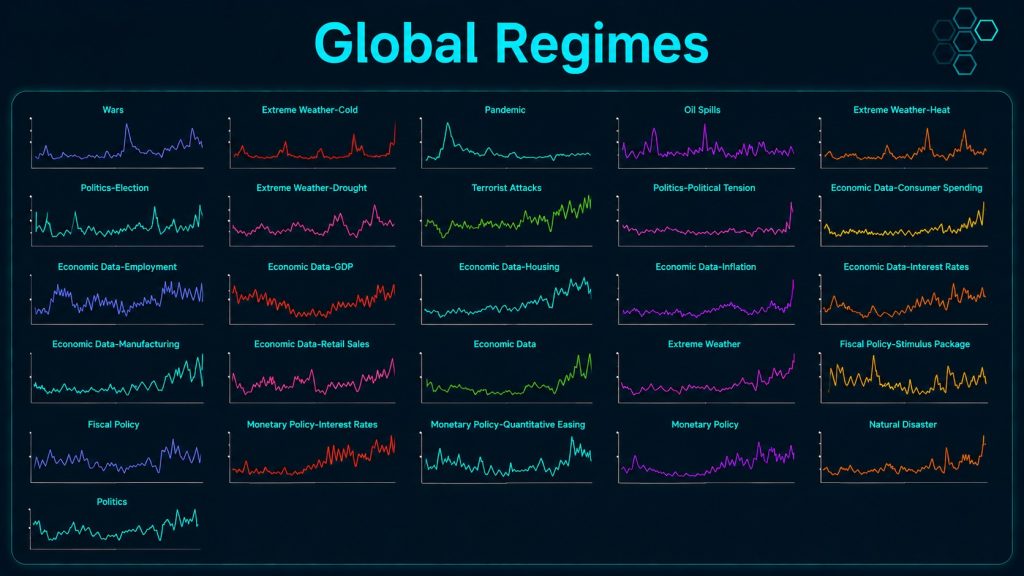

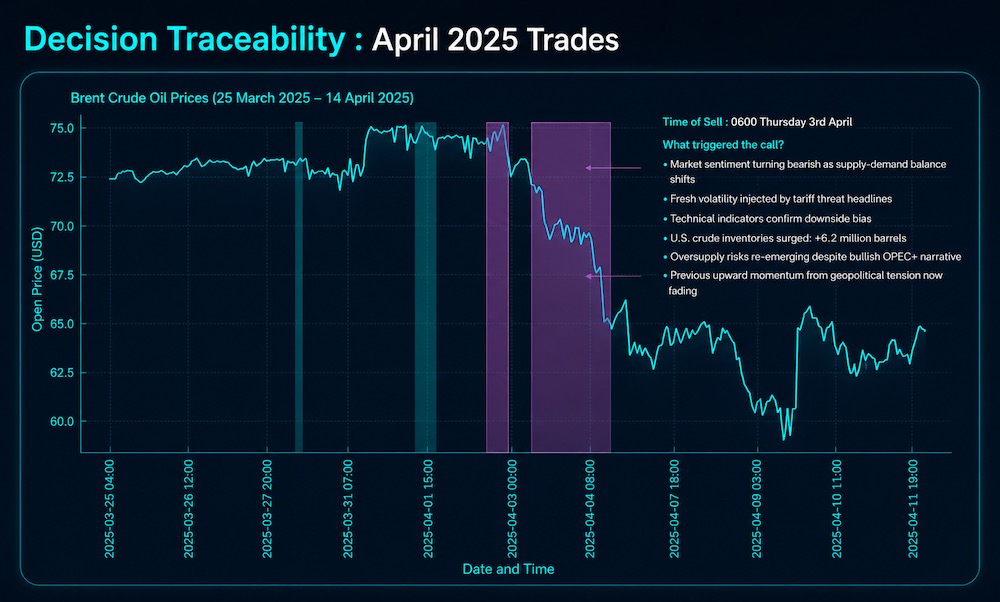
“Our real-time sentiment models track inflation narratives, central bank policy expectations, supply-chain developments, geopolitical risk and industrial demand shifts across commodities, FX and macro markets. . The key differentiator is explainability – every output is fully traceable down to the exact article, timestamp, and source. We’ve designed it with transparency embedded into the core architecture.”
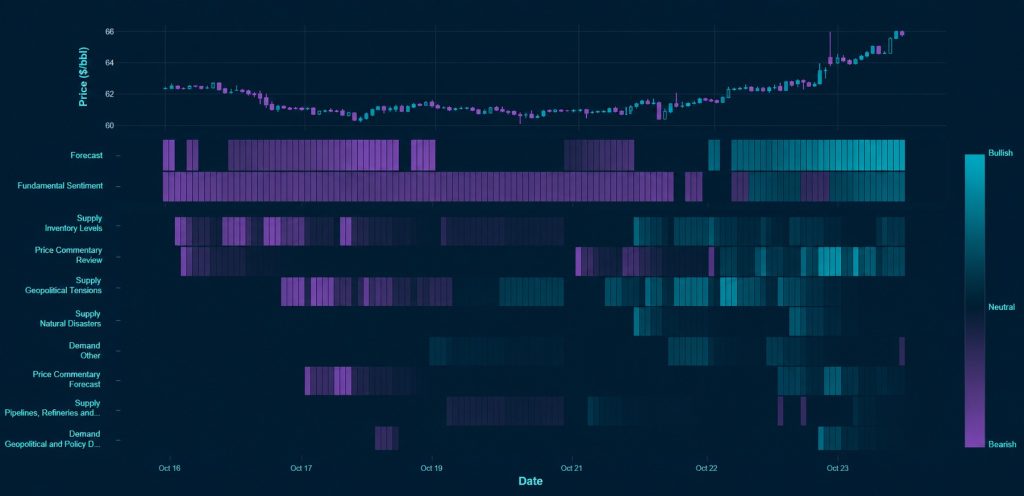

“We also generate explainable market sentiment indicators designed to help distinguish whether market moves are being driven by macro conditions, positioning flows, supply constraints or deliverability stress . That distinction is critical for traders making decisions in compressed timeframes.”

Challenges Faced
Have you faced any challenges in your sector of work recently? Chan acknowledged:
“Two big ones. First, solving genuinely difficult problems – like extracting consistent signal quality from large volumes of human-generated and event-driven data. We’re competing against firms with AI budgets that can run into the hundreds of millions or even a billion dollars a year. Our answer has been focus and efficiency: developing domain-specific models designed for financial and macroeconomic analysis.”
“Second, the commodities industry generally is still not ready for advanced technology changes. There’s resistance, inertia, cultural blockers. But we keep beating the drum. When you can demonstrate that your technology actually outperforms the market – as we did in 2025 – people start paying attention. The data speaks louder than any pitch deck.”
Evolution Of The Company’s Technology
How has the company’s technology evolved since launching? Chan noted:
“We’re starting to understand our target customer workflow much better, which allows us to adapt our technology to help them more effectively.“We began working with transformer-based architectures early as we explored large-scale narrative and market analysis Now we’ve evolved into multi-agent architectures with self-evaluation. The broader goal is now building systems capable of monitoring how macro narratives evolve across asset classes in real time.”
“The shift has been from building impressive models to building systems that integrate seamlessly into actual trading workflows. That means not just providing intelligence, but making sure it arrives at the right moment, in the right format, with full traceability. It’s the difference between a research tool and an operational edge.”
Significant Milestones
What have been some of the company’s most significant milestones? Chan cited:
“Using explainable AI to beat the markets. That’s not a claim we make lightly – it’s backed by performance data and validated by the fact that we recently signed one of the world’s largest hedge funds to use our product. When institutions at that level adopt your technology, it’s a clear signal that the approach works.”
Customer Success Stories
Can you share any specific customer success stories? Chan highlighted:
“We’ve recently signed one of the world’s largest hedge funds to use our product. I can’t share specifics due to confidentiality, but what I can say is that they saw our track record, evaluated the explainability of our outputs, and recognized that this wasn’t just another black-box AI tool. They understood that we’re providing real-time intelligence that translates directly into actionable edge.”
Funding/Revenue
Are you able to discuss funding and/or revenue metrics? Chan revealed:
“In the near future, we’re planning to execute a Series A round. The focus is on scaling the team, expanding our partnerships, and accelerating product development. We’re building something that requires the very best AI engineers, and attracting that talent – especially in a market where they’re being courted by tech giants – requires both mission and momentum.”
Total Addressable Market (TAM)
What total addressable market (TAM) size is the company pursuing? Chan assessed:
“We believe the addressable market for institutional market intelligence, analytics and alternative data exceeds $100 billion globally . When you look at what institutional investors, hedge funds, and trading firms spend on data, analytics, research, and intelligence platforms – Bloomberg terminals, Reuters feeds, specialized commodity data, sentiment analysis, alternative data sources – it’s a massive market that’s only growing as decisions become more data-intensive.”
“The reality is that margins are compressing everywhere, passive ETFs are consistently beating active managers, and the hunt for alpha has never been more competitive. Market participants are increasingly willing to pay for intelligence that gives them a genuine edge. We’re not selling another data feed – we’re selling the ability to read market perception faster and more accurately than the competition. We believe institutional investors increasingly require contextual intelligence rather than raw information alone. That’s worth considerably more.”
Differentiation From The Competition
What differentiates the company from its competition? Chan affirmed:
“We rigorously test our models against real market conditions before commercial deployment. Most AI vendors in finance build tools and hope they work. We build systems, trade with them, evaluate their effectiveness under real market conditions, and then offer them to clients. That’s a fundamentally different approach – one that earns credibility because we have skin in the game.”
“Beyond that, our architecture is built on explainability. Every decision output is traceable to specific sources with timestamps. We reduce hallucinations by tightly controlling task boundaries. In an industry where trust and auditability matter enormously, that’s a genuine competitive moat.”
Future Company Goals
What are some of the company’s future goals? Chan emphasized:
“Three priorities for the near term: First, to double the size of the team by the end of 2026. We need world-class AI engineers, and that means competing on mission as much as compensation. The best engineers want to change the world, not just maximize returns for a committee.”
“Second, complete strategic partnerships in the UK and internationally. We’re looking for partners with global reach, strong ecosystem credibility, and the ability to help scale our intelligence across multiple regions and asset classes.”
“Third, keep building toward what I think of as a world model for capital markets – a unified representation of how tradable assets interact and influence one another, whether that’s sovereign debt, FX, commodities, or even something as specific as coffee prices. That’s the long-term vision.”
Additional Thoughts
Any other topics you would like to discuss? Chan concluded:
“I think the most important thing people need to understand is that perception is becoming reality in markets. It’s not just that perception influences prices – it’s that in an age of algorithmic trading, instant news, and AI-powered decision-making, perception and reality have collapsed into the same thing.”
“What traders believe about supply disruptions, geopolitical risk, or demand forecasts moves prices just as powerfully as the underlying fundamentals. Sometimes more so. That’s what we measure at Permutable. And in a world where perception is reality, the advantage increasingly belongs to firms capable of interpreting narrative and macro shifts earlier and more consistently .”
“And then I’d like to add that culture is everything in this transformation. Whenever I’m in a board-level meeting, I know within the first minute whether that organization is capable of going through an AI transformation.The institutions that adapt effectively to AI-driven workflows are likely to gain structural advantages over time. We’re building technology for the former – for the institutions willing to adapt as fast as the world itself.”

