Plurio is an AI MarTech company building an AI agent for performance marketing teams managing from $500K in monthly advertising spend that helps teams analyze advertising performance, forecast outcomes, recommend actions, and execute approved changes across channels. The company grew out of Elly Analytics, a cross-platform marketing analytics startup founded in 2023, and is focused on automating performance marketing workflows for consumer-facing businesses with delayed conversion cycles. Pulse 2.0 interviewed Plurio Co-Founder and CEO Seva Ustinov to learn more.
Seva Ustinov’s Background


When asked about his background, Ustinov shared:
I’ve spent over 20 years building in performance marketing, much of that time working alongside Kirill Kasimskiy. Before Plurio, we built an agency from the ground up to 100+ people, serving clients across consumer software, fintech, healthtech, and other sectors. The business is still operating today without our involvement.
In 2023, we founded Elly Analytics, a startup focused on automating cross-platform marketing analytics. It scaled quickly, supporting over $100M in annual ad spend, and is now fully integrated into the Plurio ecosystem.
How Plurio Started
When asked how the idea for the company came together, Ustinov explained:
In consumer products and services, I kept seeing the same thing: strong teams spending their days not on growth, but on stitching together data.
It never felt normal that our best people were buried in dashboards for hours, waiting for delayed signals just to understand what was happening. Most days looked like 10% thinking and creating, and 90% clicking through platforms.
Plurio grew out of the frustration with that reality, out of the wish to give teams their time and attention back, and to finally make fast decision-making possible.
From Prototype To Product
When asked about his favorite memory working for the company so far, Ustinov recalled:
Two moments stand out.
Moment 1: We were building our AI agent, but it was still pretty early and unstable. I was relying on Cursor for most tasks. At some point, I tried to solve a real problem with our own agent: generating analysis and kill rules for underperforming creatives.
The plan was simple: start with our agent, switch to Cursor when it breaks. I never switched. It handled the entire task. That was the first moment it clicked inside me: this isn’t a prototype; it’s a product.
Moment 2: When we announced the funding round, the response went beyond expectations. At the same time, we were running webinars and live sessions, and people started showing up, not out of curiosity, but with intent.
It became obvious this wasn’t just noise around a launch. There was real demand. That shift from pushing a story to seeing pull was probably the strongest emotion.
Core Products And Features
When asked about the company’s core products and features, Ustinov detailed:
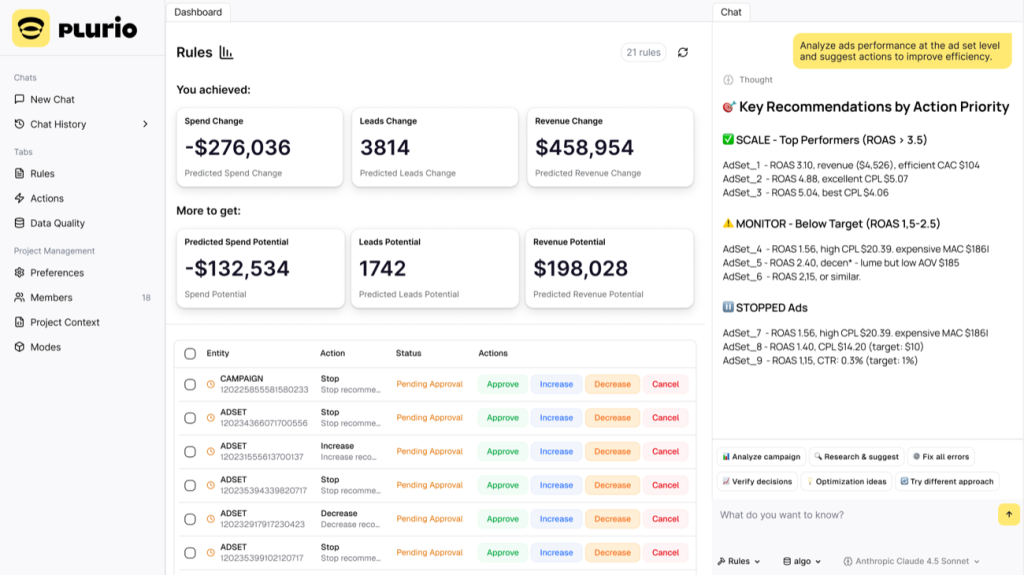
It’s Plurio, the first AI agent that acts across channels as a full-fledged performance marketer. We’ve designed it to replace the outdated and fragmented workflows of marketing teams managing consumer software and service brands with delayed conversion cycles.
Plurio changes these workflows by reading early signals- shifts in creative performance, audience quality, and channel behavior- and inferring what will happen before delayed metrics catch up.
It can see when a creative is about to fatigue, when a winning trend is forming, or when a budget adjustment will improve downstream performance, delivering attribution-first decisions.
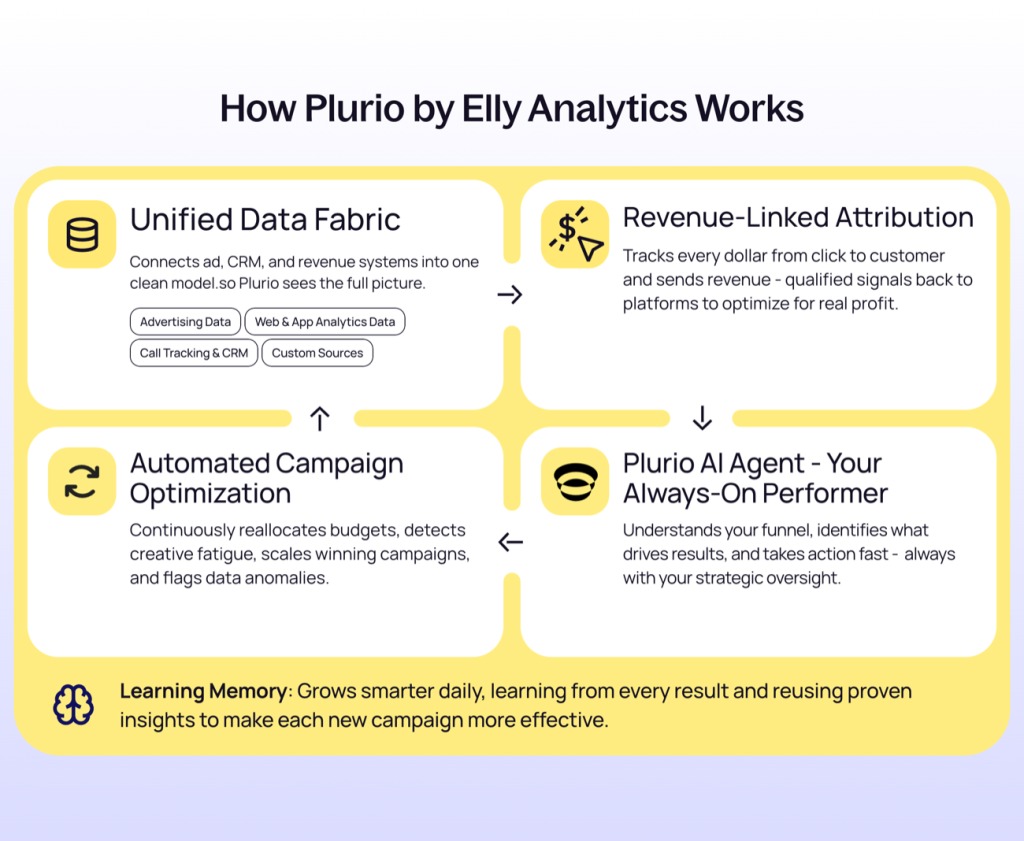
Plurio integrates advertising, CRM, and revenue data into a single source of truth, and understands what drives growth.
Teams interact with Plurio through natural-language prompts such as: “Where will revenue land if we shift 10% of spend from Meta to TikTok?” or “Pause Meta ads where ROAS drops below 2.0.”
The agent evaluates all factors that influence outcomes, from seasonality and audience quality to funnel efficiency and revenue trends, and explains what changed and why. It forecasts scenarios, recommends the next move, and executes approved changes.
Behind the scenes, it runs closed-loop optimization, learning from each result, and improving predictions with every cycle.


Constantly Renewing Product-Market Fit
When asked about challenges in the company’s sector and how Plurio has approached them, Ustinov noted:
One of the most interesting challenges of today’s market for me is that product-market fit is no longer a stage you reach and move on from. It’s a temporary status that lasts about three months.
LLMs are evolving, Claude Code is evolving, and competitors gain access to all the same tools. So you need to find a new product-market fit every three months, inventing, building, shipping, and releasing things that create real value and a wow effect.
Technology Evolution
When asked how Plurio’s technology has evolved since launching, Ustinov explained:
Quite radically. We started as a marketing analytics product, focused on aggregating and structuring data across platforms. Today, it’s an AI agent that automates up to 90% of a performance marketing specialist’s workflow, from analysis to decision-making and execution.
And it’s still expanding. For example, we’re now working hard to add capabilities like generating creatives directly within the agent, removing the need to switch tools altogether.
The path goes in stages: first, a chat for ad-hoc questions. Then regular workflows. Then turning those into rules. Then sending agents to improve the rules based on historical data, running ML models to find the best parameter combinations for key actions.
That’s where it starts to look like something genuinely hard to replicate, and something that meaningfully improves results and metrics.
Major Company Milestones
When asked about some of the company’s most significant milestones, Ustinov said:
In 2023, Elly Analytics was founded. We built the core data platform, multi-touch attribution for lead-generating businesses, got first paying clients, and started raising investment.
In 2024, we grew to 30+ active clients and announced our first funding round.
In 2025, agentic AI reached the point where we could finally do what we’d been waiting for, automate the work our clients were spending hours on in dashboards every day.
We hired a dedicated AI team and launched a pilot program, where the first clients started using our AI agent for real budget decisions. Meanwhile, the company reached $500M+ in annual client ad spend under management.
In March 2026, we raised an additional $3.5 million from AltaIR Capital, DVC, Yellow Rocks, plus strategic angels, Kos Stiskin (CEO of Finom) and Mike Yan (founder of ManyChat). We rebranded to Plurio.
TripleTen Customer Success
When asked to share a specific customer success story, Ustinov highlighted:
TripleTen is one of the largest online education companies, selling courses internationally. Their US performance marketing team spends over $1.5M per month on ads across Meta, Google, YouTube, and TikTok, 20+ ad sets on Facebook alone, dozens of creatives inside each, all generating leads that take weeks to convert into paying students.
Max Epifanov, their VP of Performance Marketing, was one of our first AI pilot users.
With Plurio, their campaign analysis dropped from 1–1.5 hours to 10–15 minutes. 20 hours saved per month. At their rates, that alone covers the entire cost of the product before counting any automation gains.
Full team adoption took two weeks. By March 2026, they had 11 automated rules running across Search, YouTube, Facebook, and creative fatigue detection. The agent proposes specific actions (increase budget, decrease budget, pause creative) and can execute them directly in the ad accounts.
The team trusts the agent enough that they’re no longer just reviewing its recommendations. They’ve moved into the next phase: the agent doesn’t just repeat what a human would do. It starts improving the process itself, not just executing rules, but writing better rules based on what it’s learned.

Funding And Early Results
When asked about funding and revenue metrics, Ustinov shared:
We can share what’s already public. We’ve recently raised a $3.5M round, bringing total funding to $4.5M. Additionally, I’d highlight Plurio’s first results:
- 100% retention from proposals to pilots among global EdTech and FinTech companies.
- 2x sales growth and 20%+ lower CAC as early results of those pilots.
- $500M in total annual ad spend across clients.
Market Opportunity
When discussing the total addressable market Plurio is pursuing, Ustinov explained:
The global digital ad market is heading toward $1.3 trillion by 2030. Marketing software and AI tools capture roughly 4% of ad spend, that gives us a TAM of about $15 billion.
Our serviceable market is narrower: US-based companies spending $500K or more per month on paid acquisition, primarily on Google, Meta, and TikTok. That’s a $6 billion SAM.
Competitive Differentiation
When asked what differentiates Plurio from its competition, Ustinov emphasized:
We’re building our AI agent for a specific audience that, until now, has largely been overlooked when it comes to meaningful automation: performance marketing teams at consumer-facing companies with long conversion funnels.
Subscription apps, fintech, edtech, healthcare, meal kits, businesses where a customer signs up today but revenue takes weeks or months to materialize.
Future Goals
When discussing Plurio’s future goals, Ustinov said:
Let me mention two of them:
The first one is to get to fully autonomous performance marketing, building a system that handles the full cycle on its own, from analysis to action to optimization.
The second one is to manage $100 billion in ad budgets. That’s the scale we’re building toward.
Building An AI-First Company
When asking Ustinov about what it was like building an AI-first company, he concluded:
We run Plurio as an AI-first company internally, not just as a product. Our entire 30-person team- marketers, customer success, sales, developers- works inside a shared AI workspace.
We’ve removed tools like Confluence; all knowledge, processes, and client context live in structured, machine-readable formats that AI agents can act on. I’ve even open-sourced the template for this model on GitHub.
We spend about 4% of payroll on AI subscriptions and tokens. I expect that to reach 10% within a year.
The payoff is measurable: team productivity is up 2–3x. This, to me, matters as much as the product itself. It shows that an “AI-first” company isn’t a buzzword; it’s a specific, reproducible way of working.

