Procurement Sciences is an AI-powered platform that helps government contractors and businesses streamline the bidding and proposal process, allowing them to find, win, and deliver contracts more efficiently. Pulse 2.0 interviewed Procurement Sciences founder and CEO Christian Ferreira to learn more.
Christian Ferreira’s Background


Could you tell me more about your background? Ferreira said:
“I began my career straight out of high school in the U.S. Marine Corps, serving as a Sergeant and deploying across the Middle East, including Afghanistan, before I turned twenty-one. The Marine Corps shaped the way I lead today by reinforcing the importance of clarity, urgency, accountability, and never asking your team to do anything you would not do yourself.”
“After completing my service, I earned degrees in computer science and business, and later a master’s degree focused on innovation and engineering. I then spent nearly a decade in the government contracting world, starting as a full stack engineer and solutions architect and eventually becoming a director of business strategy at a major prime contractor.”
“These roles gave me a deep understanding of both the technology and the operational pain points involved in government contracting. I did not enter AI from a research background. I entered it as a practitioner who lived the inefficiencies firsthand and recognized that the industry needed a better system.”
Formation Of The Company
How did the idea for the company come together? Ferreira shared:
“The idea came directly from watching talented business development, capture, and proposal teams fight to keep up with an endless stream of RFPs, compliance matrices, rewrites, and last-minute deadlines. Despite billions of dollars at stake, much of the work still relied on tribal knowledge, spreadsheets, and manual workflows.”
“When generative AI reached real maturity in late 2022, it was clear the timing was right to rethink the entire government contracting lifecycle. Not just to speed up drafting, but to improve how companies discover opportunities, decide where to compete, build compliant proposals, and execute after award.”
“That is why we started Procurement Sciences. Our goal was to build the first AI native operating system for government contracting, a platform that helps companies find, win, and deliver government contracts faster and more competitively.”
“Today, my job as CEO is to guide that product vision, build a high-performance team, and keep us focused on one mission: helping government contractors use AI to win more and deliver better.”
Favorite Memory
What has been your favorite memory working for the company so far? Ferreira reflected:
“The moments that stay with me are when customers tell us our platform changed their business.”
“One story in particular stands out. A mid-size contractor had already decided not to pursue a highly competitive bid because there were only about ten days left before submission. After they saw what our platform could do, they reversed that decision, used our AI to build a compliant and compelling proposal in a fraction of the usual time, and ended up winning a contract worth about 40 million dollars.”
“Hearing the excitement from that team reaffirmed what we now see every day. Procurement Sciences isn’t just streamlining work; it’s also opening doors to opportunities that many companies once thought were out of reach.”
Core Products
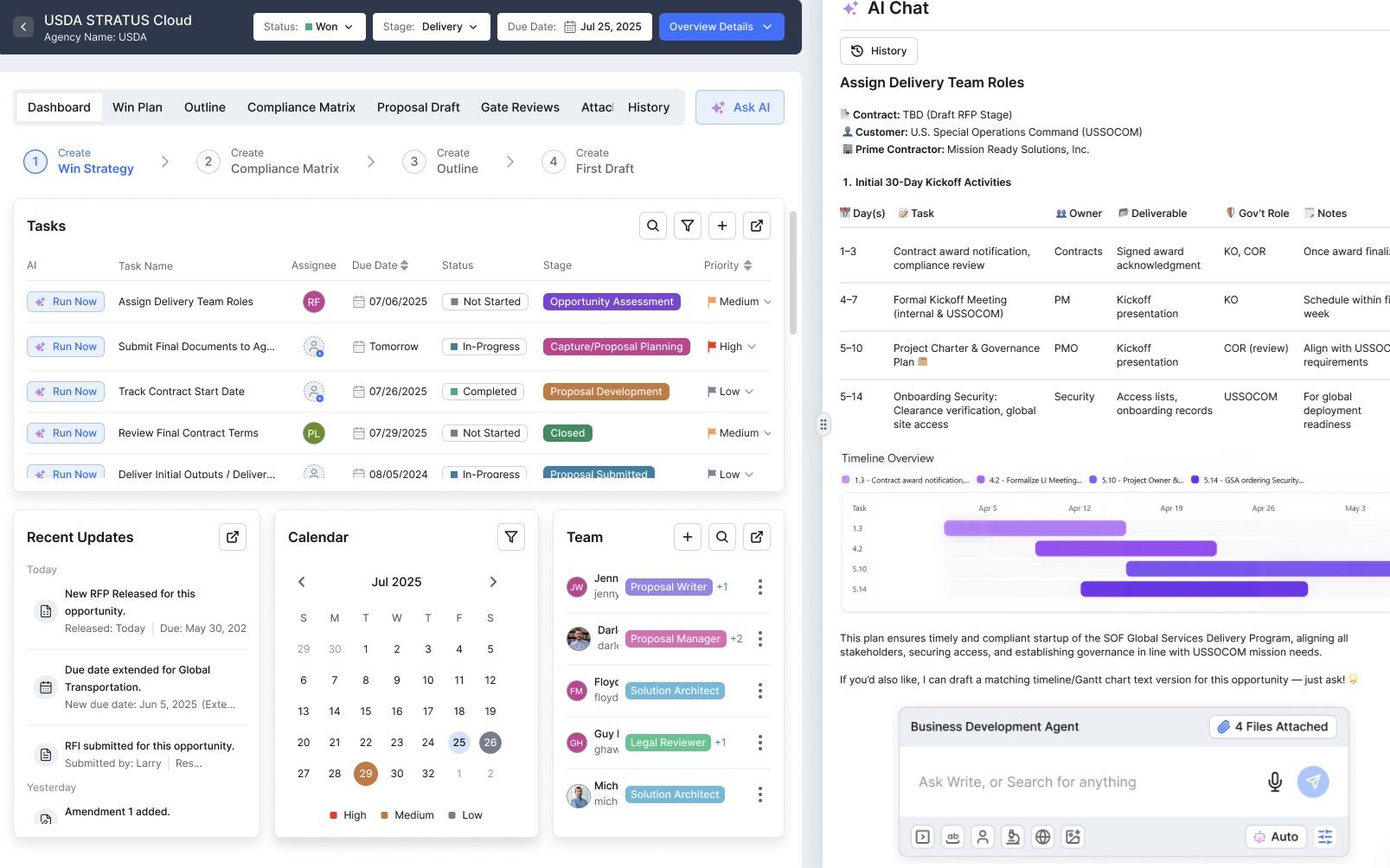

What are the company’s core products and features? Ferreira explained:
“Procurement Sciences is an AI native platform for government contracting that covers three key stages: Find, Win, and Deliver.
- Find: Opportunity discovery
- Aggregates more than 40,000 daily federal and SLED opportunities
- Provides automated fit scoring and bid or no bid recommendations
- Surfaces customer and competitor insights, teaming options, and market forecasts
- Win: Capture and proposal automation
- Builds and shreds compliance matrices from complex RFPs
- Drafts full proposal content, including technical, management, past performance, and pricing narratives
- Generates win themes, gap analyses, and strategy recommendations
- Supports color team reviews and automates rewrites based on feedback
- Deliver: Post award AI agents
- Creates kickoff and transition plans
- Helps manage risk registers and weekly reporting
- Provides contract intelligence for performance, compliance, and PMO support
- Uses AI agents trained on each award to assist delivery teams
At the core is our AI Engine, which ingests a customer’s historical document library, learns their voice, and becomes more tailored over time. The result is an AI platform for government contracting that replaces a patchwork of tools with one intelligent system.”
Challenges Faced
Have you faced any challenges in your sector of work recently? Ferreira acknowledged:
“Government contracting has a reputation for being slow to adopt new technology. The main challenge was not convincing people that AI is powerful. The challenge was proving that an AI platform designed specifically for government contracting could be trusted with high-stakes, compliance-heavy work.
We addressed that in several ways:
- We embedded FAR, DFARS, and proposal best practices directly into the product.
- We hired government contracting subject matter experts to work alongside our AI engineers.
- We focused on measurable outcomes, such as time saved and wins achieved.
- We integrated with systems customers already use, such as SharePoint, Teams, Salesforce, and Google Workspace.
Once teams saw the accuracy, speed, and guardrails in practice, adoption started to accelerate quickly.”
Evolution Of The Company’s Technology
How has the company’s technology evolved since launching? Ferreira noted:
“We started with AI proposal automation focused on drafting support, compliance, and shredding large RFPs. Customers quickly asked us to help with everything that happened before and after that step.
Today, the platform has evolved into a full lifecycle AI system. It now supports:
- AI-powered opportunity discovery
- Capture management and competitive analysis
- Proposal drafting and review workflows
- Knowledge ingestion and collaboration
- Predictive analytics and compliance automation
- Post-award AI agents that support delivery and program management
In many organizations, Procurement Sciences is now viewed as a core operating system for business development, capture, proposals, and delivery, not just a point solution.”
Significant Milestones

What have been some of the company’s most significant milestones? Ferreira cited:
“Several milestones stand out:
- Closing a 30 million dollar Series B round led by Catalyst Investors, with participation from Battery Ventures and other leading firms
- Achieving more than ten times revenue growth since our Series A
- Expanding to more than 300 organizations on the platform, including four of the Top 10 defense contractors
- Enabling more than 4 billion dollars in customer contract wins in 2024
- Hiring our CTO, Greg Larson, who previously helped scale Jasper AI and Divvy to multi-billion dollar outcomes
- Growing our team from 16 people to more than 80
- Helping customers reduce proposal timelines from weeks or months down to days or even hours
For me, the most important milestone is seeing customers win and deliver better work with the help of our AI platform.”
Customer Success Stories
Can you share any specific customer success stories? Ferreira highlighted:
“Yes, a few examples show the impact clearly:
- A customer who had originally decided not to bid used our platform with about 10 days remaining and ultimately won a 40-million-dollar contract.
- A mid-market IT contractor reduced proposal development time by about 90 percent, going from a three-week process to three days.
- Multiple large defense and aerospace companies now rely on Procurement Sciences to evaluate opportunities, build proposals, and support delivery.
Across the board, we see less manual work, faster cycles, and better win rates.”
Funding/Revenue
How much funding have you received to date and can you share revenue metrics? Ferreira revealed:
“I cannot share specific revenue numbers, but I can share the overall trajectory.”
“The company has grown more than tenfold over the past two years. In total, we have raised more than 40 million dollars in funding. Our most recent round was a 30 million dollar Series B led by Catalyst Investors, with participation from Battery Ventures, Bosch Ventures, Citi Ventures, Tower Research, K Street Capital, and Blu Ventures.”
“The quality of our investors reflects both the scale of the opportunity in AI for government contracting and the strength of the platform we are building.”
Total Addressable Market
What total addressable market (TAM) size is the company pursuing? Ferreira assessed:
“The U.S. federal government spends roughly $665 billion each year on procurement. When you add state, local, and education markets, the total addressable market exceeds 1 trillion dollars annually. If you then consider international allied markets, the opportunity grows even larger.”
“Across that entire landscape, processes are still heavily manual and expensive. Our AI platform for government contracting is designed to remove friction from every phase, from opportunity discovery to post-award delivery.”
Differentiation From The Competition
What differentiates the company from its competition? Ferreira affirmed:
“A few things clearly set us apart.”
“First, we are purpose-built for government contracting. This is not a generic AI tool. Our platform is designed around government workflows, language, and evaluation criteria, including compliance with regulations like FAR and DFARS.”
“Second, we cover the full lifecycle: Find, Win, and Deliver. Many tools focus on a single slice, such as opportunity search or document drafting. We connect the entire flow into a single AI-native system.”
“Third, we have a proprietary AI Engine. It ingests a customer’s existing content, learns their voice and patterns, and improves with use. The more customers use the system, the more tailored it becomes.”
“Fourth, our impact is measured in weeks, not minutes. Customers reduce proposal timelines dramatically and unlock capacity for more strategic work.”
“Fifth, we are practitioner-led and backed by tier one investors. The company was founded by people who have lived the challenges of government contracting. Our investors, including Catalyst Investors and Battery Ventures, typically back category-defining platforms, not incremental tools.”
Future Company Goals
What are some of the company’s future goals? Ferreira emphasized:
“We are focused on building the default AI operating system for government contracting.”
“Some of our key priorities include:
- Expanding our AI agents for program delivery and PMO support
- Strengthening teaming intelligence and partner recommendations
- Building deeper integrations into CLM, ERP, and content platforms
- Advancing predictive analytics, risk scoring, and win simulations
- Growing our presence in SLED and in allied international and NATO markets
- Continuing to invest in security, compliance, and scalability
Our long-term goal is simple: help every contractor win more, deliver better, and grow faster with the help of AI.”
Additional Thoughts
Any other topics you would like to discuss? Ferreira concluded:
“One point I think is important is how AI and human expertise fit together in this space.”
“AI is not replacing people in government contracting. It is amplifying them. The companies that build AI into their workflows now will set the pace for the next decade. Our aim is to give contractors a trusted, purpose-built AI platform that helps them compete, win, and deliver at a higher level.”

