

Ranpak manufactures sustainable, paper-based packaging materials and automated end-of-line packaging equipment. Ranpak has a complete range of converters and solutions that convert kraft paper into cushioning, void-fill, wrapping, and cold-chain applications designed to protect products during shipment. Pulse 2.0 interviewed Ranpak Chairman and CEO Omar Asali to learn more.
Omar Asali’s Background

Could you tell me more about your background? Asali said:
“I grew up in Jordan and moved to the United States to pursue my education and career. This transition was a pivotal experience that instilled in me a deep sense of resilience, determination and adaptability—qualities that have become central to my professional philosophy and long-term thinking. I came to the US as an ambitious clueless kid with big dreams and very little understanding of what lay ahead. I benefited tremendously from the possibilities and opportunities that make this country exceptional.”
“I am fortunate that my career and background is diverse. My career spanned several industries including investment banking, asset management, insurance, consumer products, industrials and industrial tech. I have worked at large firms like Goldman Sachs, and served in a leadership capacity in smaller firms like HRG Group. In the last decade, I co-founded One Madison Group, a private investment firm focused on long-term value creation.”
“Since 2019, I have served as the CEO and Chairman of Ranpak. My focus at the helm has been dual-purpose: driving commercial success through product innovation while ensuring the business remains a leader in sustainability and environmental impact. My goal is to build a legacy that proves profitability and global responsibility are not mutually exclusive.”
Formation Of The Company
How did the idea for the company come together? Asali shared:
“The idea for Ranpak originated over 50 years ago as a family owned business in Ohio with an engineer who had a portfolio of patents on machines that converted kraft paper into shock absorbing crumpled paper.”
“While the core purpose of the company; namely, using paper packaging instead of plastics, has remained consistent for half a century, its execution has evolved to meet modern demands. My responsibilities center on bridging those founding principles — advanced engineering and sustainability — with the needs of the modern economy.”
“My role is to guide the business through a period of significant transformation and innovation by focusing on:
o Technological Innovation: The world becomes more sophisticated and complex by the day. Our solutions need to continuously evolve to meet the needs of the largest and rapidly growing organizations in the world. Technology and innovation are the linchpins for being able to serve increasingly automated supply chains that are advancing at an extremely fast pace. Whether in boxes, bags, or mailers, we are here to help our customers ship their products fast and safely with an appropriate level of protection.
o Strategic Growth: Developing and implementing growth strategies that allow us to scale effectively in today’s complex, global fulfillment environments.
o Reliability: Our customers depend on us to be there for them at their busiest and most critical times. At Ranpak, we take great pride in executing for our customers by providing reliable fast solutions and outstanding service.
o Mission Stewardship: Ensuring that as we evolve we remain rooted in the goal of providing environmentally responsible alternatives to plastic and meeting the expectations of modern consumers and businesses.”
Favorite Memory
What has been your favorite memory working for the company so far? Asali reflected:
“Prior to and during COVID, we were renovating our global headquarters in the Cleveland area as well as building a new European headquarters in Eygelshoven, Netherlands. During the lockdown, many of our team members were working remotely, but many on our shop floors were the heroes showing up in person taking risks to make and ship our products.The divide between our frontline workers and office workers was a humbling reflection of the challenges of our time.”
“After the lockdown, the return to office was gratifying, not just to bring people back together and put the lockdown behind us, but to re-unite us again. One team across the globe unified by a shared mission. It was a heartwarming exercise and to add to it that we were also experiencing a modern new space made it more special. To witness the reaction of the team to the new spaces in North America and Europe was exhilarating. The excitement, energy, and pride were deep as our team settled in the new space with a sense of connection and collaboration. We worked very hard to upgrade our working space at what turned out to be a very challenging time. To be able to bring people back to a modern working space with state-of-the-art facilities with details intended to bring our people together and with formal and informal gathering places was really a lot of fun.”
“After all these years post the pandemic and going forward, I continue to hope that our physical footprint is a vibrant center for innovation, purpose and creativity for our team.”
Core Products
What are the company’s core products and features? Asali explained:
“Ranpak provides a comprehensive suite of protective packaging solutions, ranging from manual systems to fully automated configurations. All our products utilize paper-based materials to ensure high-quality protection during the shipping process and are also 100% curbside recyclable.”
“Our approach really centers on combining smart technology with reliable protection. We offer a full range of protective packaging, from classic cushioning and void fill to specialized mailers that keep items secure while they’re on the move. We also have dedicated cold chain solutions for products that are temperature sensitive.”
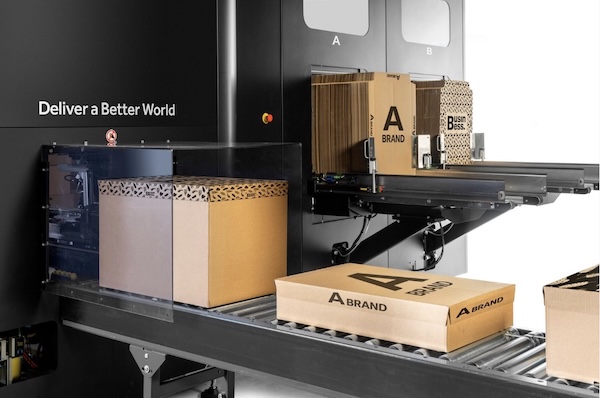
“What’s really exciting, though, is how we’ve integrated automation and intelligence into the mix. We use high-tech systems featuring AI and machine vision for data collection, along with rightsizing and precision void fill. This means we aren’t just protecting the product; we’re helping companies become much more efficient. Optimized box sizing and waste reduction is critical to the needs of enterprises looking to reduce shipping costs and lessen their environmental footprint. “
“By using sustainable paper instead of plastic our customers can significantly reduce single-use waste and meet their sustainability goals. By using technology, we can optimize the amount of packaging materials and freight, all while optimizing labor and hence lowering overall costs and environmental impact. It’s all about providing efficient consistent, high-quality protection, which is so critical when you’re dealing with fragile or high-value goods that need to get where they’re going on time and without compromise.”
Challenges Faced
Have you faced any challenges in your sector of work recently? Asali acknowledged:
“In recent years, the packaging and logistics sector has navigated a rapidly shifting landscape dealing with COVID demand pull-forward and supply chain impacts, trade disruptions, global conflicts and an energy crisis. Ranpak does business in 50 countries, so we need to be able to adapt quickly to a changing environment. Through it all we have been investing in Ranpak’s solutions and capabilities to develop differentiated automated and protective solutions and the infrastructure to serve the largest and most sophisticated corporations in the world.”
“Fortunately, there are a number of large structural tailwinds that work in Ranpak’s favor that we have positioned ourselves to benefit from. The explosion of e-commerce has put a massive amount of pressure on fulfillment centers to move faster than ever, right at a time when finding reliable labor has become a real struggle for many companies. On top of that, new sustainability regulations are essentially requiring businesses to reduce plastic, which adds another layer of complexity to their operations.”
“The innovation and investments we have made in intelligent automated and sustainable solutions over the years enable us to support our customers in navigating this. The goal is to help them do more with less by providing tools that are practical and easy to plug into their existing setups without a headache. Because these systems are scalable, they can grow right along with the business. Ultimately, by focusing on intelligent automation including physical AI, perception, data and robotics, we’re making it possible for our customers to hit those high-speed operational goals and their sustainability targets at the same time.”
Evolution Of The Company’s Technology
How has the company’s technology evolved since launching? Asali noted;
“While our core mission of sustainable packaging hasn’t changed, the way we deliver on it has undergone a massive transformation. Ranpak actually started as a materials-focused company centered purely on paper, but we’ve evolved into a technology-focused organization that utilizes Physical AI, machine vision, and robotics to solve modern logistics problems. Today our systems are much more than just machines: they combine data and intelligent controls to make packaging decisions in real-time. We’ve moved toward a model where the technology does the heavy lifting to ensure precision and efficiency:
o Intelligence and QA: We use tools like our DecisionTower, which relies on AI-powered machine vision and sensors to quality-check parcels or calculate the exact amount of void fill needed. Our solutions can automatically fill a box with the optimal amount of protective packaging and seal it without manual intervention.
o Precision Rightsizing: Our Cut’it!™ EVO system intelligently rightsizes a package to the highest point of its contents before automatically sealing it, which cuts down on wasted space and significantly lowers transport costs.
It’s been an incredible journey from being a paper machine based company to becoming a technology-driven partner. We’re still focused on sustainability, but our current solutions are far more advanced, scalable, and precise than when we first launched.”
Significant Milestones
What have been some of the company’s most significant milestones? Asali cited:
“We’ve hit some really exciting milestones over the years that have truly transformed who we are as a company. One of the biggest achievements has been our global expansion —– we now operate in more than 50 countries, with significant growth across North America, Europe, and the Asia-Pacific region. It’s been incredible to watch our customers evolve from using simple standalone machines to adopting fully integrated automation platforms on a global scale.”
“A major part of that journey has been building long-term partnerships with some of the world’s most iconic brands like, Amazon, Helly Hansen, and many others. A standout moment for us was our 2025 partnership with Walmart. As part of that multi-year strategic collaboration, Walmart announced they’d be deploying a significant number of our AutoFill™ systems across five of their next-gen fulfillment centers. Seeing our equipment and computer vision technology implemented at that kind of scale has been a huge point of pride for us, as it really reinforces our role in helping the world’s leading e-commerce and retailers modernize their fulfillment and prove just how scalable our solutions can be.”
Customer Success Stories
Can you share any specific customer success stories? Asali highlighted:
“One story that really stands out is our work with Helly Hansen. They implemented our packaging automation solutions in combination with the AutoStore AS/RS system and the results were pretty incredible—they actually managed to triple their throughput and achieve a positive ROI in less than a year. It’s a great example of how quickly these systems can pay for themselves when they’re hitting that level of efficiency.”
“That kind of success is something we see across the board with a lot of the world’s leading brands. Whether it’s companies like Medline, Sephora, and IKEA, they’ve all used Ranpak solutions to really modernize their fulfillment. It’s been rewarding to see how our technology helps such a diverse range of businesses streamline their operations and handle their growth more effectively.”
Differentiation From The Competition
What differentiates the company from its competition? Asali affirmed:
“What really sets Ranpak apart are two things: we’ve found a way to prioritize sustainability without forcing our customers to sacrifice quality and efficiency, and we are leaning in very hard on new technologies. Sustainability and technology are not just taglines for us. We don’t simply swap out plastic for paper and call it a day; instead, we take those sustainable materials and wrap them in a layer of automation, data, and intelligent systems that fundamentally change and improve the entire packaging process.”
“Another big differentiator is how we view the relationship between technology and people. While we use robotics and AI to handle the repetitive or physically demanding tasks that often lead to burnout, we don’t see automation as a tool for eliminating human workers. We believe “human in the loop” is critical for success. We acknowledge the need to upskill part of the workforce but view that as a positive long term. By letting the machines handle the grunt work, employees can move into higher-value roles that focus on things like oversight, creative problem-solving, and process optimization. It ultimately makes the warehouse a safer, more rewarding place to work while improving overall consistency.”
Future Company Goals
What are some of the company’s future goals? Asali emphasized:
“Looking ahead, our main focus is to keep blending our deep packaging expertise with cutting-edge technology to deliver ROI for our customers. We’re really leaning into the expansion of robotics and physical AI, while also growing our global footprint to support businesses wherever they operate. A big part of that is helping our customers find ways to get even more value out of the fulfillment infrastructure they already have in place.”
“We are also becoming increasingly focused on specialized areas where packaging performance is absolutely critical, especially in the cold chain sector. In those environments, things like product protection, precision, and efficiency aren’t just nice to have—they are essential. As global supply chains get more complex, we see a massive opportunity to apply our intelligent packaging solutions to solve the unique challenges found in these high-stakes environments.”
Additional Thoughts
Any other topics you would like to discuss? Asali concluded:
“I’m really fascinated by the way automation, robotics, and physical AI are completely reshaping the worlds of manufacturing and logistics right now. We’re moving away from the old-school, static mechanisms of the past and toward systems that can actually sense, decide, and act in real time. It’s a shift where AI is embedded directly into the physical equipment, allowing it to adapt on the fly to different products, varying order profiles, and changing throughput demands. Foundation models and Large Behavior Models are bringing AI into the physical world, enabling machines not only to understand information but to also predict and execute demanding and complicate physical tasks. That kind of intelligence based action is already transforming how fulfillment centers operate, making them much more efficient and resilient at scale.”
“What excites me the most is the fact that we’re still just in the early stages of this massive transformation. At Ranpak, we’re already seeing this play out in how our automated systems use machine vision, sensors, training models, and AI-driven controls to figure out the best packaging outcome for every single shipment, instead of just relying on rigid rules or manual guesswork. We also have made exciting investments, like our partnership with Pickle Robot which is a leader in trailer unloading, one of the hardest tasks to automate in logistics. The version of physical AI that we back is the one that allows the machines to work right alongside people, improving the overall flow and reliability of the warehouse while supporting safer and more skilled roles for the workforce as the industry continues to evolve.”
