

Red Pitaya offers affordable, developer-friendly platforms with open-source software that combine the functions of an oscilloscope, spectrum analyzer, signal generator, and logic analyzer in a single, compact device. Built on FPGA architecture and accessible through a browser-based interface, it allows users to progress from basic experiments to advanced projects in areas such as embedded systems, FPGA programming, and software-defined radio. Pulse 2.0 interviewed Red Pitaya CEO Mateja Lampe Rupnik to gain a deeper understanding of the company.
Mateja Lampe Rupnik’s Background

Could you tell me more about your background? Rupnik said:
“My career has centered around bridging different worlds: cultures, disciplines, and ways of thinking. I began by working with international markets in the automotive industry, which provided me with a solid foundation in supply chain management and finance. This experience quickly led me into leadership roles.”
“Later, I transitioned to the high-tech sector, joining Instrumentation Technologies, a company focused on developing advanced tools for particle accelerators, where I eventually became the CFO. When colleagues from that company founded Red Pitaya in 2013, I initially joined their journey part-time and became CEO in 2020. Along the way, I earned an MBA from the University of Ljubljana. Although my academic background in art history and Russian language may seem unrelated to engineering, it taught me to approach problems from different perspectives, and it’s something I still draw on today.”
“The common thread throughout my experiences is a commitment to creating environments where technical teams can innovate more effectively by minimizing operational friction.”
Formation Of The Company
How did the idea for the company come together? Rupnik shared:
“Red Pitaya’s story began inside Instrumentation Technologies, where our team had spent years developing sophisticated instruments for particle accelerators. At the time, our founder and CEO, Rok Uršič, saw the potential to take that hard-won expertise into entirely new markets. To spark fresh thinking, he set up a special creative space, called Room 913, where every wall was covered in whiteboards. It became an innovation lab where engineers could sketch, challenge each other’s ideas, and reimagine what measurement tools could be.”
“Leading this process, Rok brought together a group of brilliant engineers, including our current CTO, Črt Valentinčič, along with former co-founders Borut Baricevič and Aleš Bardofer. The team didn’t start with a fixed product in mind. At first, they weren’t even sure if the final product would be the size of a credit card or something entirely different. They wanted to move away from closed, expensive, single-purpose devices and instead create something open, compact, and flexible.”
“That vision crystallized in 2013 with the launch of STEMlab 125-14, a multifunction, open-source board that combined multiple lab instruments into one. The idea resonated immediately, and a successful Kickstarter campaign proved there was a global appetite for such a tool. From those early sketches on the walls of Room 913 to the first backers on Kickstarter, Red Pitaya grew into a trusted platform now used across industry, R&D, and academia.”
Favorite Memory
What has been your favorite memory working for the company so far? Rupnik reflected:
“What I find most rewarding is seeing Red Pitaya used in ways we never initially imagined. Our platform has been part of classrooms from the U.S. to India, CERN experiments, and a student’s very first electronics project. It has also found its way into some of the most advanced settings in the world — from spacecraft atmosphere monitoring at NASA, to radiation detection on the International Space Station, to structural testing of military aircraft such as the F-15 and F-16.”
“One highlight was visiting a Canadian lab where a quantum computer was built with Red Pitaya at its core. Another was seeing researchers use our boards to construct a LEGO-based quantum interferometer, showing how even complex physics can be made hands-on and accessible. And time and again, when I meet researchers in high-end labs, they tell me they still have their original board from our 2013 Kickstarter campaign. Those moments capture the strength of our community and remind me why we do what we do.”
Core Products
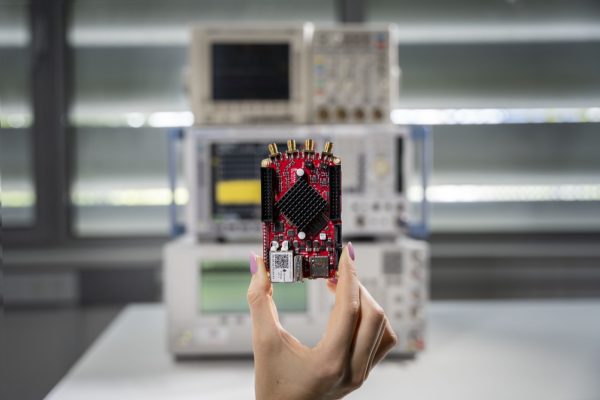
What are the company’s core products and features? Rupnik explained:
“Our core product family is the Red Pitaya platform, designed to consolidate multiple laboratory instruments into a single, compact, and programmable system. The flagship STEMlab 125-14 was the first product, combining open-source software with FPGA-based hardware to deliver oscilloscope, signal generator, spectrum analyzer, and logic analyzer functions through a simple browser interface. It quickly became a versatile tool for educators, researchers, and engineers.”
“Over time, the portfolio has expanded to meet more specialized needs. The SDRlab 122-16 was developed with software-defined radio in mind, while the SignalLab 250-12 offered higher performance for signal analysis and demanding applications. For advanced setups, we introduced multi-channel solutions, enabling synchronized, scalable experiments and industrial workflows.”
“Most recently, we announced the STEMlab 125-14 Gen 2, which builds on the success of the original board with enhanced precision, improved noise performance, and expanded synchronization options. It reflects the same mission we started with: making powerful, adaptable test and measurement systems accessible worldwide, but in a form ready for the next decade of engineering and research challenges.”
Challenges Faced
Have you faced any challenges in your sector of work recently? Rupnik acknowledged:
“We operate at the intersection of hardware, education, and research – all sectors that are cost-sensitive and relatively slow to adapt. We’ve focused on modularity, backward compatibility, and community engagement to remain relevant. That means building for long-term use, not quick upgrades.”
“A few years ago, global supply chain crises made us rethink our supply chain channels and practices. Now, we are trying to navigate the tariff situation. The US is our most important market, and we will always look for ways to support our clients there.”
“Another challenge has been the evolution of Red Pitaya itself. We began as a platform popular with hobbyists and educators, and over time, have become a trusted tool for serious industrial innovation. Managing that transition without alienating our early community has required careful balance.”
“Finally, serving such diverse segments – from classrooms to advanced R&D labs – can easily pull a company in too many directions. We addressed this by sharpening our focus on industrial innovation, while preserving the flexibility and accessibility that make the platform valuable for educators and researchers. This clarity has allowed us to align resources more effectively and build a stronger foundation for long-term growth.”
Evolution Of The Company’s Technology
How has the company’s technology evolved since launching? Rupnik noted:
“We started with a single board aimed at educators and hobbyists: STEMlab 125-14. Over time, the platform became more modular and powerful, supporting advanced use cases in quantum computing, industrial test automation, and RF systems. At the beginning of this year, we introduced Gen 2 of the STEMlab line with improved performance, additional analog inputs, and lower noise, while maintaining full backward compatibility. Our partnership with Texas Instruments also enabled higher-quality analog signal chains. Today, Red Pitaya combines real-time processing, browser-based applications, and open-source programmability, from FPGA to Python APIs, making it a flexible tool across disciplines. Perhaps most importantly, our technology is designed for scalability: one hardware platform can serve very different use cases simply through software. This flexibility has created strong stickiness among users and a natural pathway for Red Pitaya to grow with its customers: from classrooms, to prototyping labs, to industrial deployment.”
Significant Milestones
What have been some of the company’s most significant milestones? Rupnik cited:
“We’ve recently won awards across STEM education and engineering innovation. At the 2025 Learning Awards, Red Pitaya was awarded Gold in the Learning Technologies category. We were also honored with three awards at the 2025 Engineering Matters Awards in London: Environment Gold Champion, for powering LongPath Technologies’ methane leak detection system, which uses Red Pitaya hardware to monitor emissions in industrial environments, Innovation Silver Champion, also awarded for the LongPath application, recognizing how Red Pitaya’s flexible, open platform enables customers to innovate and scale advanced engineering solutions, and Diversity & Inclusion Silver Champion, awarded for the work of Sakura Particles, a team of Japanese high school girls who built a muon detector using Red Pitaya. Their project was selected in an international competition for experiments at CERN. Additionally, this year, I was named a Women in Electronics Award winner in two categories: Management/Small Team Leader of the Year and Woman of the Year. Another milestone has been opening our U.S. office to strengthen our largest market, alongside the launch of STEMlab Gen 2, which marks the next generation of our technology.”
Customer Success Stories
Can you share any specific customer success stories? Rupnik highlighted:
“One of the most rewarding aspects of leading Red Pitaya is seeing how our platform helps ambitious teams turn ideas into companies. Swabian Instruments in Germany and LongPath Technologies in the U.S. both began as startups building on Red Pitaya. Today, they are funded and scaling globally — Swabian with high-precision time measurement systems, and LongPath with methane detection networks that are already reshaping environmental monitoring.”
“Our technology has also been adopted by NASA in several contexts. It has been used aboard spacecraft to monitor atmosphere and radiation levels, and more recently in fiber-optic sensing systems that are making flight testing of aircraft faster, lighter, and more environmentally friendly.”
“Quantum is another area where we see extraordinary growth. Red Pitaya boards are in use at Xanadu, one of the world’s most prominent quantum startups, as well as in many companies that spun off from the broader community around NIST and the University of Colorado Boulder and other exciting quantum startups in Europe and globally. Many of these ventures grew out of research labs where students first encountered Red Pitaya and later brought it into their startups. That education-to-industry pipeline is a pattern we are proud to support.”
Funding/Revenue
Are you able to discuss funding and/or revenue metrics? Rupnik revealed:
“In July 2013, we officially launched our Kickstarter campaign. With the incredible support of our backers, we raised over $250k to realize our vision of creating open instruments for everyone. In February 2014, the first Red Pitaya board was sent to our Kickstarter backers. Fast-forward to today, and we’re fully bootstrapped and profitable and we are growing above the sector’s average.”
Total Addressable Market
What total addressable market (TAM) size is the company pursuing? Rupnik assessed:
“We sit across three growing markets: industrial R&D, academic and engineering education, and test and measurement. Combined, that represents a multi-billion-dollar opportunity globally. Our focus remains on accessible, modular solutions that scale across these verticals.”
“What sets Red Pitaya apart is that our products are already being used by some of the most advanced startups in high-growth fields such as quantum computing, photonics, medical devices, nuclear waste management, and disruptive energy technologies. Supporting these companies gives us a unique perspective on where innovation is heading and how emerging technologies are likely to shape the next decade.”
Differentiation From The Competition
What differentiates the company from its competition? Rupnik affirmed:
“We’re not chasing mass-market consumer scale or locked-in vendor ecosystems. Our strength lies in openness, longevity, and trust. Red Pitaya provides a flexible, developer-centric platform that can be fully adapted by the user. That transparency and flexibility – alongside affordability – is what sets us apart.”
“We are also highly agile. Many of our most exciting applications have come from ideas first proposed by our customers, and we’ve built the ability to respond quickly with customizations. That is why companies like Texas Instruments and Xanadu have turned to us for tailored solutions, and why our products are increasingly used in emerging technology sectors. Another differentiator is the community around Red Pitaya. With more than 45,000 users worldwide, customers benefit not only from our platform but also from a global exchange of projects, code, and best practices. Being part of that ecosystem accelerates innovation.”
“Finally, Red Pitaya uniquely bridges the full journey from education to prototyping to industrial deployment. Few competitors can match this continuum, and it allows us to grow with our customers, supporting them from their first experiments through to disruptive industrial applications.”
Future Company Goals
What are some of the company’s future goals? Rupnik emphasized:
“We’re expanding our US footprint, growing partnerships with universities and OEMs, and building next-gen features for advanced applications like modular sensing and real-time signal processing. A key part of this strategy is working with major industry players. With Texas Instruments, we are co-developing solutions that bring higher-quality analog performance into our platforms. With Arduino, we’ve launched a joint learning lab that connects makers with real-world engineering tools. And with Analog Devices, we’ve already hosted student workshops and are exploring deeper collaboration to strengthen the education-to-industry pipeline.”
“We are also building on the momentum of our above-average sector growth. The aim is not incremental improvement, but to position Red Pitaya at the forefront of fast-growing sectors such as quantum research, photonics, and advanced industrial applications. We aim high and the partnerships we’re building today will help us get there.”
Additional Thoughts
Any other topics you would like to discuss? Rupnik concluded:
“We believe sustainable tech means long-lasting, repairable hardware, not disposable tools. Red Pitaya is part of a broader shift toward more open, responsible engineering – where users are collaborators, not just consumers.”
