

Robot.com (formerly Kiwibot) is a company that uses artificial intelligence to operate a fleet of autonomous robots that handle tasks like campus food delivery, warehouse logistics, and out-of-home advertising. Pulse 2.0 interviewed Robot.com co-founder and President of Media Judah Longgrear to learn more.
Judah Longgrear’s Background

Could you tell me more about your background? Longgrear said:
I’ve been at the intersection of sales, advertising, and mobility for most of my career, and Robot.com is where they all converge.
I studied journalism at West Virginia University, which gave me an early grounding in communication and how messages reach people. From there, I moved into enterprise sales: NetApp, then Salesforce, then Gartner. Those roles gave me a real education in building trust with large organizations and in understanding what it takes to bring a new product category to market.
But I was always more drawn to building than selling. My first company was an Uber-style rideshare service in southwest Florida, subsidized by local advertisers instead of riders. We scaled it to five cities, then pivoted to the core technology underneath it: Nickelytics, a venture-backed adtech company I co-founded to make out-of-home advertising as measurable and scalable as a digital campaign.
In 2024, now Robot.com, then Kiwibot and, already one of the most active autonomous robot fleets in the world, acquired Nickelytics, and I’ve since taken on the role of Co-Founder and President of Media at the company. My focus is on the media and ad side: enterprise partnerships and scaling our advertising platform across a fleet of 500+ robots that have completed over 2.5 million real-world tasks.
Formation Of The Company
How did the idea for the company come together? Longgrear shared:
When Robot.com came to Nickelytics, the fit was clear: they had the fleet, operating in high-traffic environments at real commercial scale, and we had the technology to monetize that physical presence through advertising. Putting those two things together created something spectacularly novel: a robot that earns its own way through delivery while simultaneously running measurable brand campaigns.
At first, my focus was growing our US business: enterprise delivery partnerships with operators like Sodexo, Grubhub, and AWS, campus expansion, and the M&A and fundraising work that came with my board seat. In 2026, I moved fully into our media business because R-ads is a massive market opportunity and one of the clearest examples of AI doing real commercial work in the physical world.
On the media side, I oversee R-ads and everything around it: brand relationships, agency partnerships, and the team we’re building to bring this format to market. It requires a different commercial motion than enterprise delivery. You’re not just selling a service; you’re introducing buyers to a medium they’ve never put in a media plan before.
Favorite Memory
What has been your favorite memory working for the company so far? Longgrear reflected:
I have two memories that stand out, and looking back, I realize they are more connected than I first thought.
The first is from NVIDIA GTC. They selected us as their robotics partner for the show, and we ran a fleet of ten robots across the venue over four days, capturing more than 34,000 on-site impressions and over 3,300 scan-to-open engagements. The numbers were strong, but what stuck with me was watching executives chase our robots down the hall to grab the free stuff they were handing out. Some of the most serious people in the industry, sprinting after a robot with kawaii eyes.
Then there was Cannes, where we ran R-ads as the official Robotics Innovation Partner for PMG’s AI & Tech Sandbox. I spent the week watching CMOs and agency leaders crouch down to study a robot the way you would with a dog you have never met. These are people who have seen every kind of ad tech there is, and they were still curious. That is what ties the two moments together for me. Whether it is an engineer at GTC or a CMO on the Croisette, the robots keep drawing in the exact people you would expect to be the hardest to impress. Even after all this time, I am still surprised by how far these robots go and the impact they make once they are out in the world.
Core Products
What are the company’s core products and features? Longgrear explained:
Robot.com’s core products run on a single platform, spanning three markets: food automation, industrial operations, and advertising.
Most people first meet us through our R-kiwi bots that cruise campuses and closed environments at jogging speed. They’re the driving force behind our food-automation partnerships with operators like Sodexo and Grubhub. They deploy in weeks rather than months and run alongside students and pedestrians as a normal part of the environment. In industrial operations, our R-cargo handles material movement and intralogistics in warehouses and factories, which often involves heavy-duty work in environments where reliability and uptime are everything. This bot is built for the kind of repetitive transport work that’s expensive to staff and physically demanding, freeing teams to focus on the work that actually requires a human.
R-ads is our smart advertising suite that turns every robot in the fleet into a measurable media platform. This extends well beyond the robots to include 1M+ DOOH screens, 60,000+ rideshare screens, truck-side advertising on major corridors, and event activations. With five real-world surfaces, every campaign is measurable and retargetable—an advertiser’s dream! Brands like AWS and Liquid I.V. have run global campaigns through it, with custom wraps, real-time GPS tracking, and per-mile impression analytics built in.
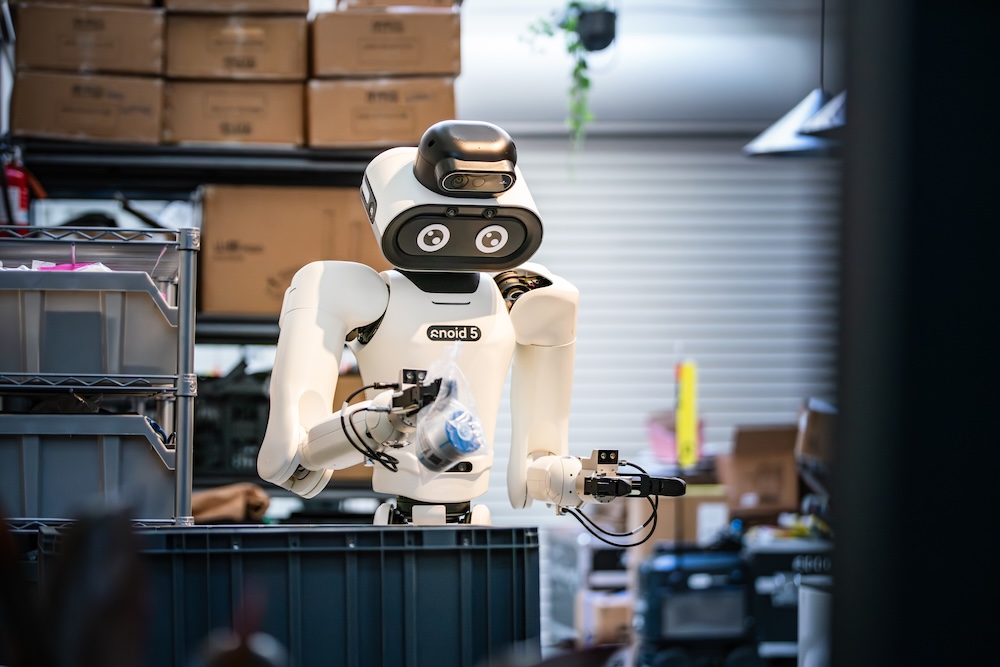
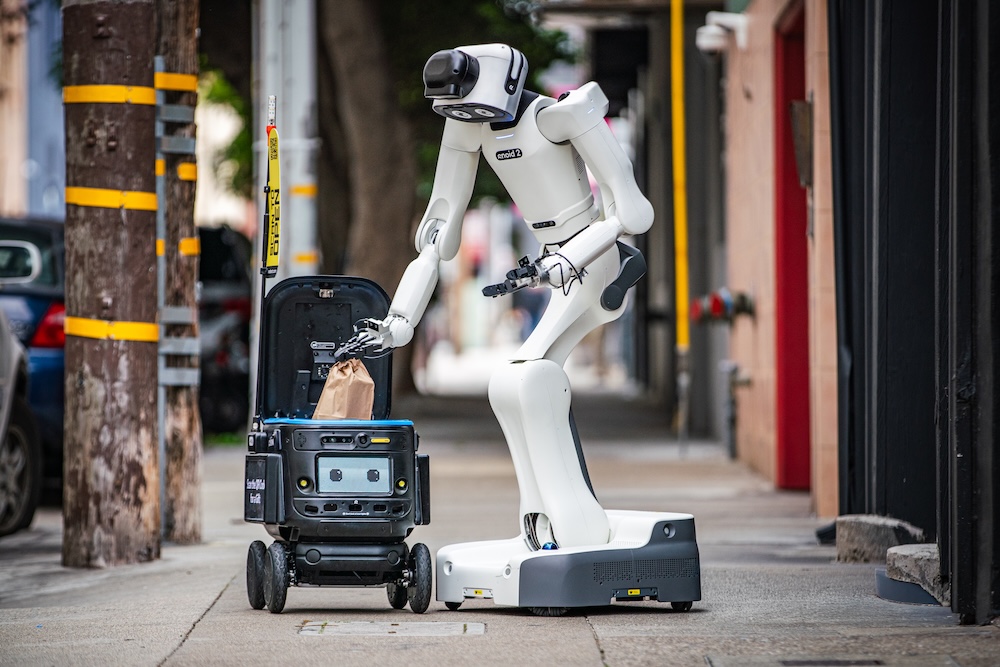
Our most recent product launch was the R-noid, a humanoid that brings hands and reach to industrial and service work with a range of 19 deployable tasks across five categories (Restaurant Assistant, Packer, Picker, Folder, and Host). One of its first deployments–delivered in a matter of weeks, not years–was running on-site order packing at an award-winning golf course.
Challenges Faced
Have you faced any challenges in your sector of work recently? Longgrear acknowledged:
The hardest part of my job isn’t technical, but that I’m selling a line item that isn’t part of the status quo yet–a media plan has billboards, transit, and digital. There’s no checkbox for “a robot that delivers your product to someone and then tells you how many people saw it.” So the early conversations weren’t really about price. They were about the category itself.
We got past it the only way you can: by showing people. Once a buyer watches a campaign go live in minutes and sees the map of where the ads actually went, the skepticism wears off fast. You don’t talk a buyer into a new medium. You let the results do the talking for you.
Evolution Of The Company’s Technology
How has the company’s technology evolved since launching? Longgrear noted:
The biggest evolution is that our robots are no longer single-purpose. When the Kiwibot fleet was only delivering food, it was a great delivery business. But the same machines that learned to navigate a quad turned out to be capable of a lot more, and over the years that fleet pushed into logistics, inspection, and advertising, and has pushed into new form factors.
R-ads is where that really clicked. Once we layered it in, every route started earning its keep twice, completing a delivery and running a measurable brand campaign on the very same trip–same hardware, but very different economics. The platform itself provides a more streamlined and consolidated user experience, too. Traditional OOH means stitching together different vendors for billboards, transit, rideshare, and trucks—each with their own contracts, creative specs, and reporting systems. R-ads brings all of those surfaces onto a single platform as a single media buy. What used to take weeks across multiple vendors now happens in one place.
On the data side, R-ads has gotten significantly more sophisticated. We can now show an advertiser exactly where their ads physically traveled, how many people saw them, and retarget those audiences online. And underneath it all, the fleet has gotten smarter. Lessons from one deployment compound across the rest, making every new environment improve the entire system.
Significant Milestones
What have been some of the company’s most significant milestones? Longgrear cited:
Of course, the 2024 merger between Nickelytics was noteworthy not only because it was the moment I joined the team, but also because it made delivery and advertising one business instead of two, and the math underneath everything changed.
Rebranding from Kiwibot to Robot.com last October was also another defining one. “Kiwibot” was a great name for one robot—slightly less great for a fleet of hundreds of bots across five products.
And owning Robot.com is the kind of URL that leaves little room for confusion about what we do, from delivery and logistics to inspection, advertising, and humanoid work, all under a single banner that finally fits the size of the operation (it’s also pretty badass, given Silicon Valley’s flood of robotics companies).
Another was just a few months ago: our fleet of 500+ Level 4 autonomous bots achieved over 2.5 million real-world robot tasks. That’s the kind of number that settles a lot of debates about whether robotics is “almost there.” This task milestone was around the same time we brought on Greg Smith, Chairman of American Airlines and former Boeing CFO, onto our board of directors. His appointment says where we are as a company: past the prove-it phase, and now building the kind of enterprise-grade governance our scale requires.
Customer Success Stories
Can you share any specific customer success stories? Longgrear highlighted:
“Liquid I.V. is an exciting one that I’m proud of. The company wanted to own a moment in Times Square, so we put 50 branded robots on the street that handed out more than 500 samples a minute, and the whole thing drove 203,000-plus impressions across 136-plus miles.
Then, AWS liked the model enough to take it global. We ran branded robots through its Gen AI Loft world tour across five cities–San Francisco, São Paulo, London, Paris, and Seoul–with a fleet custom-wrapped in AWS creative in each market. The robots rolled through the high-traffic zones around each event, handed out swag and refreshments, and pulled real-time data on who they reached–San Francisco alone covered more than 77 miles. The point AWS cared about was consistency: a same-branded experience, the same measurement, five cities on different continents, no drop-off from one market to the next.
Differentiation From The Competition
What differentiates the company from its competition? Longgrear affirmed:
Our competitors are typically focused on one thing: last-mile delivery. R-ads earns revenue on every route a robot runs, and the advertising platform subsidizes the cost of robot deployment across the rest of the business. That’s a fundamentally different unit economics equation than a pure delivery company can run. There’s also a design principle that sets us apart: our robots run on wheels, not legs. That’s a deliberate choice. Wheels are more efficient, more reliable, and they work in the real-world environments we actually operate in today. Legs are a great research topic, but wheels are what’s optimal now, today.
Future Company Goals
What are some of the company’s future goals? Longgrear emphasized:
What we’re focused on is the work itself. Doing more of what already works, with the same operating discipline. We’re 200+ people across San Francisco, Colombia, and Taiwan, with Latin American roots and a real bias toward people who’d rather ship than pitch. Growing that culture is what I think about more than any specific milestone. The future isn’t a vision, but a track record we keep adding to.
Additional Thoughts
Any other topics you would like to discuss? Longgrear concluded:
For years, the industry has made big promises about the future, such as humanoids that can solve every problem or fleets that will scale up next season. Instead, we have focused on the present by putting robots to work in real environments with paying customers and letting our results speak for themselves.
Our latest step is R-noid, and many people wonder why a delivery company would build a humanoid. The truth is, we did not plan to build a humanoid from the start. Instead, we looked for a task a robot could handle today, and this time, the job called for a different kind of robot than our usual rovers.
We’ve never aimed to build the flashiest machines just for show, because our work always starts with a real task in a real place that needs to be done now. R-noid is just the latest example of the approach we have used since our first robot began working on a campus.
