

RxUtility is a company that provides a healthcare technology API that integrates real-time, AI-powered prescription savings, manufacturer copay assistance, and price transparency directly into provider, pharmacy, and health-tech workflows to make medications more affordable for consumers. The company recently published its annual medication affordability benchmark report, “Medication Affordability: Trends, Transparency, and Predictions.” Pulse 2.0 interviewed RxUtility founder and CEO Miriam Paramore to learn more.
Miriam Paramore’s Background

Could you tell me more about your background? Paramore said:
“For me, the goal of medication affordability in the United States is deeply personal. My passion is driven by my family’s experience with the healthcare system and my role as a hands-on caregiver for both my parents as they aged and died. I witnessed healthcare systemic failures at the same time that I worked in the industry.”
“I’m a self-made entrepreneur, angel investor and board member with decades of experience driving innovation in health IT and data. I’m also an individual with a chronic disease who navigates a health plan with a $9,100 deductible. In 2024, I launched RxUtility with the vision of a world where no one has to ask, ‘Can I afford this medicine?’”
“My business interest in health tech is driven by my belief that information—not just data—is the fundamental lever needed to improve our broken healthcare system. I’ve had a long career building IT systems that haven’t seemed to help, but I’m still optimistic.”
“My passion combines with my business experience to give me the energy needed to keep creating. I was raised to believe that if you can improve things, you should. It’s also an economic and moral imperative at a time when the nation’s healthcare system struggles to deliver on its goals of high-quality, high-value care for all.”
Formation Of The Company
How did the idea for the company come together? Paramore shared:
“Millions of Americans struggle with medication costs every year, often walking away from prescriptions they can’t afford. RxUtility tackles this problem head-on by connecting health systems, pharmacists, digital health partners and consumers with real-time drug price transparency. We started with manufacturer copay coupons. We used AI and human oversight to curate the first-ever comprehensive database of all copay coupons. Then we added access to all cash coupon prices, and soon we will add access to all direct-to-consumer (D2C) drug prices. Our API—the first of its kind—digitally connects every healthcare stakeholder to all options for medication affordability in real time.”
“For fully informed choice, patients need to know all price options: the insured price, the copay coupon price, the cash price and the D2C price. Yet breakdowns in the existing digital infrastructure for pharmacy transactions leave consumers as well as healthcare providers, health plans and even pharmacists in the dark about the options to make medications more affordable and easier to access. It’s one reason why fewer than 10% of copay coupons are used.”
“In an era of increased interoperability and AI, overcoming the systems and workflows that have long impeded medication price transparency and affordability are now within reach. I created RxUtility to help people afford medicine by giving them complete visibility and choice into their medication costs and options. At the same time, we’re giving pharmacists, providers, employers and health plans a tool for price transparency that helps them run their businesses.”
“It’s time for every stakeholder in the patient journey—from physicians to health systems, health plans, employers, pharmacists, pharmacy benefit managers and consumer health apps—to be instantly connected to affordable medication options.”
Favorite Memory
What has been your favorite memory working for the company so far? Paramore reflected:
“We published a benchmark report on copay coupon savings that was the first in the industry to quantify the degree to which the U.S. health system is losing the fight for medication affordability. Our most recent data shows that more than $30 billion in annual manufacturer prescription copay assistance is available through the use of copay coupons. Yet only 10 percent of these coupons are ever used. That’s a missed opportunity to help consumers access and afford the treatment they need. It underscores why real-time medication affordability assistance at the point of prescribing and pickup is crucial.”
“At the time we published our first benchmarking report, I believed we had dug up hidden treasure. Being the first to tell this story is one of my favorite achievements to date. It’s also a testament to the power of the RxUtility team. We’re a small team, but we get so much done because we’re passionate about what we’re building. It’s a tool that will help millions of people save money on the medicines they need.”
Medication Price Transparency Being A Challenge
Why is medication price transparency such a challenge today, and how is your company addressing it? Paramore acknowledged:
“For the first time in history, there are now four consumer prices for every drug:
o The copay price set by insurance, which might actually be higher than the true cost of the drug itself—especially if the drug is a generic drug
o The copay coupon price
o The cash price, available to consumers without insurance and those who agree not to use their insurance to purchase a medication
o The direct-to-consumer price that consumers pay when they purchase a drug directly from the manufacturer
Most of the time when consumers pay for their medications, they only see one of these price options. For patients, lack of transparency leads to lack of control over their financial options for care. That’s a prescription for financial toxicity that worsens health outcomes.
Like every cool kid in health tech, we use AI to solve this problem. We built the only AI-curated database of every pharma copay coupon available. Then, we created a simple API that every healthcare technology solution in the marketplace can subscribe to and access this new data that they never had. From there, they can stream it into their workflow solutions and share these options for savings with consumers, providers, pharmacists, and even employers and health plans. By continually applying AI to the database, we’re able to update availability of copay coupons in real time, which is critical in a fast-moving field.
Recently, we added two critical data sets: real-time cash coupons and D2C prices. We’re committed to gathering all of the pieces required to create a single view of full price transparency.
Our solutions set the stage to help cure financial toxicity in healthcare. They also ensure consumers can get the medications they need, supporting better health outcomes.”
Challenges Faced In The Industry
Have you faced any challenges in your sector of work recently? Paramore noted:
“When you create something that has never before been introduced to the market, it’s sometimes hard to convince people of its value because they can’t compare it to anything else. I liken it to chocolate: If you’ve never had chocolate, once you taste it, you can’t imagine a world without it. Until then, you might think, “It can’t be that good.” When you have to educate the market on what chocolate is, it’s going to take a lot longer to sell chocolate. You spend so much time and energy telling the story. But once they taste chocolate, it’s easy!”
“Even though it has taken some time to introduce the market to the “chocolate” of copay coupons and other prices points, there are macro trends in our favor. Healthcare is too expensive and too complicated. There is a strong need to reduce healthcare costs felt by every consumer and healthcare stakeholder. There’s a desire for increased price transparency to empower consumers and other constituents to make the right decisions based on their needs and their circumstances. When we tell our story in a way that resonates, we can make a clear business case for investment.”
Significant Milestones
What have been some of the company’s most significant milestones? Paramore cited:
“I will never forget the experience of landing our first customer. That customer remains a client today. I wish I had framed that first check. There’s such validation in knowing you’ve built a product that someone is willing to pay for. This particular company is a B2C company that was very interested in helping consumers leverage our database to take control of their medical journey and options for prescription drug treatment.”
Differentiation From The Competition
What differentiates the company from its competition? Paramore affirmed:
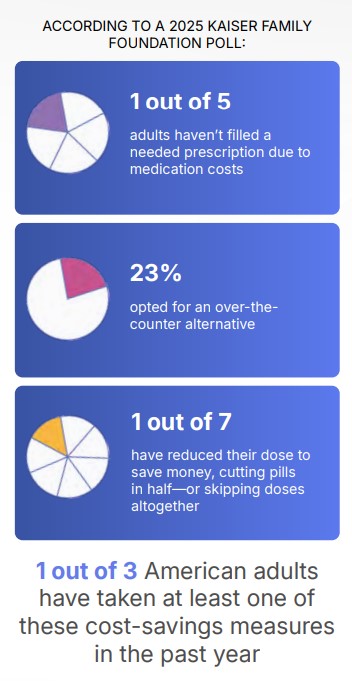
“Today, the burden of medication costs forces families to make tough decisions around health management. Medication non-adherence is a major reason for poor outcomes, significantly increasing healthcare costs.”
“But the technology that supports medication transactions hasn’t been wired to serve consumers, either in the form of prescription drug price transparency or the availability of options for offsetting out-of-pocket medication costs. We’re lighting up health tech to make it work for the consumer, starting with uncovering options for medication affordability.”
“No other company has taken this approach to medication affordability, and that’s what makes RxUtility stand out. We started with an untold story: the $30 billion of consumer savings in the treasure-trove of pharma copay coupons. Then we added dynamic cash prices. Then we added D2C prices. So we have all of the data.”
“We created a simple way for the health tech ecosystem to incorporate these data into their existing workflows via an API.”
“More than half of our database brings the consumer cost for prescription medications down to $10 or less. There are 1,200 drugs in our database, 75% of which do not have a generic equivalent. We’re making an enormous impact on medication affordability for consumers, and we’re strengthening the ability of pharmacists to match copay coupons to consumers at the point of ordering or payment.”
“We tied it all together with a simple subscription model that allows our customers to stream all of the price data they need to drive their affordability, access and adherence solutions. I’m confident that our strategy, tech, and business model give us a unique advantage.”
Future Company Goals
What are some of the company’s future goals? Paramore emphasized:
“I’ve mentioned the recent addition of cash coupons and D2C prices. We are just beginning to tell the broader story—beyond the savings from copay coupons—so one of our short-term goals is to broadly communicate to full price transparency vision.”
“In addition to more storytelling, we’re focused on scale in 2026. We will expand our customer base across several health tech sectors: consumer tech, provider tech, pharmacy tech and employer/payer tech. To succeed, we will continue to develop specific use cases that reach the consumer through these channels. These digital relationships create a win-win for every major stakeholder in healthcare by widening the ability to have conversations around affordability of treatment before the consumer reaches the pharmacy counter.”
“Ultimately, this will lead to better health outcomes by assuring consumers, “You don’t have to delay getting the medication you need or take a lower dose to offset the cost of treatment. Let’s help you find a more affordable option.””
Additional Thoughts
Any other topics you would like to discuss? Paramore concluded:
“Until we give consumers complete visibility and choice into their healthcare costs and options, we will struggle as a country to deliver on the goals of affordable care and access to care and treatment for all. We have all the data we need. We have all the systems we need. So how can we wire these things together to eliminate financial toxicity in healthcare?”
“One thing we can do is extend price transparency to each point of the patient journey. I’ve dedicated the rest of my professional life to creating tech solutions that do just that. The health tech ecosystem can make a difference for real people by saving them real money on medicine.”
“We have the tools to address the challenge of medication affordability. It’s time to embrace them.”
