

Sage is the first integrated Care Intelligence Platform built for senior living and skilled nursing. Its platform connects staffing, care coordination, resident monitoring, and documentation to help caregivers respond to residents’ needs and improve care delivery. The company’s products include the Sage Care Platform that helps caregivers stay organized throughout their shift and provides actionable intelligence across communities to drive better, more efficient care. Sage also offers AI-powered hardware, including nurse call, fall management, and elopement management tools. Pulse 2.0 interviewed Sage Co-Founder and CEO Raj Mehra to learn more about the company’s origins, its approach to modernizing senior care, and its plans to expand into skilled nursing and preventative AI.
Raj Mehra’s Background
When asked about his background, Mehra shared:
I have spent the last 15 years scaling technology and healthcare startups, beginning on the data science side at Palantir, where I helped build their healthcare practice by using data to improve clinical outcomes.
I also served as the Head of Strategy and Operations at Cedar, which is now the largest healthcare payments company serving hospitals.
My background in investment banking at Barclays and co-founding a medication discount startup, Coupon Doc, also shaped my perspective on how to scale mission-driven organizations.
How Sage Started
When asked how the idea for Sage came together, Mehra explained:
The genesis of Sage was deeply personal. In 2019, my grandmother passed away after a fall. She was on the ground for six hours because the infrastructure in her community was outdated, relying on walkie-talkies and pagers rather than data.
I realized that while senior living communities had some technology in place, it wasn’t improving the care of the residents.
In 2020, I reconnected with Ellen Johnston (CPO) and Matt Lynch (CTO), who ultimately joined me as co-founders of Sage.
While each witnessed aging loved ones struggle to get the care they needed, they also brought a unique experience to Sage. Ellen brought an incredible UX and product design background, while Matt had the technical expertise to build the operating system we envisioned.
From there, before even building a single feature, we spent a full year embedded with caregivers and residents to understand their actual pain points.
Favorite Memory
When asked about his favorite memory working for Sage so far, Mehra said:
My favorite memories are when I get to be on the front lines and meet with the people we serve.
Getting to talk with the residents, caregivers, and operational leaders allows me to see the impact we make, and meeting with executives helps to better understand where their pain is so that we can problem-solve with them.
I also love spending time with each of our team members. It is extremely motivating for me to learn where they come from and understand what brought them here and why.
Core Products And Features
When asked about Sage’s core products and features, Mehra detailed:
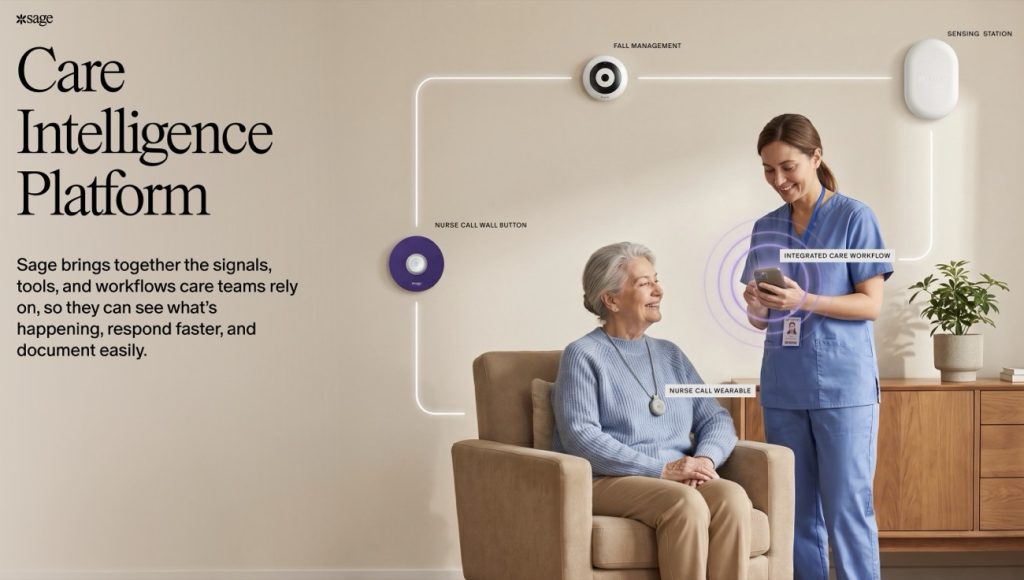
Sage is an operating system for the continuum of care. Our platform is the connective layer across the entire operation: staffing, care coordination, compliance, family communication, and financial performance, all in service of a single mission: improving quality of life for older adults and their caregivers.
A few of our key products and features include:
Sage Core: A unified operations and care management platform designed for senior living and post-acute facilities. It integrates wireless nurse calls, electronic health records (EHR), real-time insights, and documentation workflows into a single system, connecting and supporting across all levels of senior care, including independent living, assisted living, memory care, and skilled nursing.
Sage Detect: Uses advanced AI with strict privacy protocols. It processes data to identify movement patterns and emergencies without compromising the resident’s personal space or dignity. Sage Detect provides families with the assurance that their loved ones are safe and being monitored for health changes without the intrusive nature of traditional cameras or wearables that residents often forget to wear.
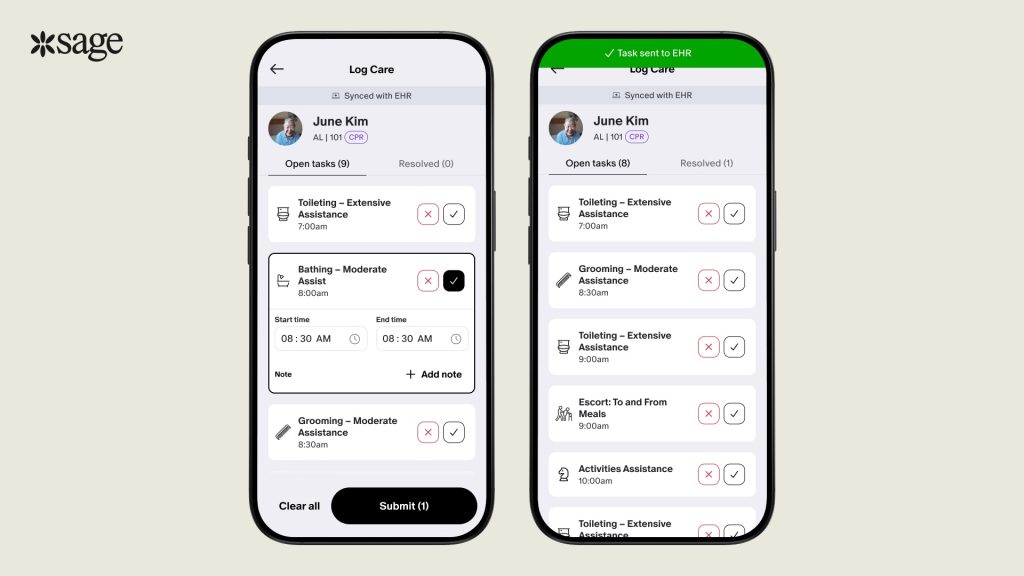
Tasking: Tasking integrates directly with the EHR to bring scheduled care plan tasks into Sage alongside real-time alerts and caregiver workflows. Caregivers can view tasks, document care, and respond to alerts in one place, while all activity seamlessly syncs back to the EHR. The result is a simpler caregiver experience, stronger documentation, and a more complete picture of care delivery for leadership.
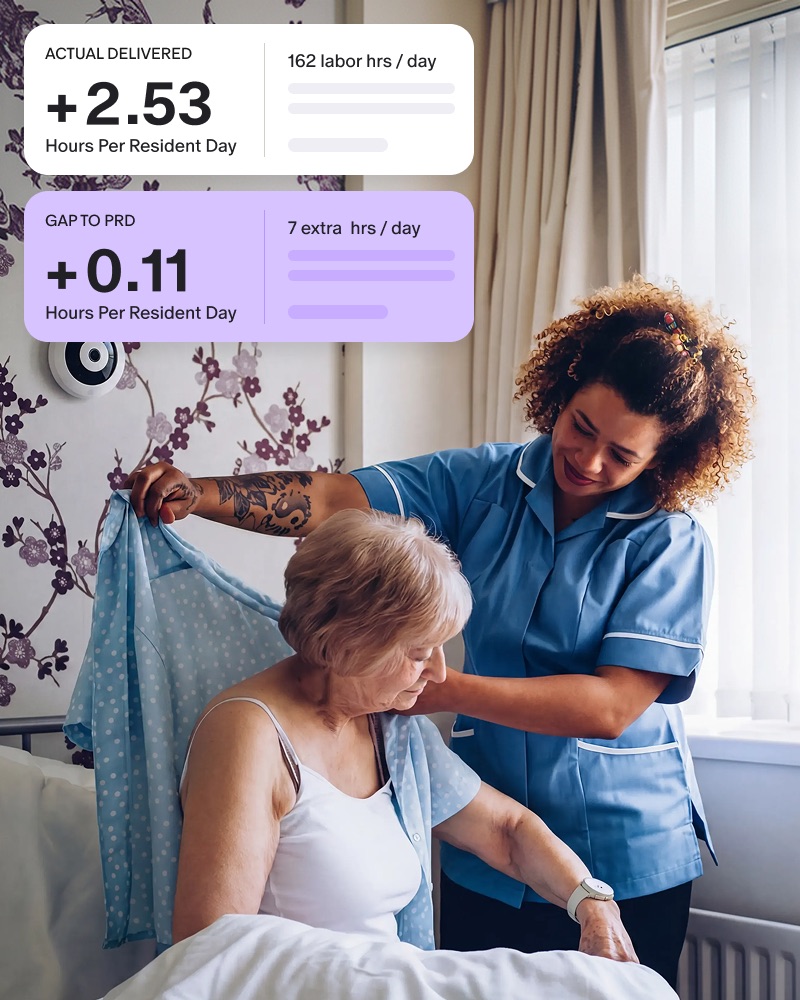
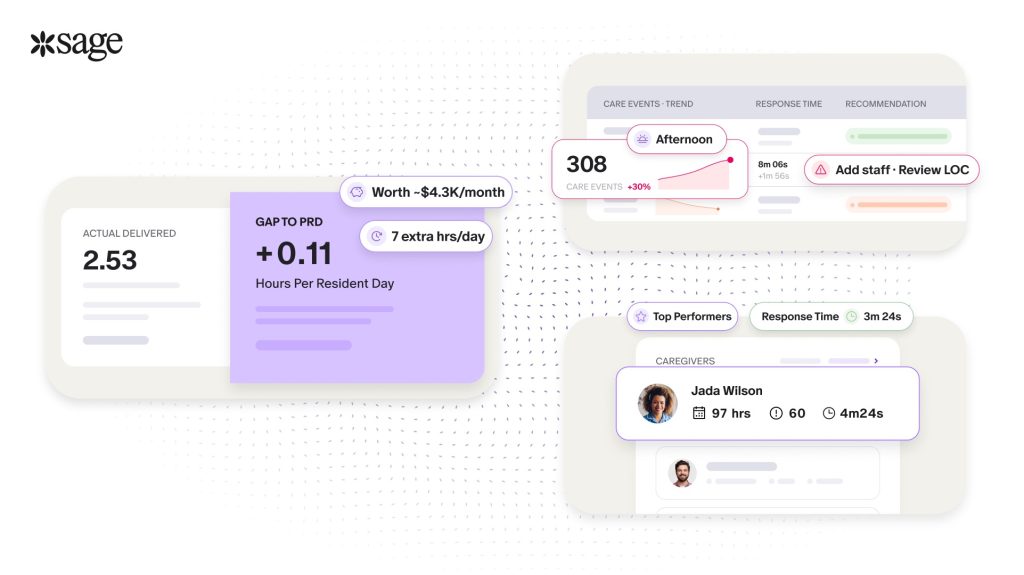
Labor: Labor connects resident needs, staff schedules, and budget goals into one place, giving senior living leaders the clarity needed to staff optimally and improve resident outcomes while staying on budget and reducing caregiver burnout that drives turnover across the industry.
Navigating Industry Challenges
When asked about challenges Sage has faced and how the company has addressed them, Mehra explained:
Building a company in this sector isn’t easy, and there’s never just one challenge.
My co-founders, Ellen, Matt, and I have all been part of other startups before, so we went into this knowing how difficult the journey would be.
Because it’s so demanding, we knew we needed a bright light to keep us moving forward. For us, that is our mission and the people we serve. When things get tough, having a bigger purpose to motivate the team keeps us focused.
One specific challenge we faced back in 2020, as we were starting, was the market’s deep skepticism toward hardware. At the time, investors were almost exclusively looking for pure software plays.
I lost count of how many times I heard, “We like the team and the vision, but why build hardware? Why can’t you just be a software company?”
Most investors didn’t want to touch hardware five or six years ago, but we stood our ground because we knew that to truly transform the caregiver experience, we had to own the entire technology stack.
We eventually found the right partners who believed in that vertical integration.
Today, we receive a significant amount of credit for being both a hardware and an AI company. Our proprietary hardware is exactly what gives us the unique data to power our AI. But back then, it was our biggest hurdle to getting off the ground.
How The Technology Has Evolved
When asked how Sage’s technology has evolved since launching, Mehra explained:
We started by fixing a broken call button, and today we’ve built a comprehensive AI care platform that is modernizing the underlying technology infrastructure for America’s aging population.
Our initial focus was on building Sage Core. We wanted to move care teams away from chaos and into structured, real-time workflows so they immediately knew who needed help and what to do next.
That initial version proved that if you give caregivers the right tools, you can completely transform an environment.
From there, our technology evolved into a much more robust, intelligent platform. We introduced Sage Detect, which provides continuous protection for residents, translating sensor data directly into immediate workflows for caregiving teams.
Now, we are driving our technology into its next phase by evolving our AI from reactive to preventative, deepening our real-time Electronic Health Record (EHR) integrations, and expanding our platform’s capabilities into high-acuity skilled nursing environments.
Key Company Milestones
When asked about some of Sage’s most significant milestones, Mehra highlighted:
In 2025 and 2026, Sage expanded its market reach, product portfolio and financing base. The company’s EHR integration network now covers approximately 75% of the senior living market; it launched Sage Detect, an AI-powered monitoring platform, and Sage Skilled, a solution tailored for skilled nursing communities. In July 2026, Sage secured a $35 million debt facility from Stifel Bank, bringing its total 2026 financing to $100 million when combined with its previously announced $65 million Series C.
We also just held our annual Sage Shift Conference in September bringing together caregivers, clinicians, operators, and industry leaders to celebrate and elevate caregiver voices, and we launched our State of Care 2026 report that examines staffing, technology and daily care delivery across senior living. Customer Success Story
When asked to share a specific customer success story, Mehra discussed Sage’s work with Navion Senior Solutions and how its technology helped a care team investigate repeated falls involving one resident.
A powerful success study is through our work with Navion Senior Solutions. The care team at one of their communities was locked into a reactive care cycle, trying to care for a resident who had suffered 12 falls over six months.
The care team did everything they could, but without clear insight into the root cause, they couldn’t get ahead of the next incident.
When Sage was first implemented, the community saw an immediate shift. The resident began using the pendant consistently, calling for help instead of attempting to get up alone, and falls stopped completely.
The resident started trusting the system because the care team always responded promptly. They even started using the pendant for non-fall-related requests, like a bowl of cereal, which the care team was happy to accommodate.
However, when the resident started having difficulty sleeping, the care team in hospice prescribed Seroquel and Ativan, and the resident faced a new challenge.
Within a single weekend, they suffered three falls, culminating in a head injury. The care team suspected the new medications were the culprit, but they needed proof.
Using Sage Insight, the care team uncovered a clear pattern: a 41% drop in call-pendant usage that began the exact day the medication was introduced.
This information proved the falls weren’t due to a worsening physical condition, but because the medication was impairing the resident’s ability to ask for help.
Armed with this data, the community’s nurse led a care plan meeting with the family and the hospice team. The data eliminated all subjectivity, allowing everyone to agree that they should discontinue the sleep medication.
Within a week and a half, the resident started returning to their baseline, even calling their child for the first time since the medication was introduced.
Ultimately, Sage helped the Navion team shift from reacting to incidents to proactively advocating for their residents.
By connecting data with clinical decisions, the community didn’t just solve a high-risk safety issue. They built deep trust with the family through transparency.
Now, the care team has the data right at their fingertips to reassure the family whenever they have questions.
Mehra also shared a comment from Navion’s Clinical Director, Caroline Hawley:
“Without Sage, the resident would have continued falling, and they might have added more medication. It’s not about what we think. It’s factual.”
Funding And Revenue Metrics
When asked whether Sage could discuss funding or revenue metrics, Mehra shared:
We recently announced a $35 million specialized debt facility provided by Stifel Bank. Combined with our recent $65 million Series C equity round led by Goldman Sachs Alternatives, Sage has raised $100 million in funding in 2026.
The financing will scale Sage’s Hardware-as-a-Service (HaaS) initiative and the capital is being used to accelerate our expansion into the skilled nursing market, advance our preventative AI capabilities for resident safety, and further centralize disconnected health systems into a unified workflow for caregivers.
On the revenue side, our platform helps operators generate up to $275 more per resident per month by providing accurate documentation to justify level-of-care adjustments and reducing caregiver turnover by 30%.
Competitive Differentiation
When asked what differentiates Sage from its competition, Mehra explained:
The senior tech landscape is incredibly fragmented, filled with point solutions and glorified digital checklists that require caregivers to constantly toggle between disconnected apps, pagers, and paper logs.
They tell you after a resident has already fallen, but offer zero real-time context.
What separates Sage is that we built a unified, mobile-first operating system rather than another isolated app.
We are replacing the reactive infrastructure of senior care with an AI-powered platform that gives caregivers real-time visibility across every facet of care.
This puts caregivers at the center of our technology, equipping them with the real-time intelligence and support they need to proactively protect and better care for their residents.
Future Goals
When asked about Sage’s future goals, Mehra explained:
Our long-term mission is to create a scalable infrastructure that can meet the historic demand of an aging population, ensuring that care is defined by dignity and visibility rather than fragmented, paper-and-pager systems.
In the immediate future, we have a few key focus areas.
We are deepening our platform’s capabilities for skilled nursing communities, which face the most demanding clinical and regulatory requirements. Our goal is to bring modern integrated infrastructure to these high-acuity environments where it can have the most immediate impact on resident outcomes.
We plan to further centralize data from all major Electronic Health Records (EHRs) into a single, real-time care view. By reducing the cognitive load on caregivers who currently have to toggle between multiple disconnected systems, we aim to make the profession more sustainable.
In September 2026, we will host our inaugural summit, Sage Shift. This is a major milestone for us as we move beyond just being a software provider to becoming a platform that convenes frontline caregivers and industry leaders.
We want to ensure that the people doing the work are at the center of the innovation we’re building.
