Sequana Medical is a medical device company that develops innovative solutions for patients with liver disease. The company’s flagship product, the alfapump, is a fully implanted device that treats recurrent or refractory liver ascites by automatically and continuously pumping fluid from the abdomen to the bladder, eliminating the need for repeated painful drainage procedures. Pulse 2.0 interviewed Sequana Medical CEO Ian Crosbie to learn more.
Ian Crosbie’s Background


Could you tell me more about your background? Crosbie said:
“I began my career working in healthcare investment banking. For 20 years, I was working with early-stage medical device and biotech companies, figuring out how to finance and grow those companies, and how they fit into the broader life science landscape. I always had a deep understanding and a deep love of the sector and what it could deliver for patients, but also for investors.”
“After a while, I got fed up with giving advice that sometimes was followed and often was not, and decided it was time to live and die by my decisions. With that, I moved over to the corporate world, and over the last 15 years, I’ve had a series of senior-level positions in startup medical device and biotech companies, culminating in the CEO role here at Sequana Medical. I can tell you, I’m having far more fun making decisions here than just giving advice, and also having to set an agenda and see it come true. It’s been 10 years since I’ve been at Sequana, and when I joined the company, I set out the vision for being in the U.S. and serving this group of patients that had limited treatment options at the time. It’s so exciting to now actually be on the market with a product to deliver, and moving away from the world of clinical development and regulatory approvals into a world of commercial success, and actually delivering the product to both doctors and patients.”
Favorite Memory
What has been your favorite memory working for the company so far? Crosbie highlighted:
“By far it was my first meeting with the FDA. We were taking them the plan for our pivotal study, the POSEIDON Study, which would get us, hopefully, on the market in the U.S. I went into the meeting with some trepidation. I’d heard stories about how challenging the FDA process could be, and I was uncertain about how they would receive our data and plans to move ahead.”
“The first thing that happened when we sat down in the meeting was they said, ‘I’d just like to congratulate you on the data you’ve delivered in your past trial,’ and I was taken aback. Their clinical reviewer at the FDA stood up and said, ‘I know exactly what you’re doing for these patients, I know exactly how these patients are treated today, they need something better, and applaud you for your efforts in what you’re doing for them.’ It completely took me aback. After that, in the meeting, we went back and forth on the design and the results of our previous work, but it set the whole scene. It made me realize that we were on the right track. It wasn’t just a vision that we at Sequana had, or a few key opinion leaders had, but the FDA was also appreciating this need. Following that meeting, we received FDA breakthrough device designation, and we had great support from the FDA. As a result, we are in the U.S. market today.”
Core Products
What are the company’s core products and features? Crosbie explained:
“The alfapump is our lead product. We treat a disease called recurrent or refractory liver ascites. This is the buildup of fluid in the belly, large amounts of fluid – 5 to 10 liters – which builds up as a result of advanced liver disease, or liver cirrhosis. This fluid builds up in the belly, and traditionally, these patients have been treated by taking them to hospital and draining them in a painful and burdensome procedure to drain out 5 to 10 liters of fluid. You can just imagine how painful and awkward, and what an impact it has on the life of these patients.”
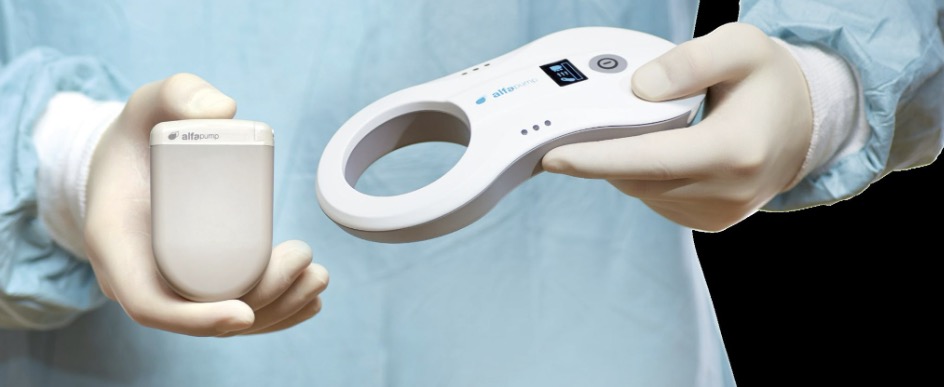
“What we have is, very simply, a high-tech, fully implanted pump – a little pump about the size of an iPhone, folded in half, that’s fully implanted inside of the body. It automatically and continuously pumps that fluid from the belly into the bladder, where the patient simply urinates it away. So you go from this issue of accumulating huge amounts of fluid, and then this terrible procedure to drain it, to a situation where the fluid never accumulates, because our clever little pump pumps it into the bladder continuously. The patient simply urinates it out in line with their normal, daily regimen, and they can live a life where they can go back to work, they can go back to traveling. They don’t have this stigma of this tremendous swelling.”

Significant Milestones
What have been some of the company’s most significant milestones? Crosbie cited:
“In recent years, there are two that really stand out. The first one was our pivotal trial. This was where we had to conduct a trial in a carefully controlled manner in U.S. patients to demonstrate what the alfapump could deliver. In that trial, we set out to demonstrate that we could halve the number of drainages that these patients had to have compared to life without the alfapump. But in the end, what we delivered was a 100% median reduction in the rate of external drainages in these patients, and these data were published in the American Journal of Gastroenterology in January 2025. You can imagine the impact that would have on the quality of life of those patients. We asked patients what difference it made to their life. Before they had a pump fitted, they had about 17 good days and 13 bad days in a month. After the pump was implanted, they had 27 good days and 3 bad days a month, which is transformative to their life, as you could imagine.”
“The second milestone was going through the FDA process. The type of device we have requires a Premarket Approval (PMA) process. This is an extremely in-depth and rigorous process, testing both the results of our clinical data, but also the electrical, mechanical, and biological safety of our device that ultimately would lead to FDA approval. We delivered the trial during COVID-19, which involved many restrictions on our patients, but we could see the FDA was working as a supportive partner to deliver what we both saw as an important message – a new pathway for these patients moving forward.”
Customer Success Stories
Can you share any specific customer success stories? Crosbie highlighted:
“Customer success stories are very clear for us. This is where we get the phone calls back from the patients, we get the reports back from the clinicians about what life was like without the alfapump compared to what it’s like with the alfapump. There are two recent patient stories that we have available on our YouTube, where two very different patients talk about what it means for their life.”
“It’s dramatic hearing firsthand about how terrible their life was, where they had to be drained so regularly, how hard it made their lives, how much it dominated their life, how much they weren’t able to do. Then, with the alfapump, you just see their mood lifting. You see this dramatic change in the things they’re capable of doing – the things that you and I take for granted like traveling to go and see friends and children, going back to work, going out to see friends. One of them talks about dancing with their wife again. Another one talks about how important it was for them to go back to work and be useful again. We talk about it internally as giving patients their lives back. Previously, their lives were dominated by a disease, now they have the chance to actually control and live their life.”
Total Addressable Market (TAM)
What total addressable market (TAM) size is the company pursuing? Crosbie assessed:
“In the U.S., we estimate that there are 70,000 patients today who have to have this drainage procedure at least 3 times a year as a result of their liver cirrhosis. That market is forecast to grow at about 9% a year for the coming years, primarily driven by the growth in obesity in the U.S. In the past, liver cirrhosis has been driven by hepatitis and alcoholic liver disease. Now, alcoholic liver disease continues to play an important part, but the number one driver of this market is obesity and fatty liver disease.”
Differentiation From The Competition
What differentiates the company from its competition? Crosbie affirmed:
“We have identified a market segment that has been ignored for decades, centuries, in fact, almost millennia. The standard of care within our market is drainage, where you allow the patients to accumulate the fluid within their bellies and have to put up with that big impact on their life, over a period of several weeks, or potentially months. Then, the patients have to come to the hospital and be drained with a painful and burdensome procedure – it’s a big needle. That is our competition. That’s what the patients have to put up with today.”
“There is no modern therapy, there is no modern alternative out there that is in development for our target patient population. As you can imagine, the difference is significant. For us, no fluid accumulates in the abdomen, they live with a flat belly, they don’t have this big restriction on their lives. The alternative is to build up 5 to 10 liters of fluid, where it’s hard to eat, sleep, breathe, move around, you’re constipated, you’re vomiting, and the difference, as you can see, is night and day. Because this market has not been the most favored in society in the past, no one else has invested there. Ten years ago, we spotted that obesity was going to change the profile of this market, and we’re proud to be at the forefront of the change in treatment for this patient population.”
Future Goals
What are some of the company’s future goals? Crosbie concluded:
“Our ambition is to change the standard of care for patients with recurrent and refractory ascites due to liver cirrhosis. We want doctors to adopt a modern solution as soon as a patient becomes clearly dependent upon repeated drainage, rather than making patients endure a life of drainages. We want the alfapump to be widely recognized as a safe and effective treatment option and to become the new standard of care, available to all patients in the U.S. who require this treatment.”
Full safety information is available on the Sequana Medical website. The FDA-approved Summary of Safety and Effectiveness Data (PMA P230044) is available on the FDA website.

