

Serhat Pala is an entrepreneur, investor, and writer whose original play, The House Between, explores love, immigration, family history, identity, and belonging. Pulse 2.0 interviewed Pala to learn more about his entrepreneurial journey, investment philosophy, transition into playwriting, inspiration for The House Between, and plans for the next chapter of his career.

Background And Move To The United States
Discussing the journey that brought him from Turkey to building businesses in the United States, Pala shared:
I never thought I would be an entrepreneur. I thought my success story would go like this: go to school, find a cushy corner office job in a big corporation, wear white shirts and ties for a while, and someday become a CXO. It did not work out that way.
Everything started well. After graduating from a good business school and completing internships at a Japanese economic policy lobby group, I became a product manager and then a strategic manager at an international bank in Istanbul, with two promotions in two years. I thought I was on the fast track.
But I did not see myself working at a bank, spending hours on ideas only to be told I could not do the things I believed were good for the business and its customers. The “no’s” I heard became more and more frustrating, and my wife was in a similar situation. We felt we were being asked to squeeze into boxes we did not want to fit into. So we decided to come to the U.S. for our MBAs, hoping that would give us a chance to reset our careers and start doing the things we wanted to do.
We gave up our good jobs back home to become hungry students again.
Our savings were supposed to last two years. Even though we both worked at school, they lasted a few months. We had accents, no American work experience, and no connections. LinkedIn did not exist yet. Our student visas limited where we could work, and any company that hired us would eventually have to apply for a work permit for us. All our applications to large corporations went unanswered, even for internships we were willing to do for free.
While I was looking for a proper corporate job, I started working at an early e-commerce startup to help with income. I was one of its very few employees, and I learned a lot in a few months by doing everything I was asked to do. The company failed soon after, but I loved the excitement and impact of working at a startup.
Around the same time the startup went under, I finally got an offer. A few days later, the company retracted it. They had decided not to apply for my work permit. That was it for me. I decided I would rather build my own business than wait for someone else’s decision.
The rest is history. I have not worked for anyone else since. I love the excitement of finding problems to solve and creating solutions in a resourceful way. Building and empowering teams to build together became what drives me.
Entrepreneurial Journey
Reflecting on the defining moments and lessons from building and scaling companies, Pala noted:
The biggest lesson is that every failure told me what the next company needed.
That startup was my first real education: a three-person internet company with almost no funding. It was the ’90s. It was like five years’ worth of startup experience condensed into five months. And then it folded.
Then a programmer friend and I built an internal website search engine. We were several years and a few technological developments too early, and our bubble burst along with the dot-com bubble in 2000. That one taught me that running my own business did not free me from other people’s decisions. This time it was investors instead of managers.
So I started the next one with a few thousand dollars on my own credit card, selling office supplies online, then outdoor gear, costumes, and medical supplies. People were just starting to buy things online, and I realized there were many small business owners who wanted to build online businesses. We built a solution for them: shopping carts, online marketing, customer service, and warehouse fulfillment, in return for a percentage of their sales and some fees. It was a very rudimentary version of Shopify meets the Amazon seller program. Because the store owners invested their own capital, time, and effort, we did not have to raise money to grow and stay profitable. The business grew fast, and we became one of Google’s very first advertising test accounts, which gave us a chance to scale.
After that business, Zeynep Ilgaz, my life, business, and family partner, saw the growing need for drug testing, both lab services and instant tests. We bootstrapped with our own money, later grew with institutional capital partners, and built Confirm BioSciences into a leader in substance abuse test kits. Our products were sold in more than 20,000 stores, under our own brands and as store brands. In the almost 15 years we grew that company, we built many of the category’s firsts. When the company was acquired, it brought us our own version of the American Dream and a chance to do things we love and make a positive impact beyond business.
Confirm was recognized with many awards for growth and innovation, but what I am proudest of is that the San Diego Business Journal named it one of San Diego’s Best Places to Work in our category four years in a row. Building a culture is hard, but keeping it while you grow is harder. I am proud of the fact that we were able to achieve that together.
Venture Investing
Describing what he looks for in founders through NuFund Venture Group and Cross Ocean Ventures, Pala highlighted:
At the early stage, there is very little data and almost no validation. Usually there is an idea, a small group of founders and team members, and a vision to build something that solves a problem and disrupts a market or a technology. So what you are really investing in is people and their ability to evolve and create in a resourceful, inspiring way while continuously reinventing themselves. That is true at NuFund Venture Group, where more than 350 investors run their own venture fund together, and at Cross Ocean Ventures, where we back seed-stage founders from Europe who are building for the U.S. market.
The best founders learn fast and evolve fast. They focus on the problem, not the solution. They keep an open mind that their way might not be the right way, and they listen to others and to the market without outsourcing their own decisions. They care about what they are building, inspire others, and hold their vision loosely and reality tightly.
I look at six things: resilience, vision, learning agility, character, execution, and founder-market fit. Learning agility carries the most weight for me. I separate hope from learning. Hope is what a founder believes will happen. Learning is what they found out last month that changed the plan. A founder who can show me the second one, with specifics, gets my attention.
The advice I give most often is this. Write it down and read it every day: “I have no absolute certainty about the business I am building. I don’t even know what I don’t know about the problems I am solving. I might be wrong, and I might be wrong often.” In my view, the founders who can say that out loud usually learn the fastest.
From Business Writing To Playwriting
When discussing his transition from business writing to playwriting, Pala recalled:
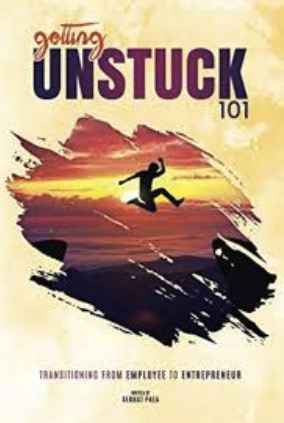
A lifelong writer, Pala brings decades of storytelling and entrepreneurial experience to his first original stage production.
My first book was not Getting Unstuck. It was a guide to hamster care, and selling the rights to that book literally paid for our plane tickets to America.
Zeynep and I were newly married in Istanbul, each working about 60 hours a week, and we wanted a starter child. Read: a pet. I had my eye on an iguana, but our marriage was too new for such a drastic move. So we found Sashimi at what was probably the only pet store in Istanbul that carried hamsters, and a month later the store gave us Sushi for free. A month after that, we had more than a dozen gummy bear-sized pups, and nobody, not even our veterinarian friends, knew how to care for them.
So we wrote The Tiny World of Little Hamsters, to my knowledge, the first Turkish book on hamster care. I sold the rights outright to the second publisher I pitched because we couldn’t wait for royalties. We needed the tickets.
Everything I wrote after that, from Getting Unstuck to my Inc. columns, was teaching: here is what I lived, here is the test, you decide. A play does not let you do that. You cannot explain anything to the audience. You put people in a room with a problem and trust the audience to feel it. For someone who has written frameworks my whole career, that was the attraction. It is also probably why my first drafts were full of stage directions.
Fiction had been on my bucket list for years, and I love theater. The play came from a question I could not answer with a framework.
The Story Behind The House Between
Outlining the story and inspiration behind The House Between, which will have its world premiere at Trinity Theatre Company in San Diego, Pala described:
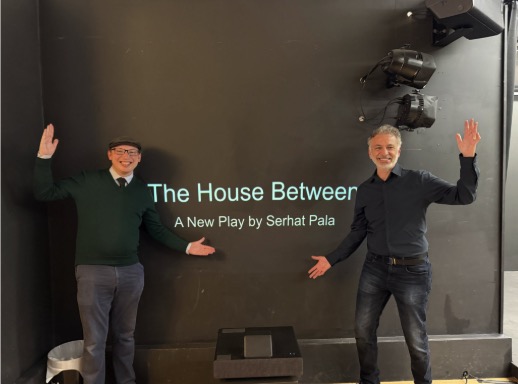
Playwright Serhat Pala with Sean Boyd, Executive Artistic Director of Trinity Theatre Company, who is directing the world premiere of The House Between. Together, they are bringing Pala’s first original play from page to stage in San Diego.
It is a late-in-life love story first.
Chrissy is a Greek-Australian painter in Melbourne. Hakan is a Turkish-American professor in Boston. Each carries an old family photograph with the same doorway in it, and each travels to Ayvalık, on Türkiye’s Aegean coast, to find it. Her grandfather left that house as a boy. His grandfather was resettled in it.
What starts as a coincidence at a doorframe becomes a slow romance. Then their grown children arrive, and the question gets urgent: are they repairing the past, escaping it, or finally choosing where to stand? Hakan’s son Arda is a startup founder building AI that reads workplace emotions. I will let your readers guess where that idea came from.
And it is funny. At least I like to think that it is. I did not want to write a history lesson.
The inspiration is the question I could not answer in an essay. I have thought and chewed on it for almost 30 years: “Where do you belong, and what do you call home when home keeps moving?”
As immigrants, and especially as parents of first-generation Americans, we play a special role: a bridge between two lands. It is a gift. But it comes at a cost, a continuous quest to figure out where you belong. When you leave your motherland, the feelings and notions of the country you left behind freeze in your mind, and you become the only place where that frozen moment in time still lives. Then your first-generation kids grow up, become adults, and all of a sudden you face that feeling again. That is what this play is about: immigrant parents of adult first-generation children and how they feel about belonging when their priorities finally shift back from their kids to their own existence.
Historical Inspiration
Explaining why the play draws upon the 1923 population exchange between Greece and Turkey, Pala detailed:
The House Between draws on Serhat Pala’s family history and explores the lasting meaning of home, memory, and belonging.
Because it is my family’s story before it is anyone’s history. My father’s family lived in Greece for centuries and left Saloniki for Turkey in the 1923 population exchange.
Many of your readers may not know it, so here is the short version. On January 30, 1923, Greece and Turkey signed a convention at Lausanne that moved about 1.6 million people: around 1.2 million Orthodox Christians to Greece and around 400,000 Muslims to Turkey. The sorting rule was religion. Not language. Not choice. So many Turkish-speaking Christians ended up in Greece, and many Greek-speaking Muslims ended up in Turkey.
In the play, Hakan’s grandfather leaves a village near Saloniki, not far from where my own family came from. His family is told: “Two bags. Leave the rest. There will be a house waiting.”
Both sides lost a home, and both sides still share more than they admit. In one scene, feta and tulum cheese sit side by side “like cousins pretending they’re not related.” Nobody in the audience has to pick a side.
What I hope people take away is a question of their own. If one person drives home and asks a parent something they never asked before, that would be enough for me.
Home, Identity, And Belonging
Discussing how his experiences as an immigrant and father shaped the play, Pala shared:
Very directly. After almost 30 years here, I still have an accent, and an accent means people wonder about your story before you tell it. Some days I still feel like a guest in someone else’s house. Hakan carries that. The script says he has “spent a lifetime explaining history; now he has to live inside it.”
The bigger part came from being a father. After an early reading in January 2025, I realized I had written almost nothing about the conflict between immigrant parents and their children. I was living it at home every day and had left it off the page. My sons grew up American, and the jokes that make me laugh do not always make them laugh. That gap is now in the play, between Hakan and his son Arda, and between Chrissy and her son John.
I did not want a hardship story, though. Zeynep and I bought our first home here in 2002. For immigrants, home is something you choose, not something you inherit.
Writing this play has been a true journey of discovering my own sense of belonging.
The Creative Process
Reflecting on what surprised him about writing for the stage and collaborating with theater professionals, Pala noted:
Two things surprised me, and both came through Sean Boyd, Trinity’s executive artistic director, who is directing the premiere. He has been my guide and Sherpa through all of this.
First, how much of my script was stage directions. I was writing a novel and calling it a play. They were my cheat sheet. I had never written a play, and I needed them to get back into the feeling every time I sat down. Sean suggested giving the actors a version with no stage directions at all and letting them find it. A good actor can do with one look what took me a paragraph.
Second, conflict. After that early reading, Sean’s biggest note was that my characters stop themselves because they are too nice. He was right, and the note was really about me. I have spent most of my working life calming rooms down. On stage, that instinct kills a scene.
The best feedback came from hearing it out loud. Friends read it in our living room in January 2026, and people smiled loudly. Trinity’s staged reading that April showed me which lines were alive and which ones only worked in my head.
Entrepreneurship And Playwriting
Highlighting the similarities between building a business and bringing an original story to the stage, Pala observed:
More than I expected. A staged reading, where actors perform the script with minimal staging in front of a live audience, is a beta test. Going in, Sean told me the signals he would watch: how long people stayed afterward, and whether strangers stayed or only friends. He also said a few 3s and 4s on a five-point exit survey are better than all 5s, because then you know it is not only friends being nice. As an investor, I knew exactly what he meant when I heard this.
Rewrites are product iterations. Casting is hiring.
The difference is the deadline. A startup can ship a fix next week. A play opens on the date printed on the ticket.
Years ago, I wrote an Inc. column called “What Businesses Can Learn From Theater Companies.” I may owe your readers the sequel with more detail.
Embracing Risk And Uncertainty
Describing what it has been like to become a first-time playwright after years of encouraging entrepreneurs to embrace uncertainty, Pala said:
In my earlier book, Getting Unstuck, I asked readers to score their business ideas, and I scored my own honestly. One of my business ideas scored so low that I told readers to skip it. If I scored a first play by a first-time playwright on financial return, it would not do much better. I did it anyway.
As I wrote in that book, “The real question is not: ‘Can you do it?’ The real question is: ‘Can you afford not to do it?’”
I also know the risk of a personal project. In the book, I admitted I gave one of my dog apps less scrutiny than usual because I love dogs. A play about my own family is the most personal project I have ever done. So I asked for help early, joined the Dramatists Guild, and tried to read and listen to people who know this craft better than I do.
And I am learning the hardest founder lesson: letting go. I recently told Sean, the play’s director, that I am not going to touch the script anymore. From here, the changes come out of the rehearsal room. I have no control over the reviews. What I control is the work.
World Premiere In San Diego
When discussing what it means to premiere The House Between in the community where he built much of his personal and professional life, Pala reflected:
I like to say I was born to be a San Diegan, just in the wrong place.
When you come here from a place where things work differently, people seem genuinely interested in what you are doing, and at first you wonder, “What’s the catch?” Then you realize there isn’t one. That is just how San Diego is. Zeynep and I arrived with almost nothing, built our companies, and raised our sons here. This city gave an immigrant a fair shot, more than once, so of course the play opens here, at Trinity Theatre Company’s new home in Miramar.
It also fits the story. San Diego is full of people from somewhere else. During the run, Trinity is planning community nights and post-show conversations, and my hope is simple: Greek and Turkish San Diegans in the same room, at the same performance, at least once. A lot of my fellow NuFund investors are coming too. Most of them have only seen me with a pitch deck or a spreadsheet. I am a little nervous about that.
And there is a family reason. Some of your readers met my son Arden here on Pulse 2.0 in 2025, when you interviewed Arden Pala about Sports4Kids. He plays Arda, Hakan’s son: a first-generation American kid, on stage in his hometown, in a play that draws on his own family’s history. I am trying very hard to be the playwright about it and not the dad. I am failing.
Future Goals
Looking ahead, Pala outlined how entrepreneurship, investing, writing, and storytelling will fit together in the next chapter of his life:
I see them as one skill: connecting dots. In Getting Unstuck, I wrote that better ideas come from more dots and more lines. The dots are your experiences and know-how. The lines are seeing how they fit together. Being an immigrant gives you extra dots, because you have lived inside at least two systems.
In the book I wrote: “I believe luck is what you create and then recognize. Opportunity may be the one to knock on your door, but luck is the one that makes sure you’re home to hear the knock.” I wrote that in 2018. I believe it more now.
Turns out a play is a lot like a startup. Endless drafts, a small team that believes, and a lot of faith.
So the next chapter is more of the same, with a different balance. I will keep investing through NuFund and Cross Ocean. I want to write a second play, and I will know much more about how after March. And I would love to see The House Between have a life after San Diego, on other stages.
For two years, it has been a story trying to come from paper to the stage. On February 26, it finally gets there. I am very excited about how it will be received.
Production Details
The House Between, a new play by Serhat Pala and directed by Sean Boyd, will have its world premiere at Trinity Theatre Company. The production is scheduled to run from February 26 through March 14, 2027, at 9520 Padgett Street, Suite 208, San Diego, California.
