Sift is a data platform built for the large volumes of sensor and telemetry data generated by complex hardware systems, including rockets, satellites, autonomous vehicles, defense platforms, robotics, and industrial equipment. The company combines purpose-built data infrastructure with automated analysis, anomaly detection, reporting, and tools spanning testing, manufacturing, and mission operations. Pulse 2.0 interviewed Sift Co-Founder and CEO Austin Spiegel to learn more about the company, hardware development, telemetry infrastructure, and its plans for future growth.
Austin Spiegel’s Background
When asked about his background, Spiegel shared:
I started my career at SpaceX as an intern and eventually joined full-time as a lead engineer. Early on, I led a team building manufacturing and test software for spacecraft and rockets before moving over to Starlink.
At Starlink, I worked on the telemetry platform that collected sensor data from every satellite in the constellation. It was a pretty massive data problem. Even back in 2020, we were already dealing with tens of terabytes of telemetry every day.
I left SpaceX in 2020 and spent about a year at Riot Games as a software engineering manager. My background at USC was in computer science with a focus on games, so I wanted to experience that world for a bit.
But I realized pretty quickly that I missed working close to hardware and building things that impact the physical world.
That’s what led me back to reconnecting with my co-founder Karthik Gollapudi, who I’d worked with at SpaceX, and eventually to starting Sift.
How Sift Started
When asked how the idea for the company came together, Spiegel explained:
When I left Riot in 2022, I knew I wanted to get back to building software for the physical world. I reconnected with Karthik, who had been a flight software engineer on Dragon at SpaceX.
We kept seeing the same problem over and over. Hardware companies were building incredibly sophisticated systems, but the infrastructure for understanding all of the data those systems generated just hadn’t kept up.
A lot of the tooling was fragmented, outdated, or held together internally by teams maintaining their own stacks.
A big moment for us was watching the Boeing Starliner demo mission failure in 2019. The investigation highlighted gaps in software and hardware validation, and a lot of that came back to testing and data review infrastructure.
Karthik had seen those challenges firsthand on Dragon, and I’d seen a different version of it while working on telemetry systems for Starlink.
Before we wrote any code, we talked to around 30 companies. Almost everyone told us some version of the same thing: they were stitching together open-source tools, dedicating engineers to maintaining them, and still struggling to get the visibility they needed.
That’s what led us to build Sift.
Impact On Hardware Development
When asked what impact he hopes Sift will have on the industry, Spiegel said:
If you look at how software used to be developed in the mid-2000s, teams would spend months building toward one huge release, test everything at the end, and hope it worked when it finally shipped.
Software development has completely changed since then. Continuous integration and deployment dramatically increased the pace of innovation because teams could iterate constantly instead of waiting months between cycles.
Hardware is still catching up to that model. Building and testing systems that combine hardware and software is fundamentally harder, but the companies moving fastest today are the ones embracing more iterative development.
I think Sift helps enable that kind of development speed for hardware companies.
Engineers can move faster because they actually have visibility into what’s happening inside their systems, and they can catch issues much earlier instead of relying on manual review.
Very practically, I think we’ll help customers increase their launch cadence, test faster, and build more reliable systems.
Core Products And Features

When asked about Sift’s core products and features, Spiegel detailed:
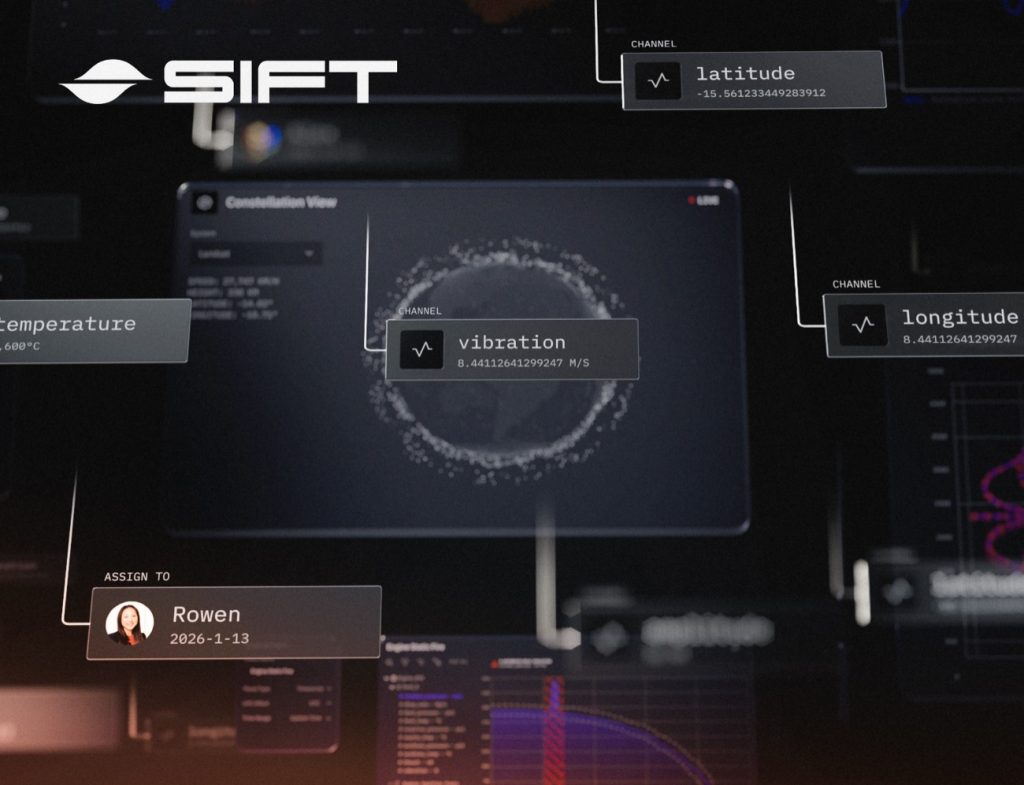
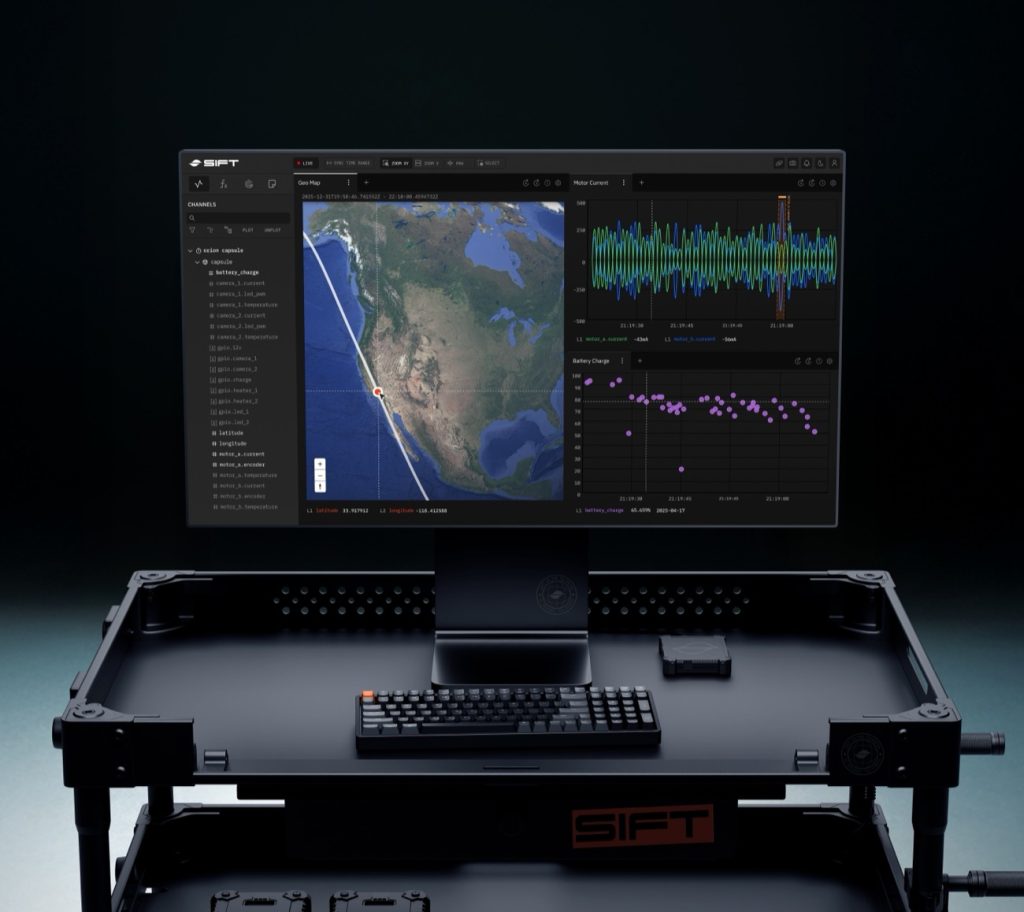
Sift is a data platform built for hardware sensor data.
We work with telemetry from systems like rockets, satellites, autonomous vehicles, and defense platforms, things like temperature, pressure, voltage, and thousands of other signal types.
At the core of the platform is a database we built from scratch because this is fundamentally a scale problem.
Hardware companies generate enormous amounts of data and often need to retain it for years because the cost of failure is so high.
The challenge is that most of that data is rarely looked at until something goes wrong and engineers suddenly need answers immediately.
On top of the infrastructure layer, we run automated analysis across incoming data, flag anomalies, and generate reports so teams aren’t manually digging through graphs trying to find problems.
The platform was built specifically around how hardware engineers work. It wasn’t adapted from a software monitoring tool.
A lot of the workflows came directly from experiences Karthik and I had at SpaceX.


How The Technology Has Evolved
When asked how Sift’s technology has evolved since launching, Spiegel said:
When we started, the product was focused on capturing, storing, and visualizing telemetry during test campaigns. That was the immediate pain point we heard from nearly every company we spoke with.
Since then, we’ve expanded toward supporting the full hardware development lifecycle, from simulation and testing to manufacturing and operations.
We’ve added tools that let engineers do deeper analysis across different types of test data in one place, and the ability to compare a new test run against every previous run of the same test to spot trends or flag deviations.
We’ve also started connecting sensor data with manufacturing records so teams can trace issues back to specific components.
And mission operations is an area where customers are already actively using the platform.
We started by solving the most urgent problem and have been expanding based on what customers need next.
Key Company Milestones
When asked about some of Sift’s most significant milestones, Spiegel highlighted:
The biggest milestones have been our funding rounds and the growth that came with each one.
Our seed round was backed by Riot Ventures and Fika Ventures with participation from more than 50 SpaceX alumni.
Google Ventures led our Series A, and we closed a $42 million Series B led by StepStone with GV participating again, bringing total funding to $67 million.
Alongside that, we’ve doubled the team every year for three consecutive years, outgrew our El Segundo office, moved into a larger headquarters in Marina del Rey, and opened a second office in San Francisco.
The pace of growth itself has been one of the biggest milestones.
Customer Success Stories
When asked to share specific customer success stories, Spiegel said:
One of our early customers, Parallel Systems, moved off its entire homegrown system onto Sift after working closely with us for about three months. That was an early signal that we were solving a real problem.
K2 Space, which is building satellite constellations, has spoken publicly about this. Their CTO has said they’re building hundreds of satellites to run for decades and that Sift is critical for automatically flagging issues in their data and closing the loop between design and real-world operations.
Astranis uses Sift across testing, manufacturing, and operations. Their VP of Software has talked about how running millions of automated tests per day can drive storage costs into the millions monthly, and that Sift removed that burden from their team.
Growth
When asked what Sift’s growth looks like today, Spiegel explained:
We’re around 70 people today and expect to continue scaling significantly following our Series B.
We outgrew our El Segundo office and moved into a larger headquarters in Marina del Rey, and opened a second office in San Francisco to be closer to customers and broaden the talent pool.
On the product side, we started with a telemetry platform and have expanded into automated analysis, anomaly detection, manufacturing data, and mission operations.
With each release, the platform covers more of the hardware development lifecycle.
Our customer base has grown significantly as well. We now work across aerospace, defense, rail, aviation, energy, and robotics, and demand continues to come from industries beyond where we originally started.
Expanding Beyond Aerospace
When asked what industries Sift serves beyond aerospace, Spiegel said:
Aerospace was our starting point because that’s where Karthik and I came from, but we saw early on that the underlying problem exists anywhere complex hardware systems are being built and operated.
Today we work with customers across defense, rail, aviation, energy, robotics, and other industrial sectors.
Robotics and autonomy is a big focus for us right now.
There’s also a lot happening in manufacturing as companies modernize legacy processes with software and AI.
Anywhere complex machines are being built and operated, Sift can help.
Competitive Differentiation
When asked what differentiates Sift from its competition, Spiegel explained:
The most common alternative to Sift is companies building their own internal stack using open-source databases and visualization tools.
A lot of teams underestimate how difficult the underlying infrastructure problem is until they’re several months in.
Where we differ is that we built our own database from scratch to handle the scale, noise, and speed that come with physical sensor data.
Most competitors focus on the application layer and rely on general-purpose databases underneath, which can work initially but often hits limitations as data complexity grows.
By owning the full stack, we can optimize for performance and volume in ways that are hard to achieve otherwise, and we have room to grow alongside our customers as their systems get more complex.
Future Goals
When discussing Sift’s future goals, Spiegel concluded:
One major focus is deepening our mission operations capabilities so Sift can support the entire lifecycle, from simulation and development through active fleet operations.
We also want to continue expanding into new industries beyond aerospace, including rail, energy, automotive, robotics, and manufacturing.
The broader vision is helping hardware companies move with the same kind of iterative speed that software companies adopted over the last two decades.
SpaceX showed what’s possible when hardware teams can move quickly and learn continuously. We want to help bring that to the rest of the hardware world.

